Your Annual Health Check Is Just A Photo. Your HRA Is The Full Movie!

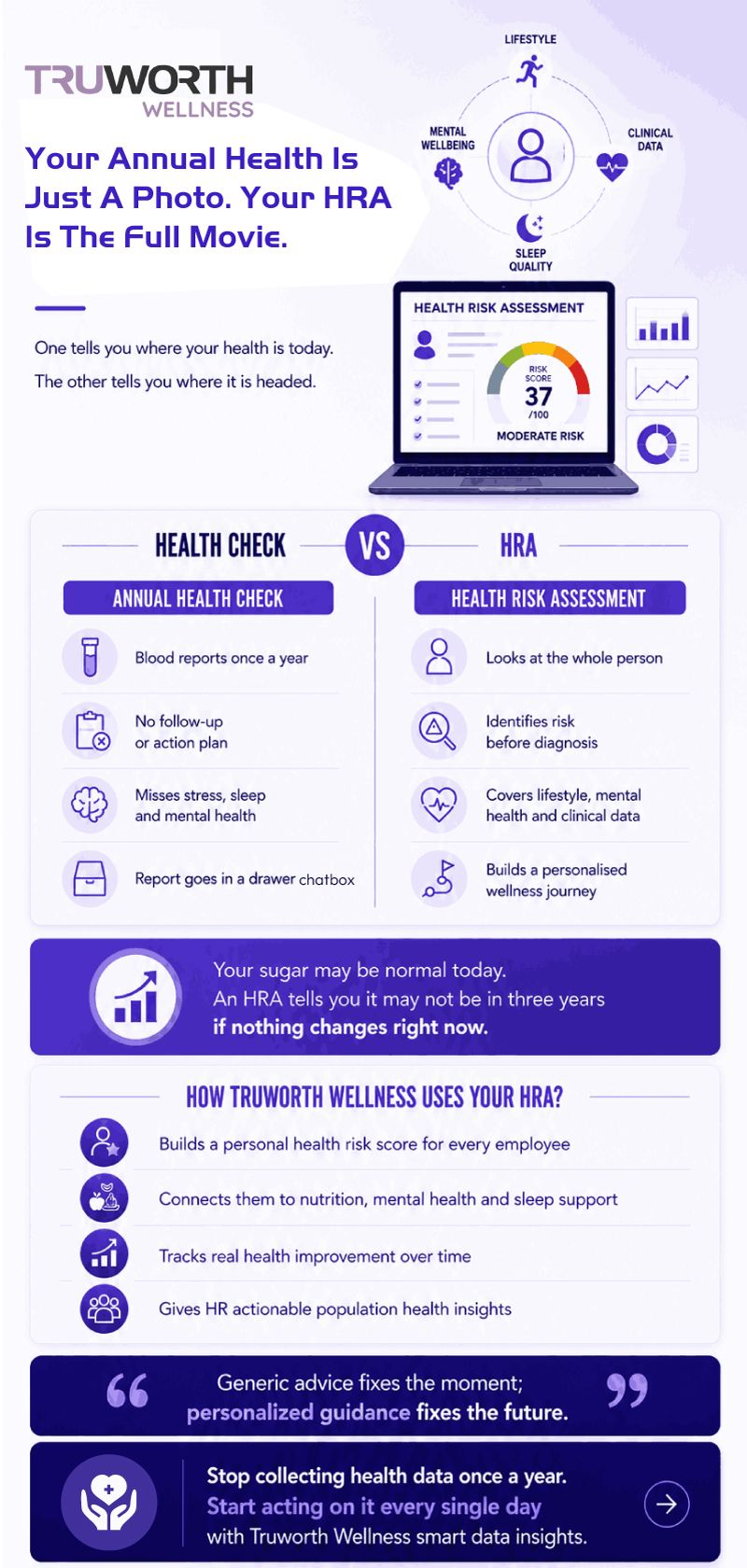
One tells you where your health is today. The other tells you where it is headed. And that difference changes everything.
Every year, the health camp arrives.
A van parks in the office compound. White coats appear in the lobby. Employees queue up before lunch, get their blood pressure checked, give a blood sample, step on a weighing scale, and walk away with a printed report in a sealed envelope.
Most of those envelopes are opened once, glanced at, and filed in a drawer or a WhatsApp chat with a worried family member. A few numbers are Googled. Some mild concern is felt. Life continues.
Six months later, nobody remembers what their cholesterol was.
Twelve months later, the van comes back.
This is the annual health check. It is one of the most common corporate wellness investments in India. It is also one of the least effective ways to actually improve employee health if not utilized properly.
Not because health checks are useless. But because a single data point, taken once a year, with no follow-up, no context and no action plan, is not a health intervention. It is a photograph. It captures one moment. It tells you nothing about the direction things are heading, the speed at which they are moving, or what needs to happen next.
A Health Risk Assessment is something different entirely. It is not a photograph. It is a movie. And the difference between the two is the difference between knowing and understanding.
First, What Is a Health Risk Assessment?
A Health Risk Assessment, or HRA, is a structured, comprehensive tool that looks at an employee's health from multiple angles at once. Not just the numbers from a blood test, but the full picture of who that person is, how they live, and where their health is likely to go if nothing changes.
A well-designed HRA typically covers:
- Current health metrics like blood pressure, blood sugar, cholesterol and BMI
- Lifestyle factors like sleep quality, physical activity levels, diet patterns and stress levels
- Mental health indicators like anxiety, mood, energy and motivation
- Personal and family medical history that affects future risk
- Workplace factors like sedentary hours, screen time and work-related stress
- Behavioural patterns like smoking, alcohol consumption and eating habits
When all of this information is brought together and analysed, something becomes visible that a single blood test can never show. The pattern. The trajectory. The direction of travel.
An employee with a normal fasting glucose today but a sedentary lifestyle, high stress, poor sleep and a family history of diabetes is not a healthy employee. They are a pre-diabetic employee who has not been diagnosed yet. The annual health check says they are fine. The HRA says they need to act now.
That is the difference.
Why the Annual Health Check May Fall Short?
To be fair, the annual health check is not worthless. It catches things. It creates a moment of health awareness. For some employees it is the only health screening they get all year.
But it has significant limitations that most organisations never talk about.
- It measures the present, not the trend: A single reading tells you where a number is today. It tells you nothing about whether that number has been creeping up for three years or whether it improved dramatically after a lifestyle change. Trend data is where the real insight lives, and a once-a-year snapshot cannot provide it.
- It has no context: A fasting blood glucose of 102 mg/dL means something very different for a twenty-five year old with an active lifestyle and no family history of diabetes than it does for a forty-two year old who sits for ten hours a day, sleeps five hours a night and has a parent with Type 2 diabetes. Without context, numbers are just numbers.
- Nothing happens after it: This is the biggest problem. For the majority of employees who undergo an annual health check, the result is a report with no follow-up. No conversation with a health professional. No personalised guidance. No action plan. No next step of any kind. The data is collected and then effectively abandoned.
- It only measures the physical: Blood pressure, glucose, cholesterol, BMI. These are important. But they tell you nothing about the employee's stress levels, sleep quality, mental health, financial anxiety or the cumulative lifestyle factors that drive physical health outcomes over time. The annual health check is measuring the downstream effects of things it is not looking at.
- It creates a false sense of security: When an employee gets a health check result that shows everything within normal range, the natural conclusion is that everything is fine. But normal today with a deteriorating lifestyle trajectory is not actually fine. It is fine for now. The annual health check has no mechanism for communicating that distinction.
How To Prioritize Your Health With Preventive Health Checkups?
What a HRA Does Differently?
A HRA does not replace the clinical measurements of a health check. It wraps context, lifestyle data and risk analysis around those measurements to create something far more useful.
Here is specifically what changes:
- It identifies risk before it becomes a diagnosis: The power of a HRA is in its ability to flag people who are currently healthy by clinical measures but are on a trajectory toward a health problem. The employee with normal blood sugar, a high-stress job, a sedentary lifestyle and poor sleep is not sick today. But the HRA can calculate their risk of developing metabolic issues in the next five years and trigger an intervention before those issues arrive.
- It gives each employee a personalised risk profile: Rather than a report that says your cholesterol is 180 and lists a normal range, a HRA gives an employee a picture of their overall health risk, the specific factors driving that risk, and the changes that would have the biggest impact on their trajectory. It is a conversation, not a printout.
- It captures the whole person: Because a HRA includes lifestyle, mental health, behavioural and environmental factors alongside clinical measurements, it sees the employee as a complete human being rather than a set of biomarkers. This matters enormously for the relevance and usefulness of the guidance that follows.
- It creates a baseline for tracking progress over time: When a HRA is repeated at intervals, the data becomes comparative. Has the stress score improved? Has the sleep quality changed? Has the metabolic risk profile shifted? This is the movie, not the photograph. Change becomes visible. Interventions can be evaluated. Progress can be measured and celebrated.
- It enables personalised intervention: A HRA that identifies an employee as high-risk for cardiovascular disease triggers a different set of recommendations than one that identifies someone as struggling with chronic stress and sleep deprivation. The personalisation that a HRA makes possible is the foundation of a wellness program that actually works, because generic wellness advice lands for nobody and personalised guidance lands for everyone.
How Truworth Wellness Uses HRA Data?
This is where the HRA moves from being an interesting tool to being the engine of a genuinely effective corporate wellness program.
At Truworth Wellness, the HRA is not a standalone exercise. It is the starting point of an individual health journey for every employee who completes it.
Here is what that journey looks like:
Step 1: The HRA itself: Employees complete a comprehensive assessment that covers clinical data, lifestyle factors, mental health indicators, workplace stressors and personal health history. The process is digital, confidential and designed to be completed in a way that feels accessible rather than clinical.
Step 2: A personalised health risk score: Based on the HRA data, each employee receives a health risk score that gives them a clear, simple picture of their current health status and the areas that need the most attention. This is not a pass or fail. It is a map.
Step 3: Personalised wellness recommendations: Based on the risk score and the specific factors driving it, the platform generates personalised recommendations. Not generic advice about eating vegetables and exercising more. Specific, contextually relevant guidance on the exact changes that will have the biggest impact for that particular employee given their particular risk profile.
Step 4: Connection to the right support: Employees identified as high-risk in specific areas are connected to the appropriate support within the Truworth platform. High metabolic risk connects to nutrition coaching. High stress scores connect to mental health support and EAP resources. Sleep issues connect to sleep coaching and relevant content. The HRA data determines the pathway and the pathway connects to real human support.
Step 5: Ongoing tracking and nudging: The wellness journey does not end with the HRA. Personalised nudges, check-ins, content and coaching keep the employee engaged with their health goals over time. Progress is tracked. Risk scores are updated as behaviour changes. The movie keeps playing.
Step 6: Organisational level insights: At an anonymised, aggregated level, the HRA data gives the organisation a population health picture that is genuinely actionable. What are the most prevalent risk factors across the workforce? Which teams or locations show the highest stress scores? Where are the metabolic risks concentrated? This organisational intelligence allows HR and wellness leaders to design targeted interventions rather than blanket programs.
Must Check: Implementing HRA Can Save So Much Money For Organizations!
What This Looks Like for a Real Employee?
Meet a thirty-eight year old project manager at a mid-size Indian IT company.
His annual health check last year came back entirely normal. Blood pressure fine. Cholesterol fine. Blood sugar fine. The report went in a drawer.
This year, his company introduced a HRA through Truworth Wellness.
The HRA captured what the health check missed:
- Sleep quality score: poor, averaging five hours of fragmented sleep per night
- Stress score: high, driven by deadline pressure and low job control
- Physical activity: very low, fewer than three thousand steps per day
- Diet patterns: high carbohydrate, low protein, meals frequently skipped and then replaced by large evening meals
- Family history: father with Type 2 diabetes, maternal history of hypertension
- Mental health indicators: mild anxiety, low energy, difficulty switching off from work
Clinical measurements: currently normal. HRA risk profile: high risk for metabolic syndrome within five years without intervention.
The HRA triggered a personalised pathway:
- Connection to a nutrition coach for metabolic risk management
- Sleep coaching and practical sleep hygiene guidance
- Stress management resources through the EAP
- A personalised step goal and movement challenge calibrated to his current baseline
- A follow-up HRA scheduled for six months later to track progress
Six months on, his sleep score has improved. His step count has doubled. His nutrition coach helped him make three specific meal changes that reduced his post-lunch energy crashes. His stress score is lower. He has not developed any clinical health issue. He may never develop one.
The annual health check would never have seen any of this coming.
Success Isn’t About Participation In Wellness Programs. It’s This.
What HR Leaders Need to Know?
If you are a HR or wellness leader reading this, here is the practical takeaway.
The annual health check is not enough on its own. It is a starting point, not a strategy. If your current wellness program consists primarily of a once-a-year health camp with no structured follow-up, you are investing in data collection rather than health outcomes.
A HRA-led wellness program does something fundamentally different. It uses data to drive personalised action. It catches risk early. It connects employees to the right support at the right time. It gives the organisation a population-level health intelligence that makes every subsequent wellness decision smarter.
The questions worth asking about your current program:
- Do we know which employees are at high risk for metabolic conditions before they are diagnosed?
- Do we have a mechanism for catching mental health risk before it becomes a crisis?
- Does our health screening data actually drive personalised intervention or does it sit in a report?
- Can we measure whether our wellness program is improving employee health outcomes over time?
If the answer to any of these is no, a HRA-led approach is the most direct path to changing that.
The Bottom Line
A photograph is useful. It tells you something real about a moment in time.
But if you want to know where something is going, you need a movie.
Your employees' health is not a static thing. It is moving, changing, developing and responding to the environment they live and work in every single day. A once-a-year snapshot is not enough to understand it, predict it or meaningfully influence it.
A HRA gives you the movie. And with the right wellness partner, that movie becomes the foundation of a health program that actually changes outcomes rather than just measuring them.
Truworth Wellness builds HRA-led wellness programs that move organisations from health data collection to genuine health improvement. From personalised risk scores and wellness pathways to nutrition coaching, mental health support and population-level health intelligence, our platform is designed to make the HRA the beginning of a health journey, not the end of a health camp. Talk to us about bringing a HRA-led approach to your workforce.