The Most Misunderstood Generation: Gen Z At Work

Every generation entering the workplace has been misunderstood. Millennials were once labeled entitled. Gen X was called disengaged. Baby Boomers were seen as rigid.
Today, Gen Z carries that spotlight.
They are often described as impatient, overly sensitive, disloyal, or difficult to manage. From a corporate lens, these labels sound familiar, but they miss a deeper truth. Gen Z is not broken, lazy, or unrealistic. They are responding to a world of work that has fundamentally changed.
To truly understand Gen Z at work, organizations must move beyond stereotypes and look at the conditions that shaped them, the pressures they operate under, and what they are actually asking for.
Also Read: Inter-Age Conflicts At Work: Gen Z VS Millennials VS Gen X VS Boomers
Who Is Gen Z In The Workplace?
Gen Z includes individuals born roughly between 1997 and 2012. Many of them entered the workforce during or after the pandemic. For them, instability was not an exception. It was the starting point.
They watched layoffs happen over video calls. They saw parents experience burnout, health scares, and job insecurity. They entered workplaces already questioning whether traditional career promises still hold value.
So when Gen Z questions authority, asks “why” often, or refuses to sacrifice health for hierarchy, it is not rebellion. It is pattern recognition.
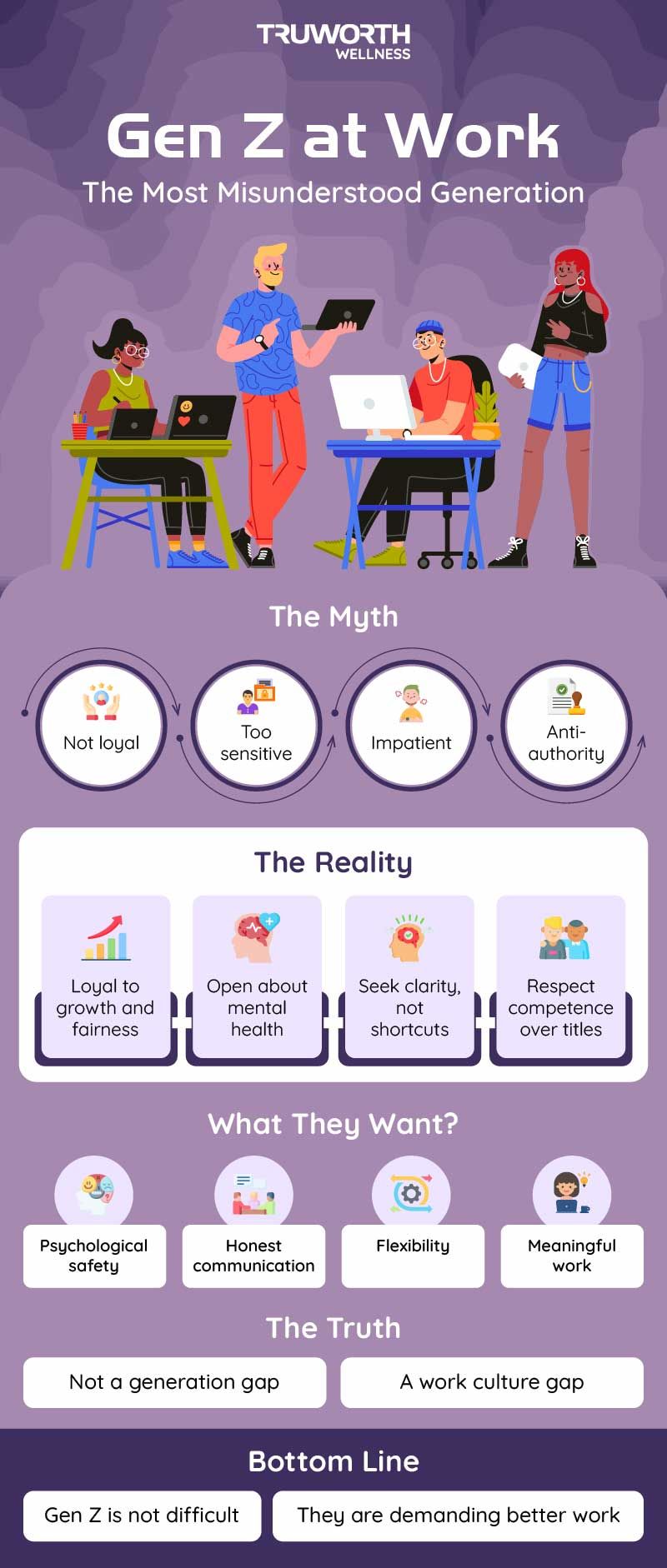
Misconception 1: “Gen Z Is Not Loyal”
This is one of the most common corporate complaints.
What organizations often interpret as lack of loyalty is actually a shift in how loyalty is defined.
Previous generations were loyal to companies. Gen Z is loyal to alignment. They stay where learning, growth, fairness, and mental safety exist. When those disappear, they move on without guilt.
Also Read: Transform Your Next 3 Months: A Guide To Wellness, Growth, And Connection
This generation grew up seeing that long tenure does not guarantee security. For them, loyalty without reciprocity feels risky, not virtuous.
The real question for organizations is not “Why does Gen Z leave?” but “What reason are we giving them to stay?”
Misconception 2: “They Are Too Sensitive for the Workplace”
Gen Z openly talks about mental health, boundaries, and emotional well-being. In traditional corporate cultures, this can be mistaken for fragility.
In reality, this generation is emotionally aware, not emotionally weak.
They are simply unwilling to normalize chronic stress, toxic leadership, or silent suffering. They name issues earlier instead of burning out quietly over years.
From a business standpoint, this is not a liability. It is an early warning system.
When Gen Z says, “This environment is affecting my mental health,” they are highlighting risks that eventually impact performance, retention, and culture for everyone.
Misconception 3: “They Want Too Much Too Soon”
Gen Z often asks for growth, feedback, flexibility, and purpose early in their careers. This is sometimes viewed as impatience.
But consider the context.
They live in a fast-moving world with rapid access to information, learning, and opportunity. Waiting silently for five years to be noticed does not make sense to them because they have seen how quickly roles, industries, and skills become outdated.
They are not asking for promotions without effort. They are asking for clarity, learning pathways, and meaningful work instead of vague promises.
When organizations fail to provide direction, Gen Z does not wait around hoping things improve. They look elsewhere.
Misconception 4: “They Do Not Respect Authority”
Gen Z does not automatically respect hierarchy. They respect competence, fairness, and authenticity.
Also Read: Understanding Favoritism At Work: Why Fairness Matters?
Titles alone do not inspire them. Behavior does.
Leaders who listen, explain decisions, admit mistakes, and demonstrate emotional intelligence earn trust faster than those who rely on position alone.
This challenges traditional command-and-control leadership styles. But it also creates an opportunity to build stronger, more human leadership cultures.
What Gen Z Actually Wants At Work?
Despite popular belief, Gen Z is not asking for unrealistic perks or constant validation. Their core expectations are surprisingly practical.
- They want psychological safety, where speaking up does not come at a cost.
- They want transparent communication instead of corporate ambiguity.
- They want flexibility that respects life outside work.
- They want learning opportunities that keep them relevant.
- They want to feel that their work has meaning beyond metrics.
These are not radical demands. They are signals of a workforce that understands the cost of burnout and disengagement early.
The Corporate Gap Is Not Generational. It Is Structural.
The tension between Gen Z and organizations often comes from outdated systems meeting evolved expectations.
Many corporate structures were designed for a time when job security was higher, hierarchies were rigid, and work defined identity. Gen Z operates in a world where change is constant, identities are fluid, and well-being is non-negotiable.
When companies fail to adapt, Gen Z becomes the visible friction point.
But the problem is not the generation. It is the mismatch.
What Organizations Can Do Differently?
Understanding Gen Z is not about creating special policies for one generation. It is about modernizing how work functions.
- Shift from Control to Trust: Outcome-based performance works better than constant monitoring. Gen Z responds well when autonomy is paired with accountability.
- Normalize Conversations Around Mental Health: This does not mean lowering standards. It means creating systems where support exists before burnout escalates into attrition.
Offer Clarity, Not Just Motivation: Clear role expectations, feedback loops, and growth pathways reduce anxiety and disengagement. - Train Managers, Not Just Employees: Many Gen Z challenges stem from unprepared managers. Leadership development is critical, especially around empathy, communication, and nervous system awareness.
- Redefine Engagement Metrics: Attendance and hours logged no longer reflect commitment. Energy, focus, learning, and well-being are better indicators of sustainable performance.
Why Gen Z Might Be the Workforce Wake-Up Call We Need?
Gen Z is forcing organizations to confront uncomfortable truths about work culture, leadership gaps, and well-being neglect.
They are asking questions previous generations learned to suppress.
From a corporate wellness perspective, this is not disruption. It is evolution.
Organizations that listen will build healthier, more resilient workplaces. Those that resist may retain outdated systems, but they will struggle to retain people.
The Bottom Line
Gen Z is not difficult to work with. They are difficult to ignore.
They reflect the consequences of years of overwork, under-communication, and misaligned values in corporate systems. Their presence challenges organizations to do better, not just for one generation, but for all.
Understanding Gen Z is not about changing them.
It is about finally changing the way we work.