How New-Gen Workplace Wellness Programs Drive Preventive & Long-Term Health?
An employee can attend every wellness session your company offers…and still be slowly becoming unhealthy.
Not because they don’t care. But because most wellness programs are not built to improve health over time.
They focus on activities. But health is shaped by daily patterns.
- Eating late again
- Sitting for long hours
- Poor sleep during busy weeks
- Constant low-level stress
These may seem small in the moment. But over time, they decide long-term health.
If organizations want real outcomes, wellness has to focus on what happens every day, not just what happens occasionally.
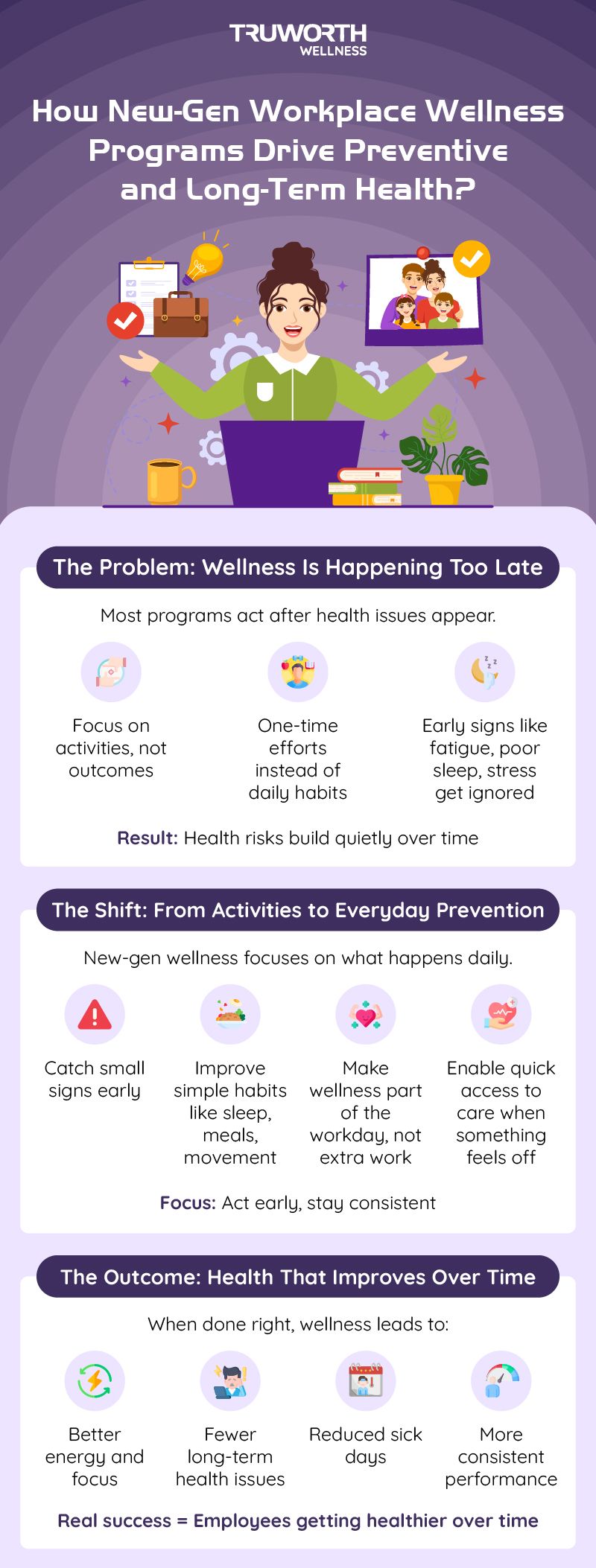
Prevention Starts Before a Health Issue Appears
Most workplace wellness programs step in when something goes wrong.
- High blood pressure
- Burnout
- Frequent sick days
But by then, the problem is already serious.
New-gen wellness takes a different approach, it acts earlier.
It focuses on small, early signs:
- Feeling tired every day
- Not sleeping well
- Regular headaches or acidity
- Difficulty focusing
- Skipping meals/Irregular meal timings
These are not major health issues yet. But they are the starting point of many long-term conditions.
Acting at this stage makes a real difference.
Long-Term Health Is Built Through Daily Patterns
Health does not change because of one big action. It changes because of repeated behavior.
That is why new-gen programs look at patterns like:
- Are employees taking breaks during the day?
- Are they able to eat on time?
- Are work hours affecting their sleep?
- Is stress becoming a daily experience?
Improving these patterns leads to better long-term health.
Not instantly, but steadily.
Wellness Should Fit into Work, Not Sit Outside It
One common problem with traditional programs is this: They feel like an extra task.
- Join a session
- Follow a plan
- Track your activity
But employees already have full schedules.
New-gen wellness focuses on making health easier within the workday:
- Encouraging short breaks between meetings
- Supporting reasonable work hours
- Making it easy to consult a doctor when needed
- Creating a work culture where health is not ignored
When wellness fits into daily work life, people are more likely to follow it.
Small Actions Matter More Than Big Efforts
Large changes often do not last. Simple actions do.
- A short walk after meals
- Sleeping at a fixed time
- Drinking enough water
- Taking small breaks from screens
These actions are easy to follow. And when repeated daily, they improve health over time.
New-gen wellness focuses on these small, consistent actions.
Access to Care Should Be Easy and Immediate
A major gap in workplace wellness is delayed action.
Employees often ignore early symptoms because:
- They do not have time
- Access to care feels complicated
- They think it is not serious
This delay turns small issues into bigger problems.
New-gen programs solve this by making healthcare easy to access:
- Quick doctor consultations
- Support for minor health concerns
- Early guidance before conditions worsen
When care is easy, people act early.
Measuring What Actually Matters
Many programs still focus on:
- Participation rates
- Number of sessions
- App usage
But these do not show real health improvement.
New-gen wellness looks at:
- Are employees feeling more energetic?
- Has sleep improved?
- Are health risks reducing over time?
- Are employees able to sustain their performance?
These are the outcomes that matter.
Prevention Is Also a Business Advantage
Focusing on prevention is not just good for employees. It also helps organizations.
- Fewer long-term health issues
- Lower healthcare costs over time
- Better productivity
- Reduced absenteeism
- More consistent performance
Healthy employees are not just present. They are able to perform better, every day.
How Truworth Wellness Enables Preventive and Long-Term Health?
Truworth Wellness is designed to support this shift from activities to outcomes.
With Truworth Wellness OPD and digital ecosystem:
- Employees can consult doctors easily, without delays
- Early symptoms can be addressed before they grow
- Physical and mental health support work together
- Care is continuous, not one-time
- Preventive health becomes part of everyday work life
This helps organizations focus not just on participation, but on real health improvement over time.
Final Thought
Workplace wellness does not need more programs. It needs better focus.
The real question is not: “Are employees participating?”
It is: “Are employees getting healthier over time?”
New-gen wellness programs answer this by:
- Acting early
- Supporting daily habits
- Making care easy
- Focusing on long-term outcomes
Because real wellness is not built in big moments. It is built in small actions, repeated every day.