How To Stop Being Nervous In Front Of The Boss?

A common workplace question with a practical, science backed answer
Almost every professional has faced this situation.
You understand your role. You know the subject. You have prepared your points. Yet the moment your boss asks a question or calls you into a discussion, your body reacts instantly.
Your heart beats faster. Your breathing becomes shallow. Words that felt clear moments ago suddenly feel harder to access.
This experience is far more common than people admit. It affects freshers, mid level professionals, and even senior leaders.
And contrary to popular belief, it is not a confidence issue.
It is a nervous system issue.
Also Read: Boss's Perfect Response To Employee's Mental Health Leave Request
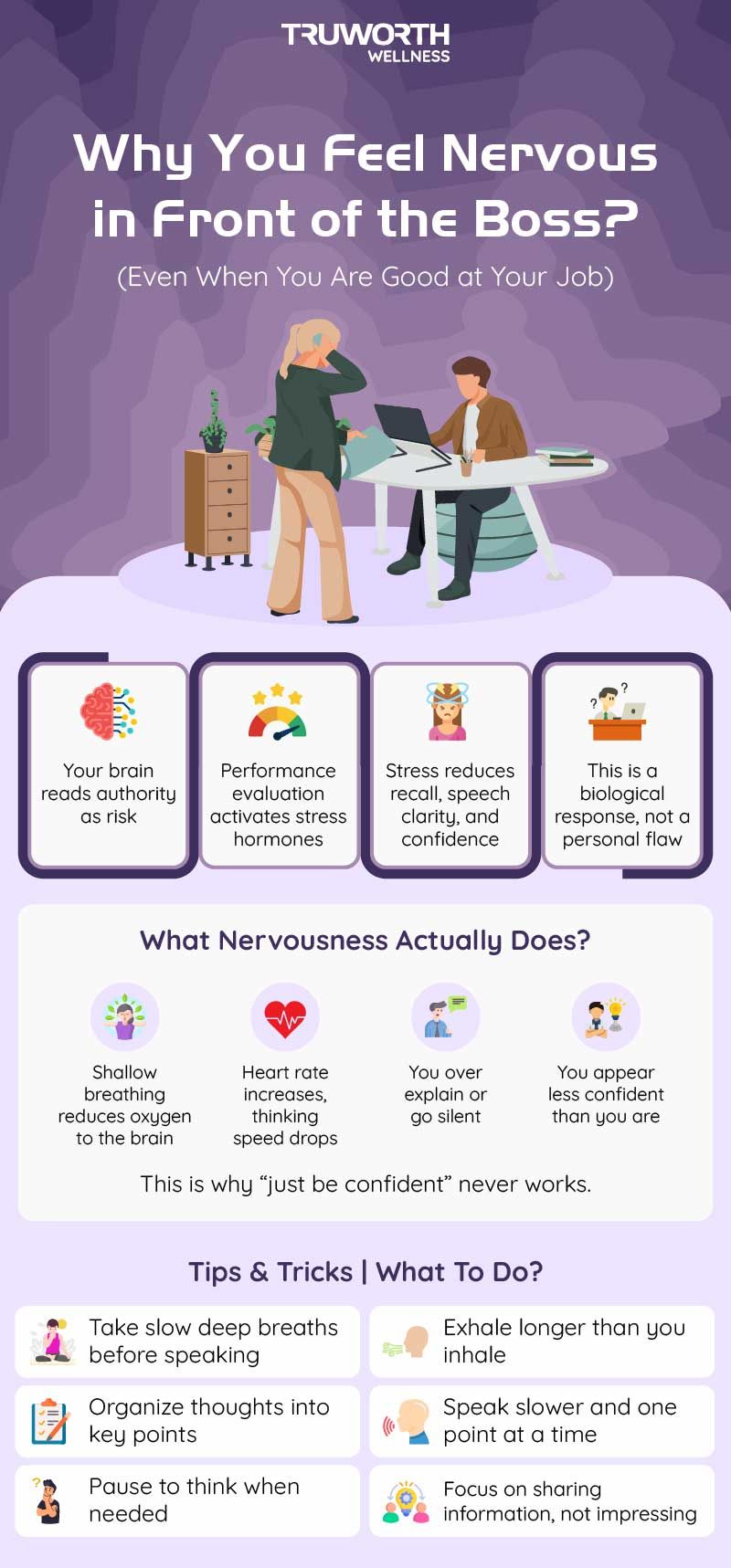
Why Nervousness Happens Around Authority?
The human brain is wired to detect threat. In modern workplaces, threat does not always mean danger. It often means evaluation.
A boss represents performance reviews, feedback, career growth, and sometimes job security. Even when the relationship is healthy, the brain registers authority as something that matters deeply.
When this happens, the nervous system shifts into a stress response.
In this state:
- Breathing becomes quicker and shallower
- Heart rate increases
- Blood flow prioritizes survival over thinking
- Access to memory, language, and reasoning reduces
This is why intelligent and capable professionals may struggle to speak clearly or confidently in front of leadership.
The body reacts before logic gets a chance.
Why “Just Be Confident” Does Not Work?
Many people try to fight nervousness using willpower.
- They tell themselves to relax.
- They force a confident tone.
- They mentally rehearse perfect answers.
Unfortunately, this often backfires.
When the body is stressed, the brain cannot simply be convinced through logic. Confidence is not a switch you turn on. It is a result of internal safety.
Until the nervous system feels regulated, clarity remains limited.
That is why effective solutions focus on what to do physically and mentally in the moment.
Also Read: Simple Tests or Exercises That Can Show If Your Employees Are Stressed Or Confident
What To Do When You Feel Nervous In Front of Your Boss?
These actions work because they are aligned with how the nervous system actually functions.
1) Slow your breathing before you speak
Before responding, take a slow breath. Make the exhale slightly longer than the inhale.
This simple adjustment sends a safety signal to the brain. It reduces heart rate and lowers physical tension.
A calmer body creates the conditions for clear thinking.
2) Organize thoughts into key points
Avoid scripting full sentences in your head. That increases pressure and cognitive load.
Instead, identify two or three key points you want to communicate. Thinking in bullet points allows flexibility and reduces the fear of forgetting exact words.
Clarity improves when the brain has structure.
3) Speak slower than feels natural
Stress makes people speak faster. This often leads to unclear delivery and increased self consciousness.
Consciously slow your pace. Speaking slightly slower gives your brain time to process and organize information.
It also makes your communication sound more composed and confident.
4) Share one point at a time
Trying to explain everything at once overwhelms both you and the listener.
Deliver one clear point. Pause briefly. Continue if required.
This reduces pressure and improves understanding.
5) Pause when you need to think
Many professionals fear silence. They rush to fill it, even when unsure.
A short pause is not a sign of weakness. It is a sign of thoughtfulness.
Pausing allows the brain to re organize information and respond with clarity. Most leaders respect this more than rushed answers.
6) Focus on sharing information, not impressing
A major source of nervousness is self monitoring.
Thoughts like:
- How do I sound?
- Do I look confident?
- What are they thinking about me?
Shift your focus outward. Concentrate on sharing accurate and useful information.
Your boss is evaluating content and clarity, not your worth as a person. This shift alone can reduce anxiety significantly.
How This Changes The Way You Are Perceived?
When the nervous system is regulated:
- Speech becomes clearer
- Thought flow improves
- Body language appears calmer
- Communication feels grounded
This naturally builds trust.
Ironically, confidence is often a byproduct of calm, not effort.
Also Read: How To Stay Calm And Mindful When You Have Back-To-Back Meetings?
Building Long Term Ease With Leadership?
While in the moment tools are powerful, long term comfort comes from consistency.
Helpful habits include:
- Regular low pressure interactions with your manager
- Asking for clarity instead of assuming expectations
- Reflecting on progress, not just mistakes
- Practicing short daily breathing or grounding exercises
Over time, repeated safe interactions teach the nervous system that authority is not a threat.
When Nervousness Feels Overwhelming
If anxiety around leadership feels intense, frequent, or begins affecting sleep, focus, or self esteem, it may need deeper attention.
In such cases:
- Emotional regulation practices help calm chronic stress responses
- Breathwork and mindfulness support nervous system balance
- Structured corporate wellness programs provide safe and practical tools
- This is not about changing personality. It is about building emotional resilience.
A Healthier Way To Look At Workplace Confidence
Confidence is often misunderstood.
It is not about speaking loudly, dominating conversations, or having instant answers.
Real workplace confidence looks like:
- Clear communication
- Thoughtful pauses
- Honest updates
- Calm presence
These qualities emerge naturally when the body feels safe.
Final Thought
Feeling nervous in front of your boss does not mean you lack capability or potential.
It means your nervous system is responding to perceived pressure.
When you know what to do in those moments, the response changes.
Calm creates clarity.
Clarity builds trust.
And trust supports growth.