Difference Between A Technically Accessible And Emotionally Accessible EAP

Most organizations believe their Employee Assistance Program is accessible because the link exists, the helpline works, the posters went out, and the vendor dashboard shows the service is live.
On paper, that is access. In real life, it is only the doorway.
The real question is not, “Can employees reach the EAP?” It is, “Do they feel safe enough to take the first step?”
Because somewhere between knowing support exists and actually booking a session, many employees quietly drop off. They see the announcement. They save the number. They tell themselves, “Maybe later.” Then work gets heavier, stress becomes familiar, sleep gets worse, and the program continues to sit there—available, functional, and unused.
This hesitation is often labelled as low awareness.
More often, it is something much more human: uncertainty, discomfort, and the quiet fear of what asking for help might mean at work.
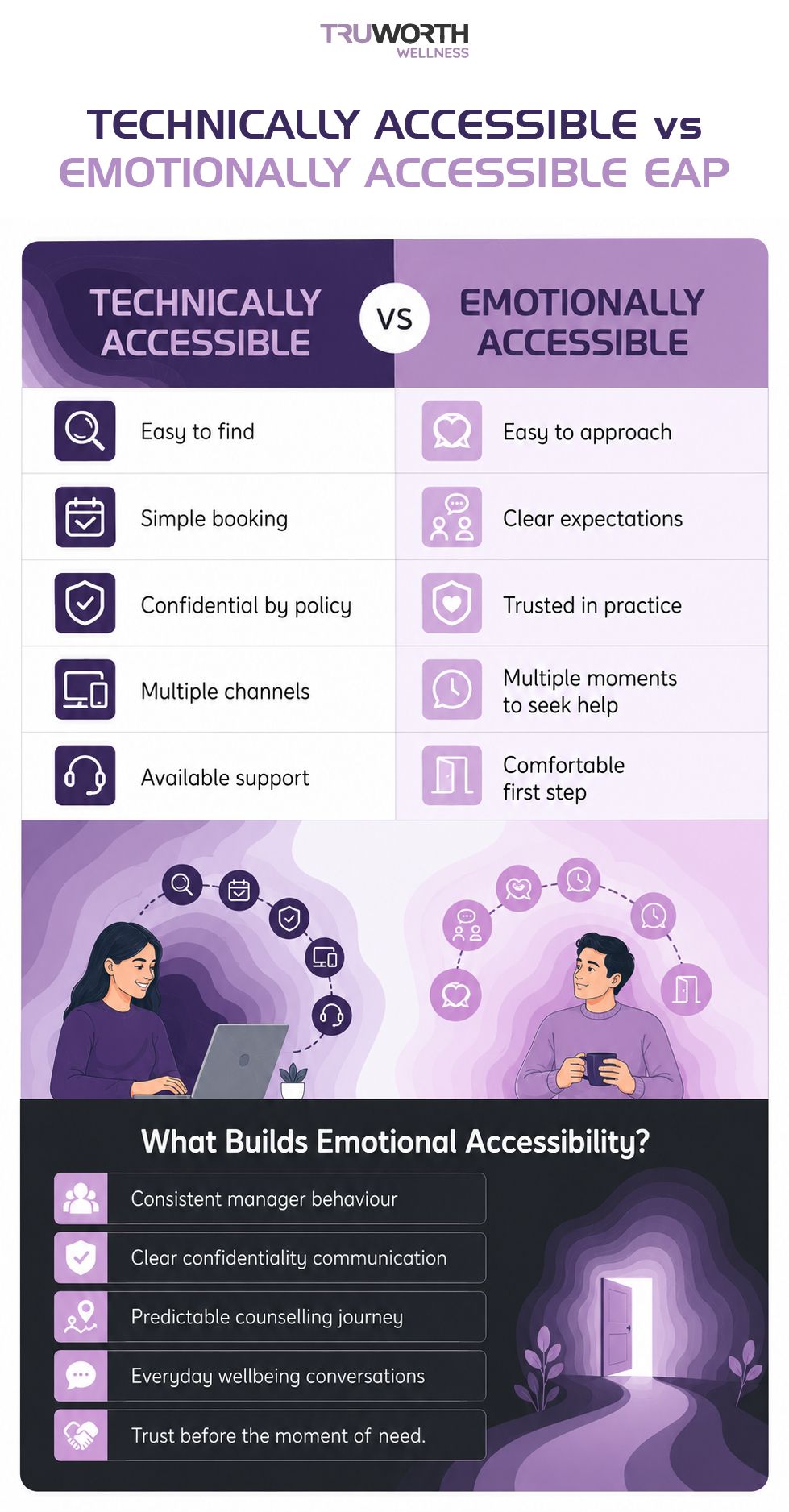
The Part Of The EAP Journey Nobody Puts On A Dashboard
A lot of EAP design begins with good intentions: make the program easy to discover, simple to book, available through multiple channels, and backed by qualified professionals. These are necessary. Without them, an EAP becomes another benefit employees are expected to appreciate but struggle to use.
But operational access only helps after an employee has already decided, “I am going to use this.”
The more fragile part happens before that decision.
Before an employee clicks a link, they run a private risk assessment in their head. Will this stay confidential? Is my issue “serious enough”? Will my manager somehow know? Will I be judged for not coping? Is this really for people like me, or only for crisis situations?
That internal conversation is shaped less by policy documents and more by everyday workplace signals.
Employees notice the small things:
- A manager celebrates employees who "push through" difficult weeks without taking time off
- Leadership encourages wellbeing but routinely schedules late-evening meetings
- Confidentiality is mentioned during induction but rarely explained beyond a single sentence
- Counselling is introduced only during Mental Health Awareness Month
- Colleagues speak openly about physical health benefits but almost never about emotional wellbeing
None of these moments technically block the EAP.
But together, they decide whether the EAP feels like a safe option or a risky one.
Technical Access Gets People To The Door. Emotional Access Helps Them Walk Through It.
This is why two companies can offer almost the same EAP and see completely different levels of engagement.
In one organization, the program is technically excellent but emotionally distant. Employees know where to find it, but they do not feel ready to use it.
In another, the same kind of support feels ordinary, private, and acceptable. Employees do not wait until they are overwhelmed to seek help.
The difference is rarely hidden inside the vendor contract.
It lives in the confidence employees build before they ever use the service.
A technically accessible EAP answers practical questions:
- Where can employees book a session?
- Which services are available?
- How many counselling sessions are included?
- Can support be accessed online?
An emotionally accessible EAP answers the questions employees may never say out loud:
- Confidentiality feels believable because it has been explained clearly and consistently.
- The first counselling session no longer feels unfamiliar because employees understand what to expect.
- Managers reinforce that seeking support is responsible rather than risky.
- Communication presents counselling as everyday support rather than a last resort.
- Employees see wellbeing reflected in workplace behaviour, not only in workplace messaging.
That is the shift organizations often miss: accessibility is not just a feature of the program. It is a feeling created by the employee experience around the program.
The Real Barrier Is Not Always Stigma. Sometimes, It Is Decision Friction.
When people feel uncertain, they rarely make a dramatic decision to reject support. They do something much quieter: they postpone it.
They tell themselves they will look into it after the deadline, after the appraisal cycle, after the client escalation, after things settle down.
But corporate life has a way of replacing one “after” with another.
And so, the EAP remains available while the employee remains alone with the decision.
This is where technically accessible programs lose people. Not because the pathway is broken, but because the emotional effort required to start still feels too high.
A link can reduce steps. It cannot automatically reduce doubt.
What Dashboards Show And What They Miss
Most EAP dashboards are good at showing what happened after someone made a decision.
Utilisation rates > Repeat sessions > Participation during awareness campaigns
These indicators matter. But they do not show the employees who almost clicked, almost called, almost booked, and then quietly talked themselves out of it.
If organizations want to improve EAP engagement, they need to become curious about the invisible drop-off that happens before utilization.
That means asking better questions:
- Employees understand exactly how confidentiality works.
- The booking journey explains what happens before, during, and after the first session.
- Managers know how to respond when someone seeks support.
- Communication reflects everyday wellbeing instead of only moments of crisis.
- Employee feedback is used to simplify the emotional experience, not just the operational process.
These are not soft measures. They are the conditions that make utilization possible.
Make The First Step Feel Human
EAPs have become easier to find, easier to book, and available through more channels than ever before.
Yet many employees still hesitate—not because support is invisible, but because using it still feels like crossing an invisible line.
The organizations that understand this stop treating the EAP as something employees simply need to be reminded about. They begin treating it as an experience employees need to feel safe entering.
That is the difference between an EAP employees can access and one they are emotionally ready to navigate.
Trust Is Not Built At The Moment Of Crisis
One of the biggest misconceptions about EAPs is that trust begins when an employee finally reaches out.
By then, trust has either been quietly built or quietly damaged.
Employees form opinions long before they need support. They notice how managers react when someone asks for flexibility. They notice whether stress is acknowledged or brushed aside. They notice whether wellbeing is discussed only during campaigns or also during high-pressure weeks.
These moments may not look connected to an Employee Assistance Program.
But employees connect them anyway.
Every workplace teaches people whether vulnerability is acceptable, inconvenient, respected, or risky. By the time someone considers counselling, they are not evaluating the EAP in isolation. They are evaluating everything the organization has already shown them about help-seeking.
That is why trust cannot be introduced at the point of booking.
It has to exist before employees ever need to use it.
Clarity Can Reduce More Anxiety Than Another Benefit Add-On
When utilization is low, the common response is to add more: more sessions, more specialists, more digital features, more communication pushes.
Those improvements can be valuable.
But sometimes employees are not looking for more services.
They are looking for more certainty.
What happens after I book? Who will know? What will the first session feel like? What kind of issues are “valid” enough to bring up? Can I use this before things become serious?
A surprising amount of hesitation disappears when organizations answer these questions clearly and repeatedly.
Instead of saying “counselling is confidential,” explain what confidentiality means in practice. Instead of only sharing a booking link, explain what happens before, during, and after the first session. Instead of positioning counselling as crisis support, normalize it for work stress, relationship strain, financial pressure, caregiving fatigue, burnout, grief, and everyday overwhelm.
Clarity does something powerful.
It turns uncertainty into expectation.
And expectation is much easier to act on than doubt.
Employees Believe What They Experience, Not Just What They Read
A polished EAP campaign can introduce a benefit.
Culture decides whether employees trust it.
If employees keep hearing “everyone is stressed,” “just push through,” or “this is not the right time to take leave,” even the best-designed wellbeing communication starts to feel decorative.
On the other hand, a simple message can carry real weight when everyday behavior supports it.
Employees notice when managers encourage early support instead of waiting for burnout. They notice when leaders talk about wellbeing without turning it into a performance speech. They notice when workload concerns lead to action, not just acknowledgement.
These experiences answer questions that brochures cannot.
They show whether the organization’s behavior matches its wellbeing promise.
And that consistency is what quietly removes emotional barriers.
The Best EAPs Simplify The Decision, Not Just The Process
Many organizations focus on making the EAP process smoother: fewer clicks, faster booking, more access channels, better digital journeys.
That matters.
But a smooth process is not the same as an easy decision.
An employee may still hesitate if they are unsure whether counselling is the right fit, whether their concern is too small, or whether the first conversation will feel awkward.
The most effective EAP communication reduces that emotional effort.
It tells employees: you do not need to be at breaking point to speak to someone. You do not need a perfectly worded problem. You do not need to justify why support would help. You can start with what is bothering you and let the conversation unfold from there.
That kind of message does more than inform. It gives permission.
Maybe Utilization Was Never The Whole Story
Utilization will always matter. It tells organizations whether employees are using the support available to them.
But utilization is a late signal.
It tells us that someone eventually reached the service.
It does not tell us how long they hesitated before getting there.
It does not show the employee who needed support but waited until the situation became harder. It does not show the employee who assumed counselling was only for crisis. It does not show the employee who worried confidentiality might not feel as private in practice as it sounded in policy.
If organizations want better engagement, they should measure and improve the conditions that make engagement possible: trust, clarity, manager behavior, psychological safety, and the emotional ease of the first step.
Because the goal is not only to increase EAP usage. The goal is to reduce the distance between needing help and feeling able to ask for it.
The Shift Organizations Need To Make
The next evolution of EAPs will not be defined only by more features, more channels, or more reminders.
It will be defined by how confidently employees take the first step.
That confidence grows when communication answers real concerns, managers reinforce what policies promise, and employees stop feeling like they need to prove they are struggling enough to deserve support.
A technically accessible EAP says: “Here is where support is available.”
An emotionally accessible EAP says: “You can use this before things fall apart, and you will not be judged for starting.”
That is the conversation organizations should be having more often.
Because an EAP succeeds not when employees know it exists, but when asking for help no longer feels like the hardest part.
The real measure of accessibility is not whether the door is open. It is whether employees feel safe enough to walk in.