The Annual Health Check Is Not Just A Benefit. It Is Workforce Intelligence, If You Use It Right.

Every year, companies across India put a surprising amount of time, money, and coordination into annual health checks.
Calendars get blocked, employees book slots, tests are done, reports are shared, dashboards are reviewed, and somewhere in an HR update, the program is marked as successfully completed.
Then, almost without anyone noticing, the whole exercise slips quietly into the background until the next cycle begins.
That is usually where the story ends.
The health check becomes one more item ticked off the HR calendar. A requirement met. A benefit delivered. A well-being initiative completed.
But that may be the least interesting way to look at it.
Because the real value of an annual health check is not only in the report an employee receives. It is also in what all those reports begin to reveal when you look at them together, responsibly and with the right guardrails.
That is where the conversation becomes far more useful.
An annual health check is not just a stack of individual medical reports. Handled ethically, it can show organizations what is quietly building across their workforce before those risks start showing up as productivity loss, absenteeism, higher insurance costs, or long-term health concerns.
The health check creates the data.
What the organization does after that decides whether it becomes real workforce intelligence.
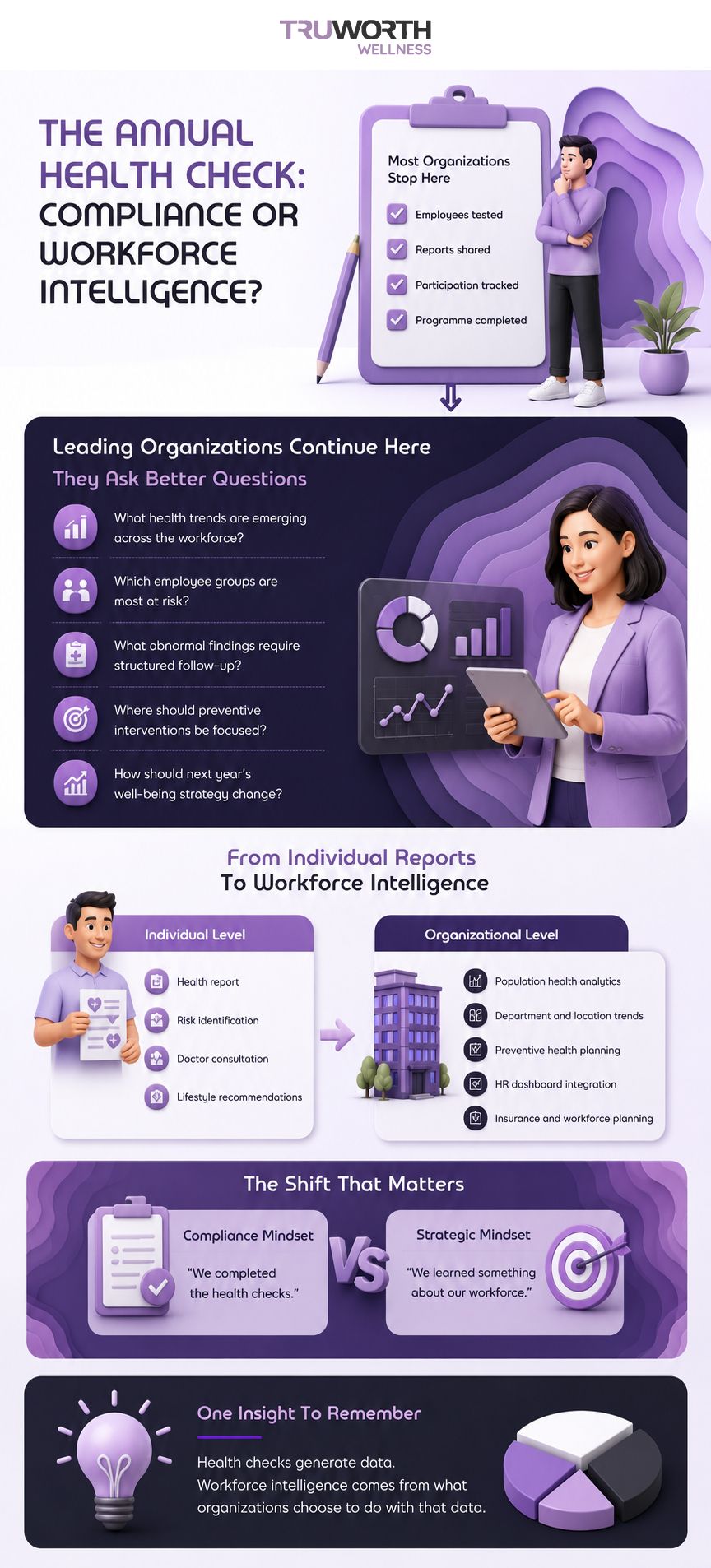
When Health Checks Become A Compliance Exercise?
A lot of organizations call their health check program successful because many employees showed up.
Employees attended > Reports were delivered > The vendor completed the engagement > Invoices were processed
From the outside, it looks like everything went exactly as planned.
Yet if someone then asked, "What did we actually learn about our workforce this year?" many leadership teams would pause.
That pause is important, because it separates a completed activity from a useful one.
A compliance mindset stops at completion. A workforce intelligence mindset asks what the activity actually revealed.
It sounds like a small difference, but it changes the way organizations judge whether the program was actually successful.
Instead of asking:
- How many employees completed the health check?
- Was participation above last year?
- Did the vendor deliver reports on time?
Organizations begin asking different questions.
- Are lifestyle-related health risks increasing?
- Which employee groups require additional support?
- Are younger employees showing early signs of chronic conditions?
- Which locations are experiencing different health trends?
- What preventive interventions should be prioritised next year?
That is when annual health checks stop being a year-end report and start becoming a planning tool.
And that is where their greatest value lies.
A Report Only Helps If Someone Knows What To Do With It
Picture this. An employee opens their annual health report after a busy workday.
Several values are highlighted in red.
1) Blood sugar levels are elevated 2) Blood pressure is higher than expected 3) Vitamin deficiencies have been identified.
The employee downloads the report, scans it quickly, and tells themselves they will "look into it later."
Weeks pass. Nothing changes. On paper, the health check was completed. In real life, not much changed. This happens more often than most organizations realise.
The program is judged by whether reports were sent, not by whether employees were helped after receiving them.
So the real question is simple. Should a health check be considered complete simply because abnormalities have been identified?
Or should success be measured by what happens after those abnormalities are detected?
The better programs treat risk identification as the beginning, not the finish line.
Most employees need help making sense of their reports: what is urgent, what can be managed, and what should be done next.
That might include:
- Follow-up consultations with medical professionals
- Nutrition or lifestyle guidance
- Specialist referrals where necessary
- Repeat testing for high-risk individuals
- Personalised preventive health recommendations
Without a clear follow-up pathway, useful health information can easily become one more file sitting in an inbox.
Individual Reports Matter. Workforce Patterns Matter Even More.
Individual reports help employees understand their personal health.
Aggregated, anonymised data helps organizations understand workforce health.
It is a simple distinction, but it is easy to miss.
One employee with elevated cholesterol may require individual medical advice.
If the same trend shows up across hundreds of employees, different locations, or specific roles, it becomes a workforce signal that deserves attention.
The goal is not to look into anyone’s personal health information.
The goal is to understand anonymised patterns that help leaders make better decisions while protecting employee privacy.
For example, organizations may discover:
- Increasing hypertension among employees below the age of forty
- Vitamin D deficiencies across office-based teams
- Higher obesity risk within sedentary job roles
- Elevated stress indicators among people managers
- Different health profiles between manufacturing and corporate employees
- Lifestyle-related conditions increasing year after year
Viewed individually, these findings are medical observations.
Looked at together, they become business insights.
They help organizations move beyond generic well-being activities and focus on what their people actually need.
Instead of running another broad wellness campaign, organizations can respond to the health issues that are actually showing up in their employee population.
That makes every future well-being investment more focused, more relevant, and more useful.
Turning Health Data Into Better Decisions
This is where HR’s role starts to shift.
For years, the success of a health check program has often been judged through operational metrics such as participation, timelines, employee feedback, and vendor performance. Those numbers matter because they show whether the program ran smoothly.
But they say very little about whether the program helped the organization understand its workforce better.
The more useful question is not, "Did the health check happen?"
It is whether it changed how the organization understands its people.
Imagine an HR dashboard that does more than show participation numbers and instead tracks workforce health patterns over the past three years.
Suddenly, leadership is not looking at isolated reports. They are seeing what is changing across the organization.
They might see metabolic health risks rising among employees below forty. Manufacturing locations may need a different focus than corporate offices. Rotational shift teams may be facing higher lifestyle-related risks than daytime teams. Managers may show higher stress indicators than individual contributors.
These insights do not replace conversations with employees. They make those conversations sharper and more grounded.
More importantly, they help organizations move from reacting after health problems appear to spotting where prevention could make the biggest difference.
That is when annual health checks become part of workforce planning, not just another well-being activity.
Better Insights Lead To Better Investments
The biggest advantage of good workforce intelligence is that it makes future decisions less guesswork-driven.
Many organizations launch well-being initiatives based on assumptions.
Stress workshops get chosen because stress comes up often. Nutrition campaigns feel relevant to everyone. Fitness challenges are easy to launch and usually get participation. Sometimes these programs create excellent outcomes. Sometimes they don't.
Without a clear view of the workforce’s real health profile, organizations are still making educated guesses. Health check data helps reduce that uncertainty.
For example, if aggregated reports show rising cardiovascular risk across multiple locations, heart health programs become easier to justify. If vitamin deficiencies are common, nutrition education may be more useful than another generic fitness challenge. If lifestyle-related risks are concentrated in certain employee groups, support can be designed for those groups instead of being rolled out in the same way to everyone.
The result is not only better well-being programs. It's better allocation of resources.
Procurement Should Look Beyond Operational Efficiency
Health check vendors are usually evaluated on practical questions.
- Can they conduct camps across multiple locations?
- Can they complete testing within agreed timelines?
- Are reports delivered accurately?
- Can they manage employee scheduling efficiently?
These questions are important. They help the program run smoothly. But they should not be the only questions that shape procurement decisions. Organizations also need to know what happens once testing is over.
Questions worth asking include:
- How are abnormal findings prioritized and communicated?
- What structured follow-up support is available for employees?
- Does the reporting highlight meaningful workforce trends rather than only individual results?
- Can anonymized population health insights be integrated into HR dashboards?
- Will the data help leadership make better workforce decisions over time?
The real difference between vendors is often not the number of tests they offer.
It is the quality of insight they help organizations draw from those tests. A health check provider should not be seen only as a diagnostics partner. In many cases, they can become a long-term workforce health partner.
A Better Conversation For Leadership
Annual health checks should not end with a presentation on participation percentages and completed reports.
They should open a better leadership conversation.
- What is changing across our workforce?
- Which risks require attention before they become larger health challenges?
- Where should future well-being investments be directed?
- How do different employee populations compare?
- What support should managers receive?
- How can preventive healthcare become part of our long-term people strategy?
These questions push annual health checks beyond compliance. They turn them into decision-making tools.
A Final Thought
Every organization collects data. Far fewer turn that data into something leaders can actually use. Annual health checks are no different.
On their own, they produce useful medical information for individual employees. Used thoughtfully and responsibly, they can also help an organization understand the health of its workforce before emerging risks begin affecting productivity, engagement, absenteeism, healthcare costs, and long-term business performance.
The organizations that get the most value from annual health checks are not always the ones running the most comprehensive test packages.
They are the ones asking better questions after the reports arrive. They look beyond participation rates to understand trends.
Beyond compliance to identify opportunities. Beyond individual reports to recognise patterns.
Because health checks create data.
Workforce intelligence depends on what organizations decide to do with that data.
That shift in thinking is what turns an annual health check from a yearly activity into one of the most useful decision-support tools an organization can invest in.