Corporate Wellness Programs: Cost V/S Value

Most organisations think about wellness as a cost to be minimised. The ones getting the most from their investment think about it as a value to be maximised. Here is the difference.
Every year, HR leaders across India sit in budget meetings defending their wellness programs against the same question.
What is the return on this?
It is a fair question. Wellness budgets in Indian organisations range from a few thousand rupees per employee per year to significantly more, and the commercial justification for that investment is not always clear or well-articulated.
The problem is usually not that the investment lacks value. The problem is that the value is not being measured in ways that translate to the commercial language that finance and leadership teams find persuasive.
Here is how to think about the cost-versus-value question clearly, honestly and in terms that build a genuinely defensible investment case.
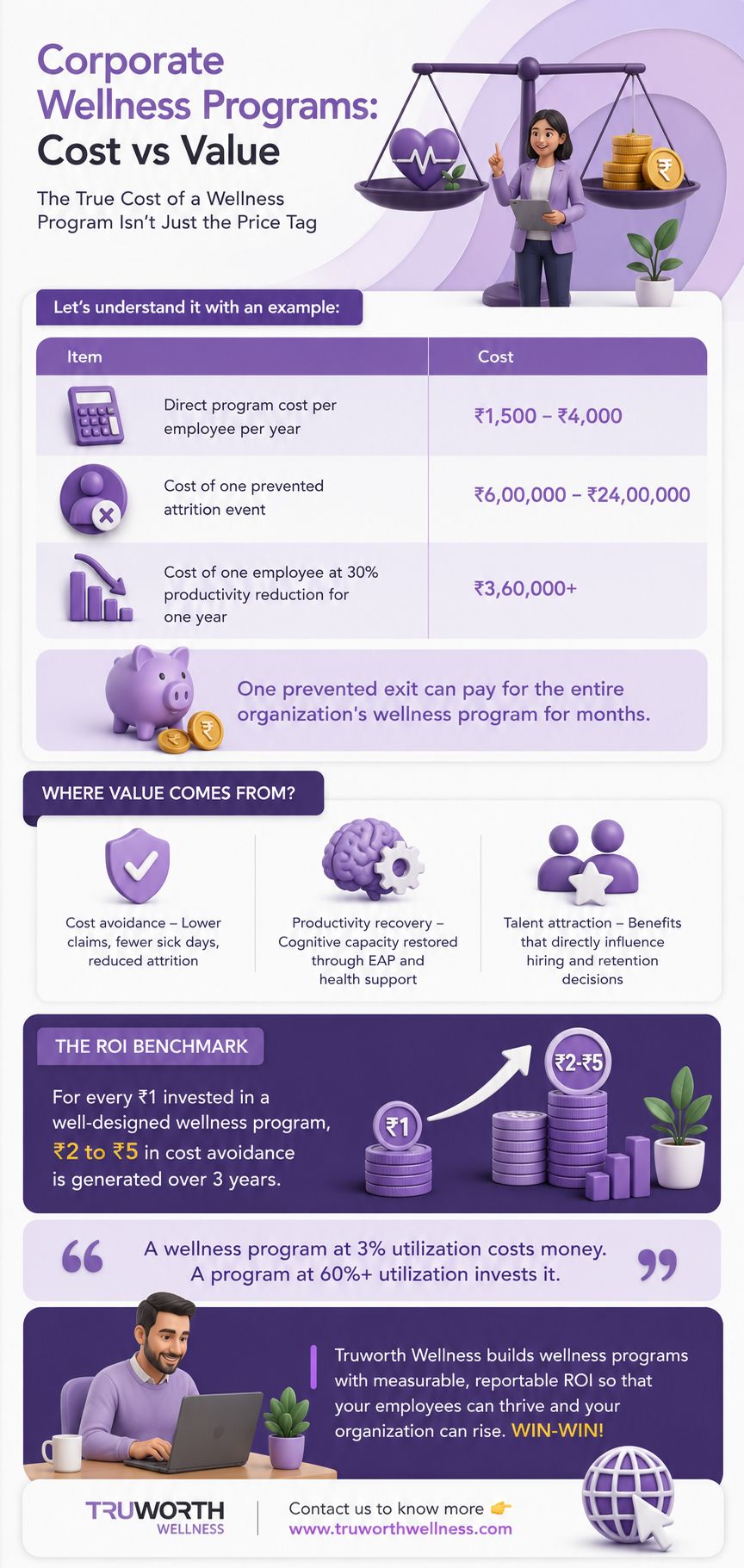
The True Cost of a Wellness Program
Before evaluating value, it helps to understand cost accurately. Because most organisations undercount both the direct costs of their wellness program and the indirect costs of not having an effective one.
Direct costs of a wellness program typically include:
- Annual health check or HRA program fees
- EAP vendor fees, typically per-employee-per-month
- OPD benefit or CarePass subscription costs
- Wellness platform subscription
- Manager training and program communication costs
- Administration time for the HR team
For a mid-sized Indian corporate of five hundred employees, a comprehensive wellness program including HRA, EAP, OPD access and a digital wellness platform might cost between one thousand five hundred and four thousand rupees per employee per year depending on the scope and vendor.
At the higher end, this is a total program cost of approximately twenty lakh rupees per year. At the lower end, it is approximately seven-point-five lakh rupees per year.
These are real numbers that require real justification.
Indirect costs that most organisations do not count:
The direct program cost is only meaningful in the context of the costs of not having the program. These include:
- Attrition costs from health-driven exits: at fifty percent of annual salary for a mid-level employee earning twelve lakh rupees, one prevented exit saves six lakh rupees
- Presenteeism costs from unmanaged health conditions: at thirty percent productivity reduction for employees with common unmanaged conditions, each affected employee costs approximately thirty percent of their annual salary in unrealised output annually
- Insurance premium escalation from unmanaged chronic disease: group health insurance premiums in India have been rising at fourteen percent per year, driven significantly by manageable chronic conditions going unmanaged until they become expensive hospitalisations
- Recruitment and replacement costs from health-driven attrition: at one hundred fifty percent of annual salary for knowledge workers, attrition is expensive
- Sick day costs: unmanaged conditions drive significantly more sick days than managed ones
When these indirect costs are included in the calculation, the cost-versus-value equation for a comprehensive wellness program shifts substantially in favour of investment.
The Value Side of the Equation
Value from a corporate wellness program comes from three sources.
1. Cost avoidance
This is the most quantifiable value. It includes:
- Insurance claim cost reduction from preventing or delaying chronic disease
- Sick day reduction from earlier treatment of acute conditions through OPD access
- Attrition cost reduction from retention improvements driven by perceived wellness support
- Productivity recovery from employees who return to full functioning through EAP support rather than prolonged presenteeism
Research from global EAP and wellness program studies consistently shows that for every one rupee invested in a well-designed wellness program, between two and five rupees in cost avoidance is generated over a three to five year period.
2. Productivity improvement
This is harder to measure precisely but is the largest component of wellness program value.
Employees who are physically healthy, mentally well and financially stable perform better. The specific productivity improvements from common wellness interventions include:
- Metabolic health improvement: reduction in afternoon energy crashes and brain fog that affect output quality
- Mental health support: recovery of cognitive capacity lost to anxiety, depression and burnout
- Sleep improvement: measurable increase in decision quality and sustained concentration
- Chronic disease management: reduction in the productivity loss from poorly managed conditions
3. Retention and talent attraction
The talent market increasingly weights benefit quality in employment decisions. Organisations with genuinely effective, well-communicated wellness programs attract and retain talent more effectively than those with benefits that exist on paper only.
The value of each prevented attrition event is significant and measurable. The value of the talent attraction advantage is harder to quantify but real.
Why Cheap Wellness Programs Are Often the Most Expensive?
This is the most important and most counterintuitive point in the cost-versus-value conversation.
A wellness program that costs five hundred rupees per employee per year and sits at three percent utilisation produces almost no cost avoidance, no productivity improvement and no retention benefit. Its actual cost is five hundred rupees multiplied by the employee count, producing essentially zero return.
A wellness program that costs three thousand rupees per employee per year but achieves thirty percent utilisation and produces measurable improvements in health risk scores, EAP engagement and OPD utilisation is generating cost avoidance and productivity return that substantially exceeds its cost.
The cost-per-employee figure is not the metric that determines value. The value generated per rupee invested is the metric that determines value. And value per rupee invested is almost always higher in well-designed, well-utilised, more expensive programs than in cheap, low-utilisation, low-engagement ones.
The organisation that buys the cheapest EAP because the per-employee cost is lower is often buying the most expensive outcome because the cheap EAP produces no utilisation and no return.
How to Build the Business Case?
For HR leaders who need to justify wellness investment to leadership, here is the most effective framework.
Calculate the baseline cost of the current situation:
- Current attrition rate and replacement cost per exit
- Estimated sick day cost per year
- Group health insurance premium and its year-on-year growth
- Any data on engagement scores or productivity metrics
Calculate the projected return from specific program components:
- Prevented attrition at fifty percent of salary per prevented exit
- Sick day reduction from OPD access
- Insurance premium growth reduction from preventive health investment
- EAP ROI at three to five rupees per rupee invested based on published research
Present the net position:
- Program cost versus projected cost avoidance over three years
- Productivity improvement as a separate, additive benefit
- Talent attraction and retention value as a further additive benefit
The three-year frame is important. Many wellness investments, particularly in preventive health, produce returns that take twelve to eighteen months to fully materialise. A one-year ROI calculation will understate the value.
How Truworth Wellness Helps Build the Business Case?
Truworth Wellness provides HR leaders with the data they need to make the commercial case for wellness investment. HRA trend data shows year-on-year changes in workforce health risk markers. EAP utilisation and outcome data demonstrates the reach and effectiveness of mental health support. OPD utilisation data shows the reduction in healthcare barriers and the healthcare-seeking behaviour change that drives down long-term cost.
Ready to build the business case for your wellness investment? Talk to Truworth Wellness about how to measure and communicate the value of what you are building.