EAP For SMEs V/S Large Enterprises: What Changes?

The mental health needs of a fifty-person startup and a five-thousand-person corporation are not the same. Here is how EAP design should reflect that difference.
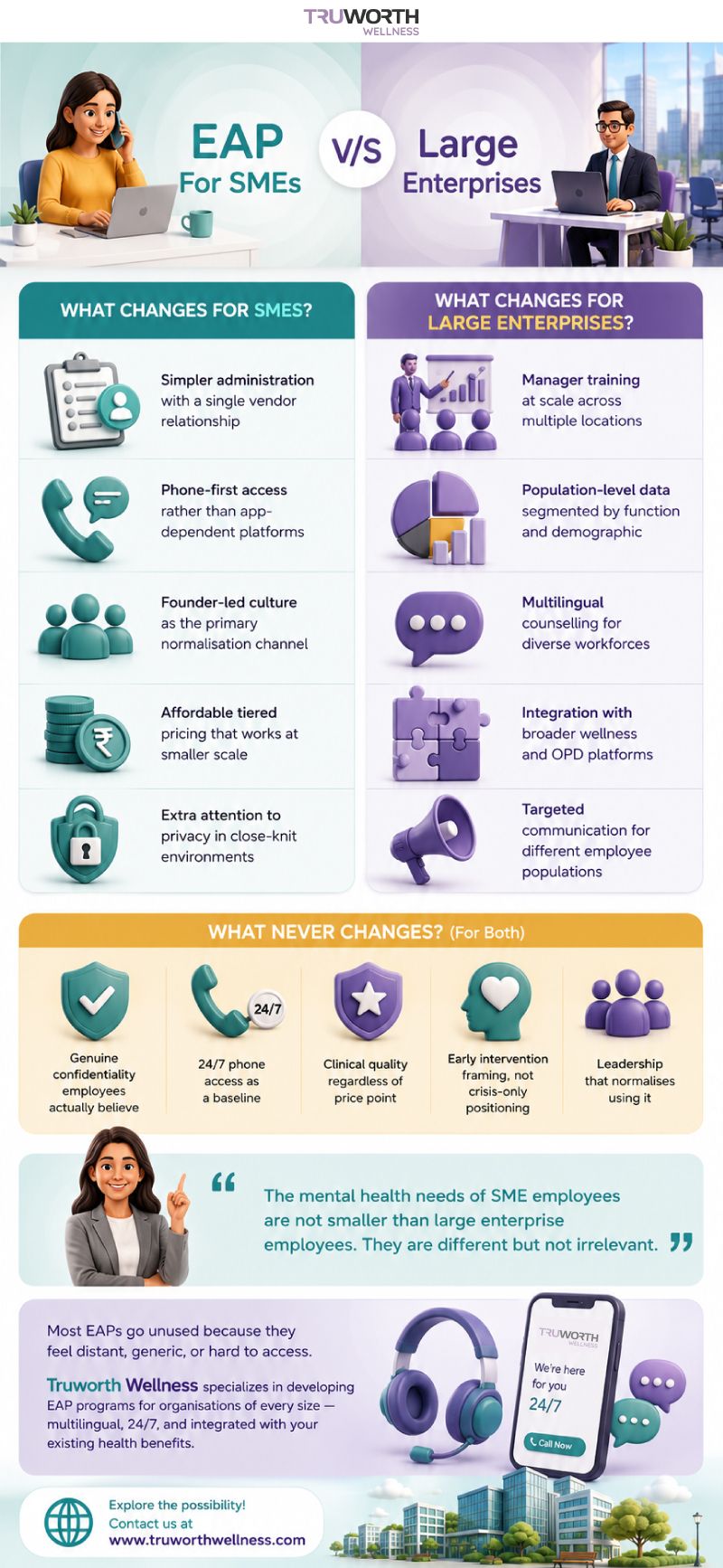
The Employee Assistance Program conversation in India has historically been dominated by large enterprises. The assumption has been that EAPs are for organisations with large HR budgets, dedicated wellness teams and the administrative infrastructure to manage a complex benefit.
This assumption is wrong. And it is costing small and medium-sized enterprises the productivity, retention and wellbeing benefits that a well-designed EAP delivers.
The mental health needs of employees in an SME are not smaller than those of employees in a large corporation. They are different. And the EAP that serves them best is also different, in design, in delivery model, in pricing structure and in communication approach.
Here is what changes between the two.
The Fundamental Difference in Context
Before getting into design specifics, it helps to understand the different contexts in which EAPs operate in SMEs versus large enterprises.
The SME context:
- Smaller teams where everyone knows each other, which both reduces stigma and increases privacy concerns
- Less formal HR infrastructure, often meaning one HR person or a founder managing people matters
- Fewer administrative resources to manage vendor relationships, utilisation reporting and program communication
- Often faster-changing environments with higher uncertainty and change-related stress
- Tighter budgets requiring clearer ROI
- Employees who may have chosen the SME specifically for its culture and therefore have higher expectations of personal care
- Leadership who is often personally known to employees, making leadership normalisation of EAP more immediate and impactful
The large enterprise context:
- Large, dispersed workforces across multiple locations, functions and demographic profiles
- Dedicated HR and wellness teams with administrative capacity
- Larger budgets that can support more complex program architecture
- More formal, structured benefits communication channels
- Higher anonymity, which reduces the privacy concern of being identified as an EAP user but also reduces the personal connection that drives culture
- More complex organisational structures that require manager training at scale
What Changes in EAP Design for SMEs?
1) Simplicity over complexity
A large enterprise can manage a multi-vendor wellness ecosystem with separate EAP, OPD and wellness platform providers.
An SME typically cannot. The EAP for an SME needs to be simple to administer, simple to communicate and simple for employees to access.
This means:
- A single point of contact for the employer rather than multiple vendor relationships
- Simple, clear employee communication that does not require a dedicated wellness team to manage
- Easy onboarding that does not create significant administrative burden
- Clear, accessible reporting that gives the HR manager or founder the information they need without requiring data analysis expertise
2) Affordability without compromising on quality
EAP pricing for large enterprises is typically per-employee-per-month at a rate that makes sense at scale.
For SMEs with fifty to two hundred employees, the per-employee cost needs to reflect the smaller base without compromising on the quality of clinical support.
The most appropriate pricing models for SMEs are:
- Tiered per-employee pricing that reflects smaller workforce size
- Subscription models with a defined scope of service rather than unlimited usage models that price for large utilisation
- Bundled models that combine EAP with OPD access in a single affordable package
3) Phone-first, app-optional
Large enterprises often have the digital infrastructure and employee engagement to support app-based wellness platforms with significant uptake.
Many SMEs, particularly those with younger or more digitally varied workforces, are better served by a phone-first EAP where the primary access is a helpline number rather than an app with login requirements.
A number that every employee can call from any phone at any time is both the most universally accessible and the most administratively simple access model. It should be the default for SME EAPs.
4) The founder or senior leader as the primary culture carrier
In a large enterprise, EAP culture is built through manager training programs, leadership communications, employee town halls and sustained internal campaigns.
In an SME, the founder or senior leader is the culture.
When the founder of a thirty-person company mentions in an all-hands that they spoke to a counsellor during a difficult period and found it helpful, the cultural permission that creates takes immediate effect across the entire organisation. This is a lever that large enterprises cannot pull as directly. SME EAP communication strategy should centre on founder and senior leadership authenticity as its primary channel.
5) Privacy in close-knit environments
In a small organisation where colleagues know each other personally, the concern about being identified as an EAP user is real and should be designed for explicitly.
Design elements that address this:
- External EAP provider, never an internal counsellor known to the team
- Explicit, repeated communication that no information about EAP usage is shared with the employer
- A completely separate access pathway from any internal HR system
- Options to access support outside working hours when privacy is easier to maintain
What Changes in EAP Design for Large Enterprises?
1) Scale of manager training
In a large enterprise, the manager referral pathway into the EAP needs to work across potentially hundreds of managers in multiple locations and functions. This requires a structured training program, standardised referral language, ongoing reinforcement and a system for measuring manager referral activity as a metric.
2) Population-level data and segmented communication
Large enterprises can use anonymised EAP utilisation data to understand population-level mental health trends by function, location, seniority and demographic. This data is genuinely useful for HR strategy and requires the data infrastructure to collect and analyse it meaningfully.
EAP communication can also be segmented in large enterprises in ways that are not possible or necessary in SMEs. Different messaging for different employee populations. Targeted outreach to high-risk groups. Specific campaigns around known stress peaks like appraisal season or post-restructuring periods.
3) Integration with broader wellness infrastructure
Large enterprises typically have broader wellness ecosystems including health insurance, OPD benefits, wellness platforms, health risk assessments and condition management programs. The EAP for a large enterprise should integrate with this ecosystem rather than operating as a standalone point solution.
4) 24/7 multilingual capability
Large enterprises often have diverse workforces with significant non-English-comfortable employee populations and employees working non-standard hours across manufacturing, logistics and service functions. 24/7 availability and multilingual counselling capability are baseline requirements for large enterprise EAPs in a way they may not be for smaller, more homogeneous workforces.
The Common Ground
Despite these differences, certain EAP design principles are non-negotiable regardless of organisation size.
- Genuine confidentiality that employees believe
- Clinical quality of counsellors regardless of price point
- Accessible 24/7 by phone at minimum
- Proactive employee communication rather than passive availability
- Leadership normalisation of use
- Early intervention framing rather than crisis-only positioning
These are not scale-dependent. They are the prerequisites for any EAP to deliver value.
How Truworth Wellness Serves Both?
Truworth Wellness designs EAP programs for organisations across the size spectrum. For SMEs, the focus is on simplicity, affordability, phone-first access and leveraging founder culture as the primary utilisation driver. For large enterprises, the focus is on scale, integration, multilingual capability, population-level data and manager training infrastructure.
In both cases, the underlying design principle is the same. An EAP only works if employees use it. Everything in the program design is oriented toward making that as likely as possible.
Building an EAP for an SME or a large enterprise? Talk to Truworth Wellness about designing a program that fits your organisation's actual context.