3 Absolute MUST-HAVES For Wellness Programs (Skip One, & You’re At Zero)

Let us be honest with you. Most wellness programs fail. Not because they’re bad ideas. But because they miss the core essentials.
You can have a beautiful office gym, free fruit bowls, and a meditation app subscription. But if you skip even one of the three factors below, your program’s result will be zero. People won’t join, they won’t stick, and you’ll have wasted time and money.
These three factors are not “nice to have.” They are MUST MUST. No exceptions.
Let’s dive in.
The “Zero” Rule – Explained Simply
Think of these three factors as the legs of a stool.
| Missing Factor | What Happens? |
|---|---|
| No leadership walk-the-talk | No trust. People think it’s a trick. |
| No psychological safety | No honesty. People hide their struggles. |
| No ease of use | No action. People give up before starting. |
If any leg is missing, the stool falls.
Your wellness program doesn’t go from 100 to 60. It goes from 100 to 0.
- You cannot “make up” for missing safety with a better gym.
- You cannot “fix” hard-to-use software with more prizes.
- You cannot “replace” leadership example with more emails.
Factor #1: Leadership Walk-the-Talk (Not Just Posters)
What does this mean?
It means the boss, the manager, the team lead actually participates. They don’t just send an email saying “health is important.” They show it.
- The CEO takes a lunch walk – not a working lunch.
- The manager uses their mental health day – openly.
- The team lead refuses late-night emails – and says why.
Why is this a MUST MUST?
Because people watch what leaders do, not what they say.
If the boss skips the wellness webinar to attend another sales meeting, the message is clear: Wellness is optional. Work comes first.
When leaders don’t walk the talk, employees feel:
- “This is fake.”
- “If I join, I’ll look lazy.”
- “They say wellness, but they reward burnout.”
Skip this = Zero
No poster, yoga class, or step challenge will fix a leadership team that works 14-hour days and brags about it. Without leadership modeling behavior, participation drops below 10%. That’s zero impact.
Factor #2: Real Psychological Safety (Not Just “We Care” Stickers)
What does this mean?
Psychological safety means an employee can say:
- “I’m overwhelmed.”
- “I made a mistake.”
- “I need a break.”
…without fear of being judged, punished, or labeled “weak.”
It is not a foosball table. It is not an anonymous suggestion box. It is not a “we care about you” poster on the wall.
It is the daily, lived experience that being human is allowed.
Why is this a MUST MUST?
Wellness programs ask people to be vulnerable.
To track sleep. To share stress levels. To join a grief support group.
If the workplace feels unsafe, no one will do that. Instead, employees will:
- Hide their stress
- Pretend they’re fine
- Clock in, smile, and quietly burn out
Wellness without safety is like handing out umbrellas during a hurricane and saying “stay dry.” It’s useless.
Skip this = Zero
You can have the best mental health app in the world. If an employee fears that using it will be seen as “unreliable,” they won’t open it once. Zero usage. Zero change.
Factor #3: Easy, Not Epic (Low Friction = High Participation)
What does this mean?
Most wellness programs fail because they ask too much.
- Download three apps
- Attend a 90-minute workshop
- Fill out a 20-minute health survey
- Join a 6-week challenge with daily check-ins
That’s high friction. And high friction kills participation.
Easy means:
- One click to join
- Five minutes or less per day
- No extra meetings
- No special gear
- No embarrassing weigh-ins

Why is this a MUST MUST?
People are tired. They have kids, commutes, deadlines, and doctor appointments. They do not have “extra energy” for a complicated wellness program.
- If it takes more than two minutes to figure out, they quit.
- If it requires logging into three different platforms, they quit.
- If they need permission from a manager to join, they quit.
Examples of low friction wins:
- A 5-minute guided breathing session embedded in the team chat tool
- Walk-and-talk meetings instead of sitting
- Free blood pressure check at the coffee machine (not the HR office on the 4th floor)
- One text message per week with one tiny action (“Drink water now”)
Skip this = Zero
You can spend lakhs on a fancy wellness platform. If employees need 12 clicks to log one meal, zero people will use it after week two.
Conclusion: The Ultimate Wellness Reality Check
At the end of the day, a successful workplace wellness program isn't defined by the size of your budget, the flashiness of an app, or the aesthetic of your office gym. It lives or dies by your culture.
Think of Leadership Walk-the-Talk, Psychological Safety, and Ease of Use as the three unbreakable pillars of your initiative. Skip just one, and the entire structure collapses to zero.
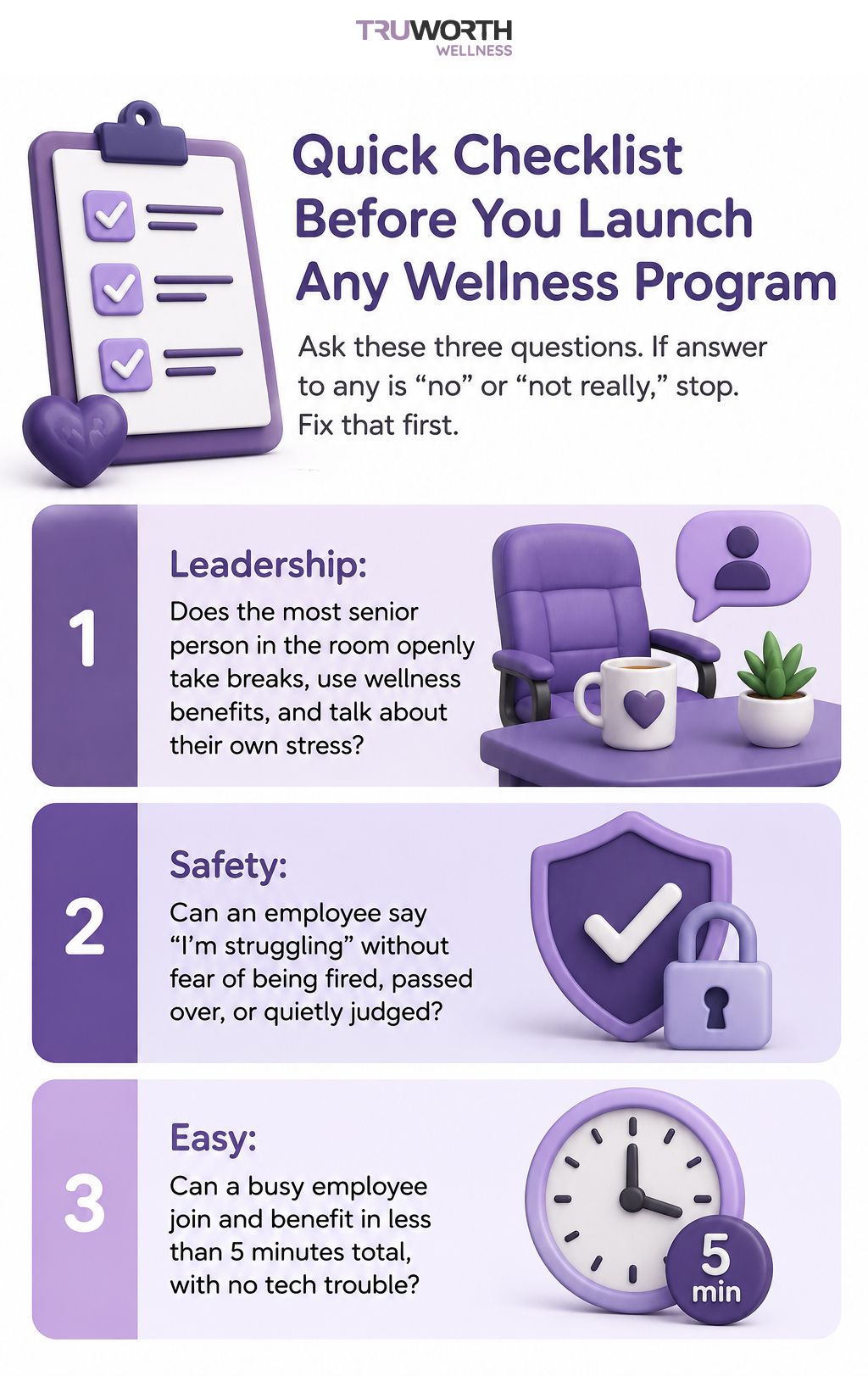
Before launching your next health challenge or investing in new software, ask your leadership team three hard questions:
- Are we modeling the behavior we are asking our employees to adopt?
- Do our people feel safe enough to raise their hands and say, "I need help"?
- Are we making participation effortless, or are we adding another chore to their already packed days?
Build a foundation of trust, safety, and simplicity first. Once those are locked in, your wellness program won't just look appealing; it will actually change lives.