How EAP Programs Improve Employee Productivity And Retention?

Most companies see the EAP as a mental health benefit. The ones getting the most value from it see it as a productivity and retention tool. Here is the evidence.
When HR leaders present the EAP to their CFO, the conversation almost always goes to cost. What does it cost per employee? What is the ROI? How do we justify this to the board?
These are fair questions. They also miss the more compelling framing.
The EAP is not primarily a cost. It is a productivity and retention infrastructure. And the return it generates, when the program is well-designed and genuinely utilised, shows up in three specific places: in how well employees perform, in how long they stay and in how much the organisation spends on the downstream consequences of unaddressed mental health challenges.
Here is how each of those connections actually works.
How Unaddressed Mental Health Affects Productivity?
Before understanding how an EAP improves productivity, it helps to understand the baseline it is working against.
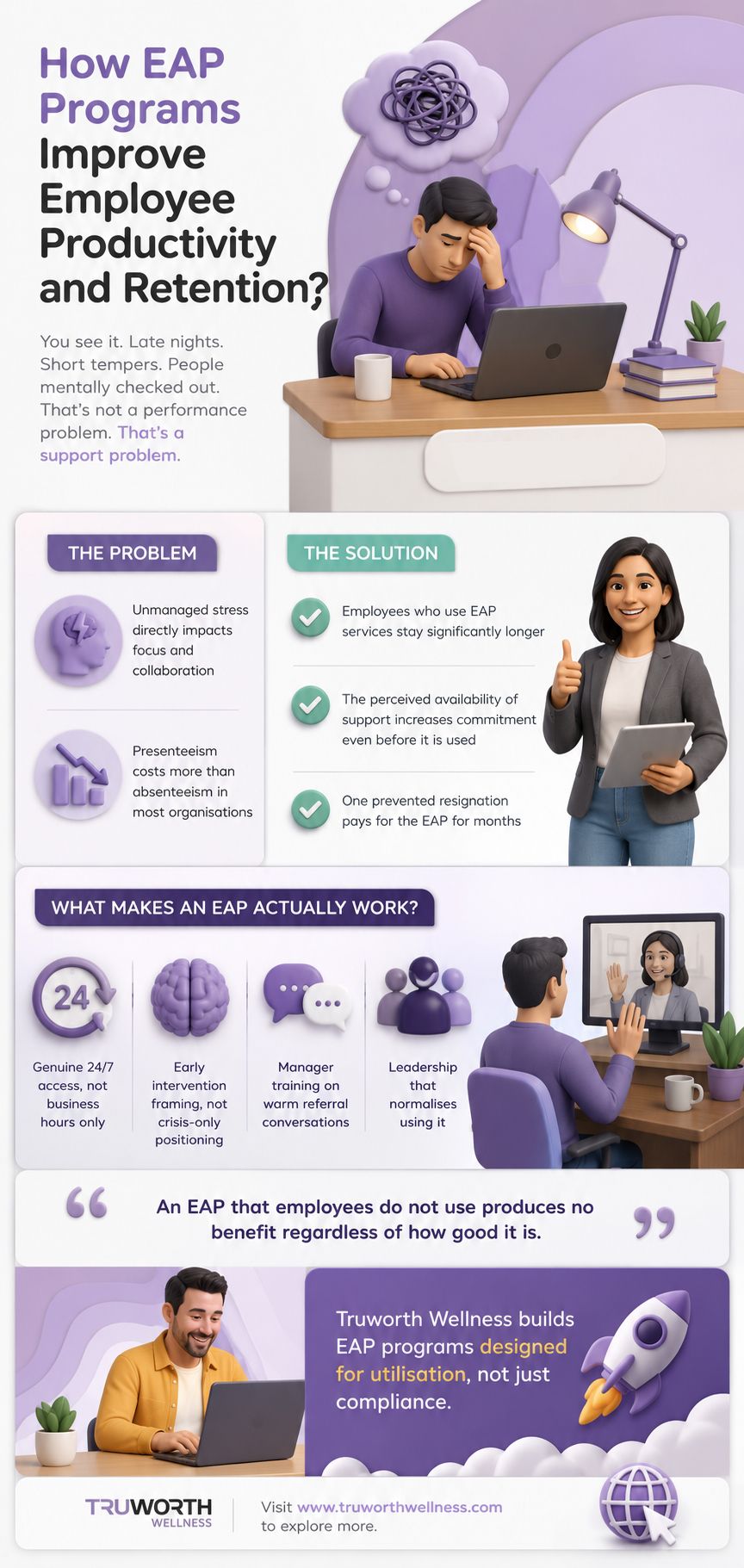
Employees with unaddressed mental health challenges are not absent from the productivity equation. They are present but not fully functional. This is called presenteeism and it is significantly more costly than absenteeism in most research.
An employee managing untreated anxiety:
- Takes longer to complete tasks that should be quick
- Makes more errors in work that requires careful attention
- Struggles to make decisions with confidence
- Has difficulty concentrating through meetings and focused work periods
- Produces lower-quality output than their capability suggests
- Withdraws from collaboration and communication in ways that affect team performance
None of this shows up on an attendance record. All of it affects what the organisation gets from that employee's time.
Research estimates that mental health-related presenteeism costs organisations significantly more per employee per year than absenteeism. The employee is at their desk. Their mind is not fully there.
How the EAP Addresses the Productivity Gap?
A well-designed, well-utilised EAP creates the conditions for early intervention in mental health challenges before they reach the level of severity that significantly impairs functioning.
The employee who accesses counselling when anxiety is moderate rather than waiting until it is debilitating experiences:
- Faster return to full cognitive functioning
- Less total time spent operating at reduced capacity
- Better sleep, which directly improves concentration and decision-making
- Reduced physical health symptoms that accompany unmanaged anxiety
- More effective working relationships through better emotional regulation
The productivity return is not theoretical. One of the publication from the World Health Organization shows that investing in evidence-based workplace mental health interventions can improve employee wellbeing, reduce absenteeism and presenteeism, and enhance organisational productivity.
In Indian corporate contexts, where mental health challenges are common, stigma remains significant and early intervention is rare without a formal support structure, the productivity case for a well-designed EAP is substantial.
How the EAP Affects Retention?
The retention connection is less obvious than the productivity connection but equally well evidenced.
Employees leave organisations for many stated reasons. Growth, opportunity, compensation, management. Beneath these stated reasons, a significant proportion of voluntary exits are driven by mental health and wellbeing factors that employees rarely articulate directly.
The employee who leaves citing growth opportunities is sometimes leaving because:
- The sustained stress of the role became unmanageable without support
- A personal crisis collided with professional demands and the organisation had no framework to help
- Burnout accumulated to the point where leaving felt like the only option
- They felt invisible as a human being rather than a resource in the organisation
An EAP does not eliminate the stressors that drive these decisions. But it provides a structured response to them that changes the cost-benefit calculation for the employee considering whether to stay.
Research on EAP and retention consistently shows:
- Employees who use EAP services have significantly higher retention rates than those who do not
- Organisations with high EAP utilisation have lower voluntary attrition than those with low utilisation
- The perceived availability of mental health support, even before it is used, increases employee commitment to the organisation
The last point is particularly significant. Employees who know support exists and believe it is genuine stay longer even if they never use it. The signal that the organisation cares is itself retention-positive.
 Truworth Wellness
The Cost of Not Having an EAP
The most practical way to understand the EAP's value is to calculate the cost of the outcomes it prevents.
1) Cost of voluntary resignation
Recruitment advertising, agency fees, hiring manager time, onboarding, training and the productivity gap during the replacement period typically costs between fifty and two hundred percent of the departing employee's annual salary. For a mid-level employee earning twelve lakhs per year, a conservative replacement cost is six to twelve lakhs.
If an EAP prevents two resignations per year in a company of five hundred employees, the program has paid for itself multiple times over regardless of any productivity benefit.
2) Cost of extended presenteeism
An employee operating at sixty percent capacity due to unmanaged anxiety for six months has cost the organisation forty percent of six months of their salary in lost output. For the same mid-level employee, this is approximately two to two-point-four lakhs of unrealised productivity.
3) Cost of escalated mental health crises
When mental health challenges that could have been addressed early through EAP counselling escalate to clinical crises requiring extended leave, medical treatment or managed exits, the cost to the organisation is substantially higher than early intervention through an EAP would have been.
What Makes an EAP Actually Deliver on Productivity and Retention?
Not all EAPs produce these outcomes equally. The difference between an EAP that improves productivity and retention and one that sits at three percent utilisation is primarily a design and culture question.
- Utilisation is the prerequisite for everything: An EAP that employees do not use produces no productivity or retention benefit regardless of how clinically excellent the counselling is. Utilisation requires accessibility, genuine confidentiality, leadership normalisation and proactive communication.
- Early intervention requires early access: The productivity and retention benefits of an EAP accrue primarily from early intervention. An EAP that is positioned as a crisis resource will be accessed too late to prevent the productivity loss and retention risk that early intervention would have avoided.
- Manager capability amplifies EAP impact: Managers who are trained to notice struggling employees and make warm EAP referrals are the most effective driver of early utilisation. Without manager engagement, the EAP depends entirely on self-referral, which is the highest-barrier access pathway.
 Truworth Wellness
How Truworth Wellness Builds EAPs That Deliver?
Truworth Wellness designs EAP programs around the principle that an EAP only delivers its productivity and retention value if it is actually used. Our programs include 24/7 helpline access, multilingual counselling, proactive employee communication, manager training on referral conversations and regular utilisation reporting that helps organisations track whether the investment is reaching the people it is designed for.
The goal is not an EAP on paper. It is an EAP that shows up for employees at the moments that matter and produces the outcomes that make the investment worthwhile.