Employee Data Privacy: Is Your Organization Prepared For The Sensitive Data Dilemma?

Not long ago, most organizations needed only a limited set of employee information to operate effectively. Today, employee data privacy has become a defining part of the workplace experience.
Names, addresses, payroll details, attendance records, and employment documents were often enough.
Today, the picture looks very different.
Employees participate in health assessments, access counselling through an Employee Assistance Program, complete wellbeing surveys, and join fitness challenges, health checkups, financial wellbeing initiatives, and preventive care programs. As employee wellbeing programs become more personalized, organizations and their partners process more sensitive employee data across digital platforms.
The result is simple: Organizations now hold more employee data than ever before.
And some of that data is deeply personal.
Information about physical health, mental wellbeing, family responsibilities, financial concerns, stress levels, lifestyle choices, and personal circumstances can now form part of the modern employee experience. This makes workplace data privacy more than a compliance concern; it is a question of trust.
This evolution creates meaningful opportunities. Corporate wellness programs can offer more relevant support, personalize care, and identify workforce trends that might otherwise go unnoticed.
It also creates a challenge that many leaders are only beginning to fully appreciate.
How can organizations use enough information to support employees effectively while maintaining the employee health data protection that makes participation feel safe?
That is the sensitive data dilemma.
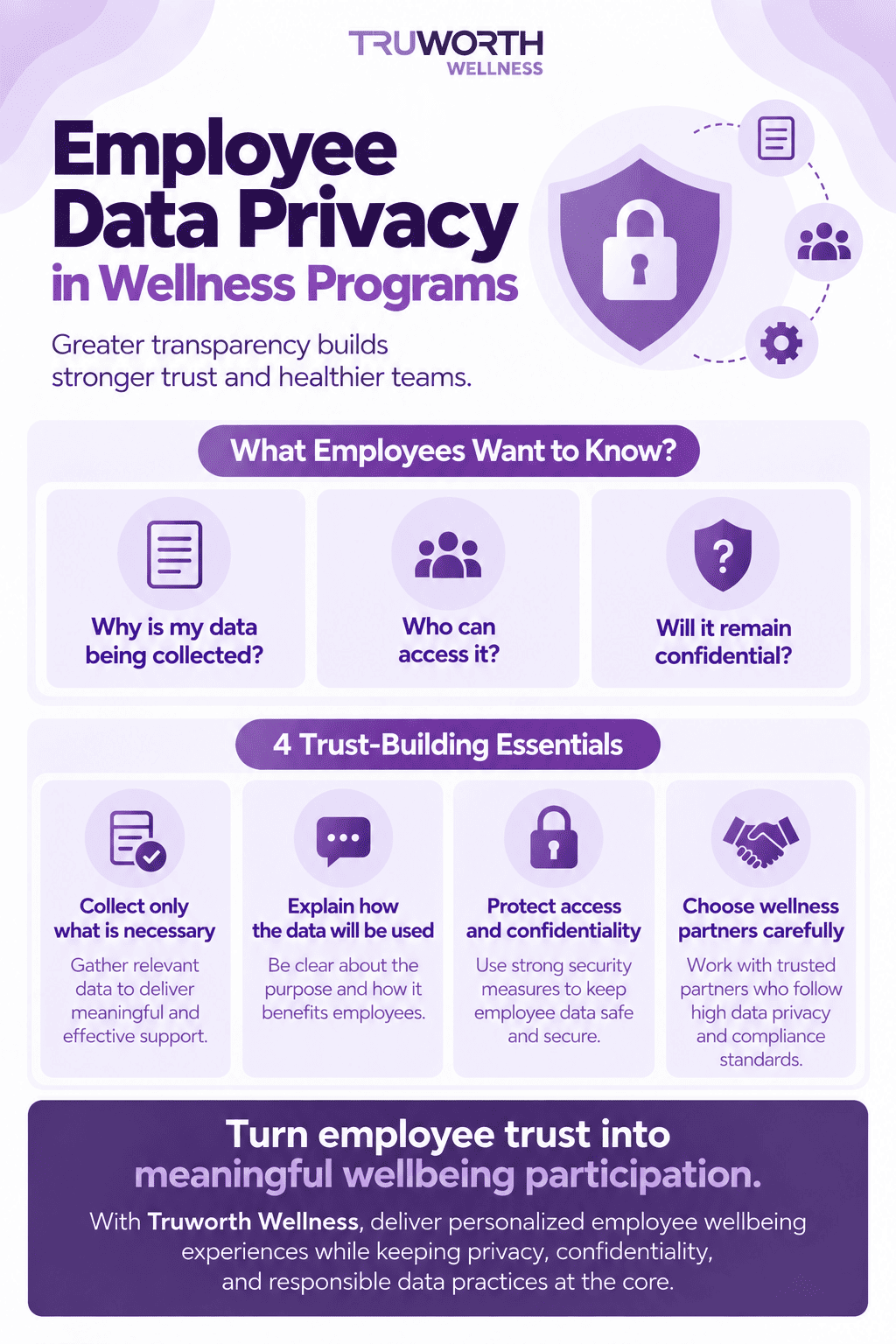
Employee Wellbeing Programs Collect More Sensitive Employee Data
There is an interesting paradox in modern workplace wellbeing.
Employees often want personalized support.
They want health recommendations that feel relevant, resources that reflect their needs, and easier access to healthcare, mental health support, and financial wellbeing guidance. The value of employee wellbeing programs often depends on responsible personalization.
None of this can happen without data.
Consider how many workplace initiatives rely on employee information:
- Health risk assessments
- Preventive health checkups
- Employee Assistance Program services
- Mental wellbeing surveys
- Financial wellbeing programs
- Fitness and lifestyle initiatives
- Healthcare utilization analytics
- Personalized wellbeing journeys
Each initiative may require employees to share information they consider personal, private, or sensitive. That is why data privacy in employee wellness programs must be designed into the experience from the start.
The challenge isn't collecting the data.
The real challenge is maintaining confidence in how sensitive employee data is collected, accessed, retained, and protected.
Because when trust begins to erode, participation in corporate wellness programs often follows.
Workplace Data Privacy Begins With a Simple Employee Question
When organizations discuss HR data privacy, conversations often focus on compliance frameworks, policies, and legal obligations.
Those are important.
Employees, however, tend to think about the issue differently.
Most employees are not reading every employee data privacy policy line by line.
They're asking a simpler question:
"Can I trust my employer with this information?"
That question influences countless workplace decisions.
An employee considering counselling support may wonder: how confidential is an EAP, and will anyone in the organization know I sought help?
Someone completing a wellbeing assessment may wonder who can see the results.
An employee participating in a health program may wonder whether personal information could affect future workplace decisions.
These concerns are rarely expressed openly.
Yet they often influence participation rates more than organizations realize.
Trust doesn't disappear because of a policy violation.
Trust often weakens because employees feel uncertain about how their information is used, shared, or protected. Clear communication is central to how to build trust in workplace wellness programs.
Why Employee Trust Matters in Wellness Programs?
Many leaders think about data protection primarily in terms of security incidents.
A breach is obviously serious.
But trust can be damaged long before any breach occurs.
Imagine an organization launches a wellbeing initiative designed to help employees better understand their health.
The program is clinically sound. The technology is secure. The intentions are good.
Yet participation remains lower than expected.
Employees hesitate to complete assessments. They skip surveys. They avoid sharing information.
Why?
Because they are not entirely convinced about how the data will be handled, even when the technology and intentions are sound.
This is where the true cost of mistrust becomes visible.
Organizations may experience:
- Lower participation in wellbeing initiatives
- Reduced utilization of support services
- Less accurate workforce insights
- Lower engagement with healthcare programs
- Reduced effectiveness of employee support strategies
The challenge is that these outcomes rarely appear on a security dashboard.
Yet they directly influence the success of workplace wellbeing programs. This is why employee trust matters in wellness programs: without it, even a well-designed service can go unused.
Sensitive Employee Data Is No Longer Just an HR Issue
Traditionally, employee information was largely viewed as an HR responsibility.
Today, sensitive employee data sits at the intersection of HR, technology, leadership, healthcare partners, and external service providers.
- HR teams use workforce insights.
- Wellbeing providers deliver and manage employee wellbeing programs.
- Technology teams manage platforms and integrations.
- Leadership teams rely on aggregated workforce analytics.
- Healthcare and EAP partners manage specialized services and EAP confidentiality.
As this ecosystem expands, so does the complexity of corporate wellness data security and responsible information management.
This creates several challenges:
- Multiple Systems: Employee information may reside across HR systems, healthcare tools, and a corporate wellness platform in India or another operating market.
- Multiple Stakeholders: HR, technology teams, service providers, and vendors may interact with different parts of the employee information lifecycle.
- Increasing Personalization: Organizations increasingly seek tailored employee experiences.
- Rising Employee Expectations: Employees are becoming more aware of privacy and data usage practices.
Managing these realities requires more than an employee data privacy policy.
It requires a culture of trust.
Five Employee Data Privacy Challenges Organizations Commonly Face
1. Balancing Personalization And Privacy
Employees appreciate personalized support.
At the same time, they don't want to feel monitored.
Organizations must carefully distinguish between supporting employees and appearing intrusive.
The line between personalization and overreach can sometimes be surprisingly thin.
2. Building Trust Through EAP Confidentiality
Services such as EAPs depend heavily on employee confidence and clearly communicated boundaries.
If employees question EAP confidentiality or remain unsure about how confidential an EAP is, utilization often suffers.
This is why a trusted Employee Assistance Program communicates what remains confidential, what data is reported in aggregate, and where legal or safety exceptions may apply.
 Truworth Wellness
3. Vendor Data Management in Employee Wellness
Many corporate wellness programs rely on external healthcare, technology, and support partners.
Effective vendor data management in employee wellness requires organizations to assess privacy standards, access controls, retention practices, breach processes, and responsible data handling across every partner.
4. Closing HR Data Privacy Communication Gaps
Sometimes organizations are handling employee data responsibly but failing to communicate that clearly.
Employees often assume the worst when information is unclear.
Transparency matters.
5. Keeping Pace With Privacy and Security Expectations
Privacy and security expectations continue to evolve across markets, including requirements that may affect a corporate wellness platform for Indian workplaces.
Organizations should review applicable requirements with qualified legal and security teams while keeping the employee experience clear and positive.
Also Read: How Employers Can Use OPD Data To Spot Health Trends? (Without Breaching Privacy)
How to Protect Employee Data in Wellness Programs?
The answer is not simply to collect less data.
It is to collect, use, share, retain, and secure data more responsibly.
The following principles can strengthen employee health data protection without weakening the relevance of support.
1. Define and Communicate the Purpose
Before participating, employees should understand:
- Why information is being collected?
- How it will be used?
- Who can access it?
- How it will be protected?
Ambiguity creates doubt. Clear purpose and plain-language privacy communication build confidence.
2. Collect Only What Is Necessary
Just because information can be collected doesn't mean it should be.
Organizations should focus on relevance rather than volume and document those choices in their employee data privacy policy.
3. Make Workplace Data Privacy Transparent
Employees should not be surprised by how their information is used, shared, or retained.
Transparency builds trust before questions arise and helps employees make informed choices about participation.
4. Choose and Govern Partners Carefully
Whether working with healthcare providers, EAP vendors, or a corporate wellness platform in India, organizations should evaluate how employee information is handled throughout the ecosystem.
 Truworth Wellness
5. Make Confidentiality and Security Visible
Confidentiality and corporate wellness data security should not be buried in policy documents.
It should be actively communicated and reinforced.
Employees are more likely to engage when access boundaries, EAP confidentiality, and employee health data protection are visible and understood.
Organizations That Get Employee Data Privacy Right Think Differently
The most successful organizations do not treat workplace data privacy as a compliance-only exercise.
They view it as part of the employee experience.
They recognize that every wellbeing initiative ultimately depends on employee trust.
A health assessment only works if employees participate honestly.
An Employee Assistance Program works only when employees feel safe accessing support.
An employee wellbeing program works only when people believe their information will be treated responsibly.
Trust is not separate from wellbeing.
In many ways, it is a prerequisite for it.
Looking Ahead: Trust-Led Corporate Wellness Programs
The amount of employee data organizations manage is unlikely to decrease.
If anything, corporate wellness programs, healthcare initiatives, and personalized employee experiences will continue to expand.
This creates an important leadership challenge.
The organizations that succeed will not necessarily be those collecting the most data.
They will be the ones creating environments where employees understand their choices and feel comfortable sharing relevant information.
Because in a data-driven workplace, trust has become one of the most valuable assets an organization can protect.
And unlike technology, trust cannot be upgraded, replaced, or purchased after it is lost.
A FINAL THOUGHT
The future of workplace wellbeing will depend on data and responsible personalization.
Its success will depend on employee trust, confidentiality, and security.
Truworth Wellness Perspective on Employee Data Privacy
The most effective employee wellbeing programs are built on a simple principle: employees should understand what information is collected, why it matters, who can access it, and how it is protected.
A solution such as the Truworth Wellness employee wellbeing platform can support personalized care and wellbeing solutions for employees while keeping transparency, trust, and responsible data practices central to the experience.
For organizations evaluating a corporate wellness platform for Indian workplaces, these principles should guide both technology selection and program design. The same trust-first approach is essential when employees access support through Truworth Wellness EAP.
Frequently Asked Questions About Employee Data Privacy
What is employee data privacy in workplace wellness programs?
Employee data privacy refers to how organizations and their partners collect, use, access, share, retain, and protect employee information. In employee wellbeing programs, this may include health assessments, counselling usage, lifestyle information, survey responses, and other sensitive employee data.
How can organizations protect employee data in wellness programs?
Organizations should collect only necessary information, clearly explain its purpose, restrict access, use appropriate security controls, define retention periods, and regularly review vendors. These measures should be documented in an employee data privacy policy and communicated in plain language.
How confidential is an Employee Assistance Program?
An Employee Assistance Program is generally designed to protect individual confidentiality, while employers may receive aggregated or anonymized utilization insights. Employees should be told what remains confidential, what limited exceptions may apply, and how the provider maintains EAP confidentiality.
Why does employee trust matter in wellness programs?
Trust affects whether employees participate honestly, use support services, and share relevant information. Even secure corporate wellness programs may underperform when employees are uncertain about workplace data privacy or how their information could be used.
What should organizations assess when choosing a wellness vendor?
Vendor data management in employee wellness should cover access controls, encryption, data hosting, subcontractors, retention and deletion, incident response, regulatory alignment, and employee communication. Organizations should also confirm what data the vendor shares with HR and whether reporting is aggregated.
Can wellness data be used to personalize employee support safely?
Yes. Personalization can support more relevant care when it is based on informed participation, data minimization, appropriate consent or another valid basis, role-based access, and clear boundaries. Employees should understand their choices and how personalized recommendations are generated.