How to Measure Employee Wellness Programme ROI: Metrics HR Should Track

Short Answer (Blog Briefing)
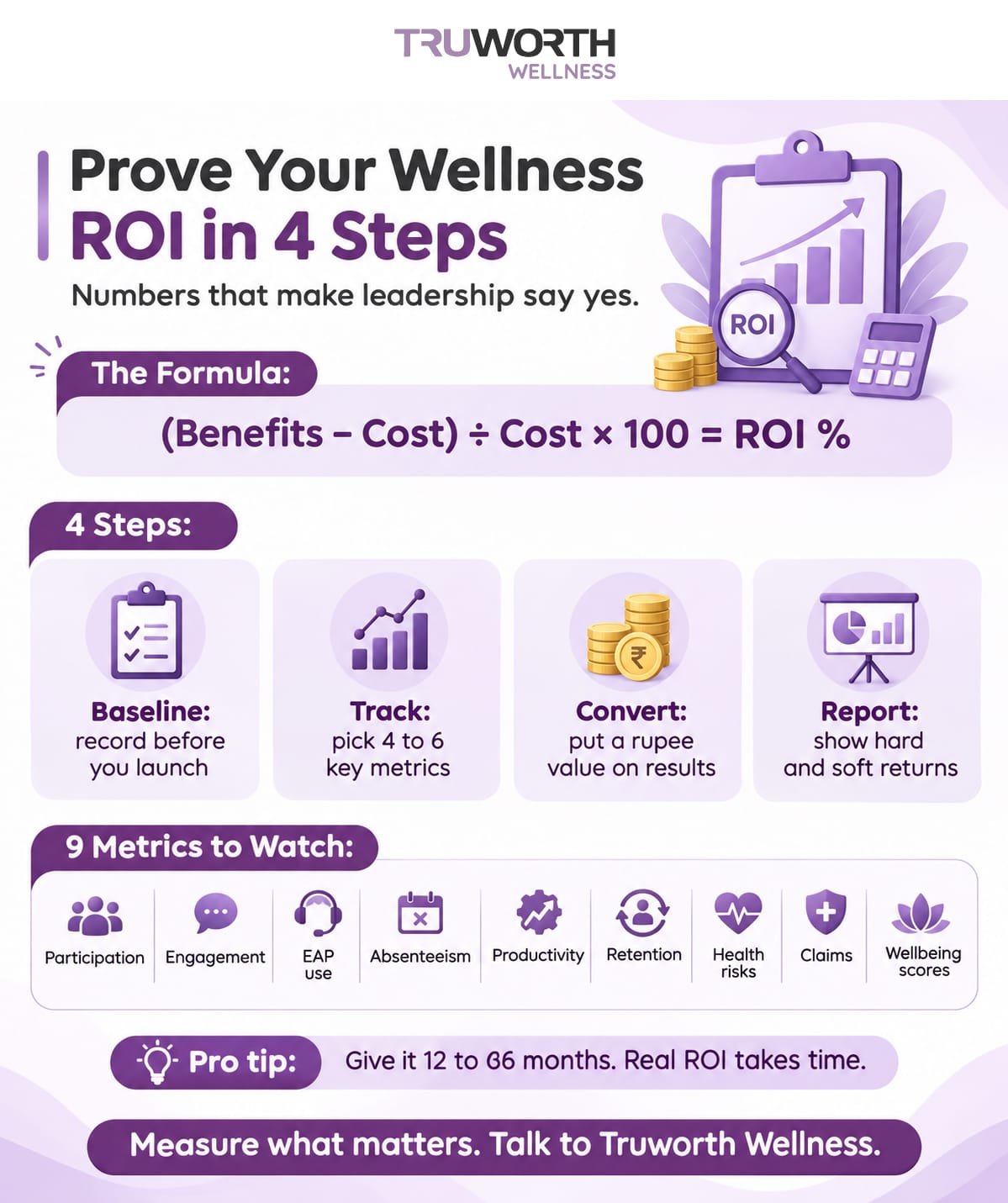
Every HR leader has heard the same question in a budget meeting: "What are we actually getting for the money we spend on wellness?" If your answer is a list of events held and webinars attended, it will not convince a CFO. Employee wellness ROI is the number that turns a nice-to-have benefit into a business case.
The challenge is that wellness outcomes are spread across many areas: sick leave, attrition, insurance claims, engagement and productivity. This guide explains how to measure wellness program ROI step by step, which wellness program KPIs matter most, and how to present the results so leadership takes them seriously.
Also Read: The Hidden Costs Of Presenteeism And How To Address It?
What Is Employee Wellness ROI?
Employee wellness ROI compares the financial value a wellness programme creates with what it costs to run. It is expressed as a percentage or a ratio, for example "₹1.80 returned for every ₹1 spent".
The costs side is usually easy: vendor or platform fees, internal staff time, incentives, communications and any on-site services. The benefits side takes more work, because you have to attribute reduced absenteeism, lower attrition and lower claims to the programme, then put a rupee value on each.
How to Calculate Wellness Program ROI: The Formula
Here is the standard formula for corporate wellness program ROI:
ROI (%) = (Total Benefits − Total Programme Cost) ÷ Total Programme Cost × 100
An illustrative example (hypothetical numbers): A company with 500 employees spends ₹25 lakh a year on its wellness programme. Over 12 months it records:
- 1.5 fewer sick days per employee. At ₹3,000 per day, that is 750 days, or ₹22.5 lakh saved.
- 6 fewer voluntary exits. At ₹4 lakh per replacement (hiring, onboarding, lost productivity), that is ₹24 lakh saved.
- ₹6 lakh lower group health insurance claims.
Total benefits are ₹52.5 lakh. ROI = (52.5 − 25) ÷ 25 × 100 = 110%.
Use your own salary, replacement cost and claims data. If you can, ask Finance to confirm the rupee values so the figures stand up in a review.
What Does the Research Say About Employee Wellness ROI?
The evidence is mixed, and being upfront about it makes your report more credible.
- Positive findings: A widely cited Harvard meta-analysis in Health Affairs found that medical costs fell by about $3.27 and absenteeism costs by about $2.73 for every dollar spent on wellness programmes. It mostly reviewed studies of large employers in the US.
- Cautionary findings: The Illinois Workplace Wellness Study, a randomised controlled trial, found strong participation but no significant effects on medical spending, productivity or most health outcomes after more than two years. It also found that participants were often already healthier than non-participants.
- The business context: The WHO estimates that 12 billion working days are lost each year to depression and anxiety, costing the global economy close to US$1 trillion.
The lesson for HR: results depend on programme design, who participates and how you measure. Set baselines, compare against a control group where possible, and avoid claiming more than your data shows.
Also Read: The Hidden Productivity Cost Of Avoiding Preventive Healthcare
9 Employee Wellness Metrics HR Should Track
Here is what HR should track for a wellness program, grouped by what each metric tells you.
1. Wellness Program Participation Rate
Formula: Unique participants ÷ eligible employees × 100
This is the first check on reach. Low participation makes every other metric weaker. Break it down by location, department, age group and gender to find who is being missed.
2. Active Engagement Rate
Formula: Employees using the programme at least once a month ÷ enrolled employees × 100
Being registered for an event does not guarantee active engagement. Track repeat use of consultations, challenges, sessions and the app, so you can tell sustained engagement from a one-time click.
3. EAP Utilisation Rate
Formula: Employees (and dependents, if covered) who used EAP services ÷ total eligible × 100
This shows whether counselling and support services are being used. Benchmarks vary widely by industry and country, so compare against your own previous quarters. Very low usage often points to stigma or poor awareness, not lack of need.
4. Absenteeism Rate
Formula: Total days absent ÷ (employees × working days) × 100
The wellness program impact on absenteeism is one of the easiest benefits to convert into rupees: days saved × average daily cost. Compare year on year, and compare participants with non-participants.
5. Presenteeism and Productivity
Presenteeism occurs when employees show up for work but struggle to function at their usual level. Measure it with validated self-report tools (such as WHO-HPQ or WPAI), manager input, or role-specific output data. It is harder to measure than absence but often larger in cost.
6. Retention and Attrition
Formula: Employees who left ÷ average headcount × 100
To measure the impact of wellness programs on retention, compare voluntary attrition between participants and non-participants, and look at exit-interview reasons. Be careful about selection bias: engaged employees may join wellness programmes anyway.
Also Read - Wellness Programs: Lessons Companies Have Learned The Hard Way
7. Health Risk Trends
Track aggregated, anonymised data from health checks and risk assessments: share of employees with high blood pressure, elevated blood sugar, high stress or poor sleep. Look at movement over 12 to 24 months, not one snapshot. Never report data that identifies individuals.
8. Healthcare and Insurance Claims
Work with your insurer or TPA to review claim frequency, claim size and the main claim categories over time. Claims often take 2 to 3 years to show a clear trend, so avoid judging the programme on year one alone.
9. Employee Wellbeing and Satisfaction Scores
Use pulse surveys, eNPS, stress and burnout scores, and programme satisfaction ratings. These capture what money cannot, and they usually move before costs do.
Quick Reference: Employee Wellness Metrics for HR
|
Metric |
What it shows |
How often to track |
|
Participation rate |
Reach |
Monthly |
|
Active engagement |
Depth of use |
Monthly |
|
EAP utilisation |
Support uptake |
Quarterly |
|
Absenteeism |
Direct cost savings |
Monthly or quarterly |
|
Presenteeism and productivity |
Performance impact |
Half-yearly |
|
Retention |
Talent cost savings |
Quarterly |
|
Health risk trends |
Population health |
Annually |
|
Healthcare claims |
Insurance cost impact |
Annually |
|
Wellbeing scores |
Employee experience |
Quarterly |
How to Prove the Value of a Wellness Program to Leadership
- Set a baseline before launch. Without "before" numbers there is no ROI story. Record absenteeism, attrition, claims and survey scores for the previous 12 months.
- Pick 4 to 6 metrics tied to business goals. If leadership cares about attrition, lead with retention. If cost is the concern, lead with claims and absence.
- Convert outcomes to rupees. Agree the cost of one absent day and one replacement hire with Finance.
- Use a comparison group. Compare participants with similar non-participants, or one location against another, to avoid giving the programme credit for general trends.
- Report both hard and soft returns. Show the ROI percentage next to engagement and wellbeing scores, and be honest about what is estimated.
- Give it time. Most programmes need 12 to 36 months to show their full financial effect.
Common Mistakes When Measuring Employee Wellness ROI
- Counting activity, not outcomes: number of webinars is not a result.
- Skipping the baseline: you cannot prove change without a starting point.
- Ignoring selection bias: healthy, motivated employees join first, which can flatter results.
- Measuring too soon: claims and health outcomes move slowly.
- Overlooking privacy: only use anonymised, aggregated data and follow the Digital Personal Data Protection Act, 2023 requirements for health data.
- Using one metric alone: employee wellness ROI is a combination of several indicators.
Final Thoughts
Measuring employee wellness ROI is not about forcing a perfect number. It is about collecting honest, consistent data, linking it to business goals and being transparent about what the data can and cannot prove. Start with a baseline, track a focused set of metrics and report them regularly, and your wellness programme becomes a business investment instead of a cost line.
Turn wellness data into a business case.
Truworth Wellness helps HR teams run an integrated, outcomes-based programme, from OPD benefits and EAP to engagement and reporting, so you can show leadership real results in retention, healthcare costs and health outcomes.
Sources and Further Reading
- Baicker, Cutler and Song (2010), Workplace Wellness Programs Can Generate Savings, Health Affairs (PubMed)
- Jones, Molitor and Reif (2019), What Do Workplace Wellness Programs Do? Illinois Workplace Wellness Study (PMC)
- WHO and ILO: new measures to tackle mental health issues at work (2022)
Disclaimer: The ROI example uses hypothetical figures for illustration. Results will vary by organisation. This article is for general information and is not financial or legal advice.
Frequently Asked Questions About Employee Wellness ROI
What metrics should HR track for a wellness program?
Start with participation rate, active engagement, absenteeism, retention, EAP utilisation and employee wellbeing scores. Add presenteeism, health risk trends and healthcare claims as your programme matures and your data improves.
What is the wellness program ROI formula?
ROI (%) = (total benefits − total programme cost) ÷ total programme cost × 100. Benefits include rupee savings from reduced absenteeism, lower attrition, lower claims and productivity gains.
How do I calculate ROI on employee wellness initiatives?
First total all programme costs. Then measure each outcome against your baseline, convert it into rupees, add them up and apply the formula. The worked example above shows each step.
Is an employee wellness program worth it?
Research is mixed. Some studies report savings above cost, while a large randomised trial found little effect on spending in two years. Results depend on programme design, participation and goals, so measure your own outcomes rather than relying on averages.
How do I measure employee wellbeing programme ROI in India?
Use the same formula but value benefits in rupees using your own salary, replacement-hire and insurance claim data. Include mental health support and stress metrics, because they are significant in Indian workplaces. Keep all data anonymised and compliant with data protection law.
How do I track EAP utilisation rate?
Divide the number of employees (and covered dependents) who used EAP services by the total eligible population, then multiply by 100. Ask your EAP provider for anonymised monthly or quarterly reports.
How do I measure the impact of wellness programs on retention?
Compare voluntary attrition rates of participants and non-participants over 12 months or more, and review exit interview reasons. Use similar groups for comparison, since highly engaged employees may be more likely to stay anyway.
What is a good wellness program participation rate?
There is no single standard, because it depends on programme type, incentives and workforce. Set a target from your own first-quarter baseline, then aim to improve it steadily with better communication and manager support.
How long does it take to see employee wellness ROI?
Engagement and wellbeing scores can move within months. Absenteeism and retention usually take 6 to 12 months, and claims and health outcomes often take 2 to 3 years.