What Rising Gen Z Attrition Is Teaching Employers About Wellbeing, Workplace Experience, And Workforce Investments?

A Gen Z employee joins your organization.
The onboarding experience is smooth. They seem engaged during meetings. Their manager is optimistic. The team starts investing time in training and development. Then, often sooner than expected, the resignation email arrives.
For many employers, the conversation that follows sounds familiar.
"Young employees don't stay."
"They're always looking for the next opportunity."
"They expect too much too quickly."
Perhaps.
But if the same pattern is emerging across industries, companies, and geographies, it may be worth asking a different question.
What if Gen Z attrition is not actually a retention problem? What if it's a feedback mechanism?
That possibility changes the conversation entirely.
Because when employees consistently leave within the first one to three years, the issue may not simply be about loyalty. It may be about how quickly employees are evaluating whether an organization is delivering the experience it promises.
The reality is that Gen Z has not necessarily changed what employees want from work. Growth, support, recognition, flexibility, and wellbeing have always mattered.
What has changed is the willingness to wait.
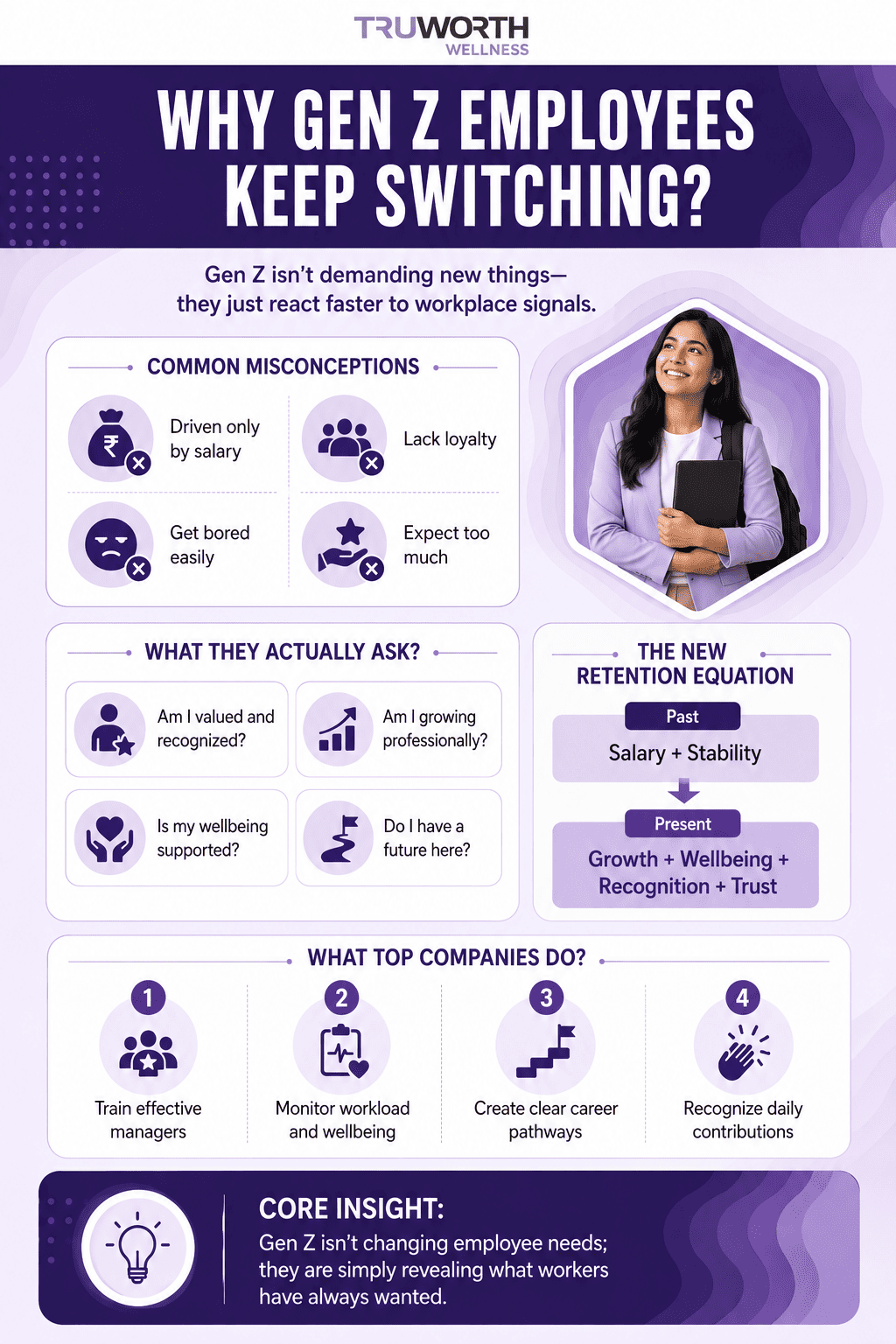
Gen Z Isn't Leaving Because They're Different. They're Leaving Because They're Deciding Faster.
Many workplace challenges being discussed today are not new.
Employees have struggled with unclear career paths for decades. Difficult managers have always existed. Burnout is not a recent phenomenon. Neither is workplace stress.
Previous generations often accepted these realities as part of professional life. Frustrations were tolerated because growth was expected to take time. Employees frequently stayed long enough to see whether situations improved.
Gen Z appears to approach the workplace differently.
Rather than waiting years to determine whether an organization aligns with their expectations, many younger professionals begin evaluating that fit almost immediately.
They are constantly asking themselves questions such as:
- Am I learning and growing?
- Does my manager invest in my development?
- Do I feel valued here?
- Is my wellbeing genuinely supported?
- Can I see a future in this organization?
- Does the culture match what was promised?
These questions are not unique to Gen Z.
The difference is that they are being asked earlier and acted upon sooner.
Viewed through that lens, rising attrition starts looking less like a generational challenge and more like an organizational signal.
The Missing Piece In Many Retention Conversations
One aspect of retention often receives less attention than it deserves.
Employees want to feel valued.
Not through slogans. Not through annual appreciation events. Not through posters about workplace culture.
They want to feel valued in ways that influence their everyday experience.
They want managers who acknowledge effort, not just outcomes. They want feedback that helps them improve rather than feedback that only arrives when something goes wrong. They want their opinions to be heard, their contributions recognized, and their growth taken seriously.
At first glance, this may sound like a culture issue.
In reality, it has significant implications for employee wellbeing.
Feeling undervalued creates stress. Feeling ignored reduces engagement. Feeling invisible weakens a sense of belonging. Over time, these experiences influence motivation, mental wellbeing, and ultimately retention.
Many organizations focus heavily on what they provide employees. Fewer spend enough time understanding how employees feel while receiving it.
That distinction matters.
An employee may have access to excellent benefits and still feel disconnected from the organization.
Conversely, employees often remain committed to organizations that make them feel supported, respected, and invested in.
This is where retention and wellbeing begin to overlap.
The Workplace Contract Has Quietly Changed
For years, many organizations operated with a relatively straightforward retention formula.
Offer competitive salaries. Provide career progression. Build a positive workplace culture.
Employees will stay.
While those factors remain important, the expectations surrounding work have expanded considerably.
Today's employees increasingly view work as part of their broader life experience rather than a separate compartment. They expect organizations to care about more than productivity. They want support systems that help them navigate challenges both inside and outside work.
This shift has elevated the importance of factors such as:
- Wellbeing support
- Flexibility
- Psychological safety
- Manager quality
- Career development
- Meaningful recognition
- Learning opportunities
These are no longer secondary considerations.
For many employees, they are fundamental parts of the employment experience.
Organizations that continue viewing them as optional extras may find themselves struggling to understand why retention challenges persist despite competitive compensation packages.
What Gen Z Is Really Exposing?
One of the most interesting aspects of Gen Z attrition is that it often highlights workplace gaps that already existed.
Take wellbeing as an example.
Many organizations have invested significantly in employee wellness over the past few years. There are Employee Assistance Programs, mental health resources, health checkups, wellness challenges, learning platforms, and employee engagement initiatives.
Yet utilization often remains lower than expected.
This raises an important question.
Is the issue a lack of resources, or a lack of connection between those resources and the employee experience?
Employees rarely evaluate support based on what exists inside a benefits brochure.
They evaluate support based on what they can access, understand, and trust.
For example:
- An EAP has little value if employees don't understand how it works
- A wellbeing platform creates limited impact if engagement remains low
- A health checkup initiative is unlikely to improve outcomes if participation is poor
- Learning opportunities matter less when career pathways remain unclear
The challenge is not simply offering support.
The challenge is ensuring employees experience that support in meaningful ways.
Gen Z often identifies these gaps quickly because they tend to evaluate the entire employee experience rather than individual benefits in isolation.
Why Procurement Team Should Be Paying Attention?
Traditionally, conversations around attrition sat firmly within HR.
Today, they increasingly involve procurement, finance, and leadership teams as well.
The reason is simple.
Every resignation carries a cost.
There are visible costs such as recruitment, onboarding, and training. There are also less visible costs including productivity loss, team disruption, institutional knowledge loss, and manager bandwidth.
As turnover rises, organizations naturally begin examining where they are investing resources and whether those investments are producing meaningful outcomes.
This is where procurement conversations are evolving.
Historically, wellbeing solutions were often evaluated based on factors such as:
- Cost per employee
- Platform features
- Service availability
- Vendor capabilities
Those factors remain important, but they no longer tell the whole story.
Organizations are increasingly asking:
- Are employees actually using these services?
- Which programs have the highest engagement?
- Are we improving employee experience?
- Do employees perceive value in these investments?
- Are these initiatives contributing to retention and engagement?
In other words, the conversation is shifting from procurement of services to procurement of outcomes.
That shift may prove to be one of the most important workforce trends of the coming decade.
The Difference Between Benefits And Experiences
One reason organizations struggle with retention despite substantial investment is that employees rarely evaluate benefits in isolation.
They evaluate experiences.
- A health benefit is experienced through accessibility
- An EAP is experienced through trust
- A manager is experienced through daily interactions
- A culture is experienced through behavior rather than values written on a wall
This distinction is critical because it highlights why some organizations achieve stronger retention despite offering fewer benefits.
Employees often care less about the number of initiatives available and more about whether those initiatives improve their daily experience.
They ask themselves practical questions:
- Can I access support easily?
- Does my manager encourage healthy behaviors?
- Do I feel comfortable asking for help?
- Am I recognized for my contributions?
- Does the organization genuinely invest in my growth?
The answers shape how employees perceive the workplace.
And perception often drives behavior.
A Better Question For Employers
Perhaps the most valuable question organizations can ask is not, "Why is Gen Z leaving?"
A better question may be:
"What are they seeing that we're missing?"
That shift in perspective changes everything.
Instead of focusing exclusively on retention tactics, organizations begin examining the employee experience more closely. They start evaluating manager effectiveness, wellbeing support, communication practices, growth opportunities, and workplace culture through the eyes of employees.
In many cases, the answers are already there.
They appear in engagement surveys, utilization reports, manager feedback, and exit interviews. The challenge is connecting those signals into a broader story.
A Different Way To Think About Retention
Perhaps the biggest lesson from Gen Z attrition is that retention cannot be solved through compensation alone.
People stay where they feel supported.
They stay where they see growth. They stay where managers invest in them. They stay where wellbeing feels real rather than performative.
Most importantly, they stay where the overall employee experience consistently aligns with the promises made during recruitment.
That principle applies to Gen Z. It also applies to everyone else.
The organizations that treat rising attrition as a source of insight rather than frustration may uncover something valuable. Beneath every resignation is information about the employee experience.
The companies willing to listen carefully may discover that improving retention is not about convincing employees to stay longer.
It is about creating workplaces that give them a reason to.
Every resignation is telling you something. Gen z just says it faster.
Truworth Wellness Perspective
The future of retention may depend less on adding new benefits and more on helping employees feel supported, valued, and able to grow throughout their journey with the organization.