Inter-Age Conflicts At Work: Gen Z VS Millennials VS Gen X VS Boomers

Why Generational Tension Exists and How Workplaces Can Turn It Into Strength?
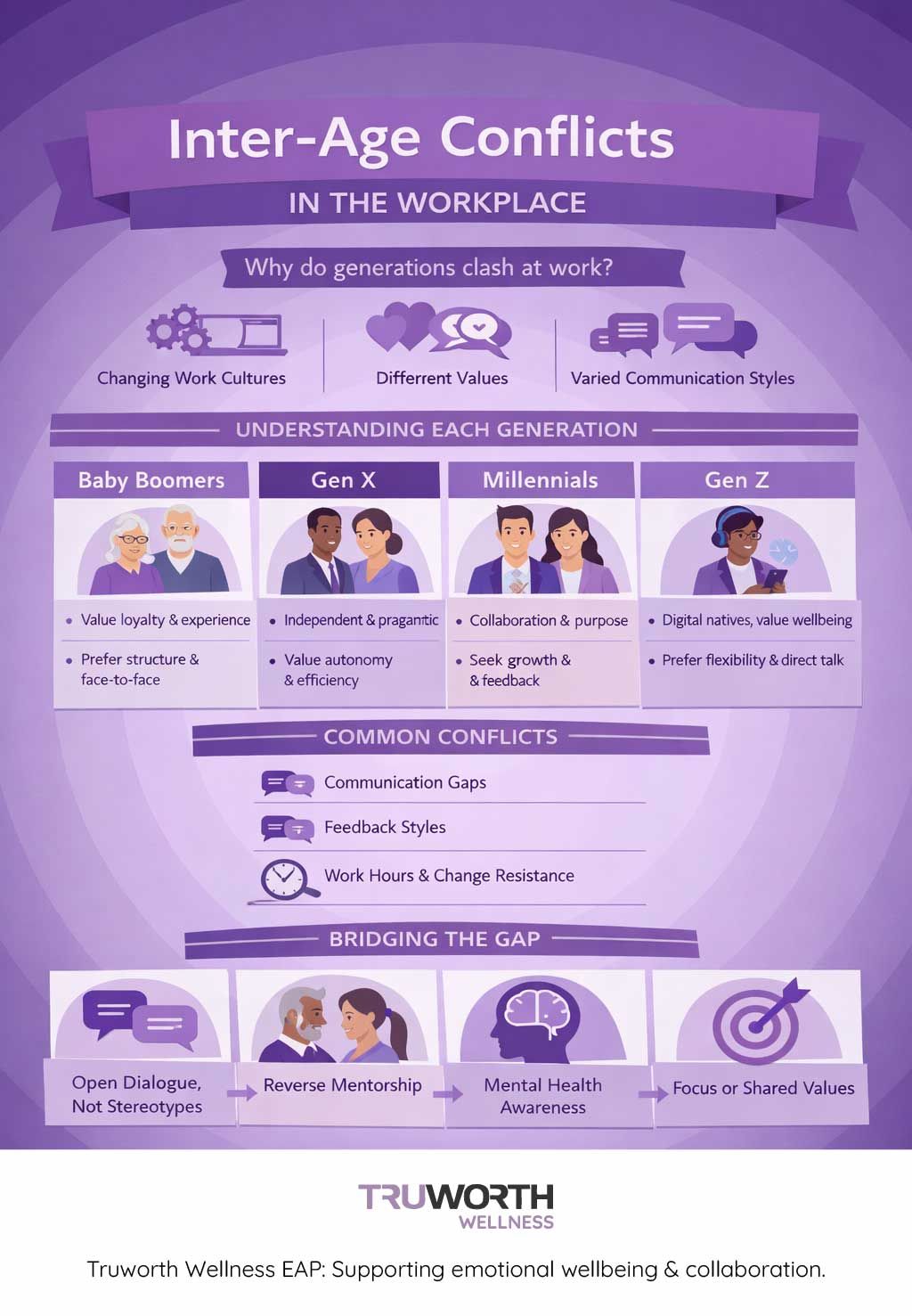
Walk into almost any modern workplace, and you will find four generations working side by side. Baby Boomers bring decades of experience. Gen X values independence and pragmatism. Millennials thrive on collaboration and purpose. Gen Z is rewriting rules around work, identity, and boundaries.
This diversity should be a strength. Yet for many organizations, it quietly becomes a source of tension.
Comments like “They don’t want to work hard anymore,” or “Why are they so resistant to change?” or “Why do meetings need to be emails?” are not just casual remarks. They are symptoms of inter-age conflict at work.
Understanding why these conflicts arise is the first step toward building healthier, more productive workplaces.
Also Read: Office Politics: Resolving Conflicts/Issues At Work
Why Inter-Age Conflicts Are Increasing?
Generational conflict is not new, but it feels sharper today for three key reasons.
- First, workplaces are changing faster than ever. Technology, remote work, AI, and constant upskilling mean that experience alone is no longer enough, and fresh perspectives are no longer optional.
- Second, values around work have shifted. Younger generations question long hours, rigid hierarchies, and delayed gratification. Older generations may see this as entitlement, while younger employees see it as self-respect.
- Third, communication styles differ widely. What feels efficient to one generation can feel dismissive or overwhelming to another.
These differences often go unspoken, turning into silent frustration, misinterpretation, and disengagement.
Also Read: Bridging The Generational Gap: How Different Age Groups Can Learn From Each Other At Work?
Understanding Each Generation Beyond Stereotypes
Before labeling behaviors as “difficult,” it helps to understand what shaped each generation.
Baby Boomers
Boomers grew up in a world where job security was linked to loyalty. Many built their identity around work and believe in earning respect through years of service.
At work, they value structure, face-to-face conversations, and clear authority. When they see younger employees questioning systems or prioritizing work-life balance, it may feel like a lack of commitment.
What they often want is respect for experience and recognition of long-term contribution.
Generation X
Gen X is often called the forgotten generation, but they are the quiet backbone of many organizations. They grew up during economic uncertainty and became self-reliant problem solvers.
They value autonomy, efficiency, and minimal micromanagement. They dislike unnecessary meetings and corporate jargon.
When Gen X employees feel stuck between managing up and managing younger teams, frustration can build. They want trust, flexibility, and results over appearances.
Millennials
Millennials entered the workforce during rapid globalization and digital expansion, often alongside economic instability. They were encouraged to chase meaning, growth, and feedback.
At work, they value collaboration, transparency, and purpose. They ask why things are done a certain way, not to challenge authority, but to understand impact.
Older colleagues may perceive them as impatient or overly idealistic. Millennials often feel misunderstood and labeled as demanding when they are simply seeking clarity and growth.
Also Read: Developing An Ideal Workplace For Millennials
Generation Z
Gen Z is the first generation to grow up fully online. They have witnessed burnout, layoffs, and global crises early in life.
They value mental health, inclusion, flexibility, and authenticity. They prefer direct communication, fast feedback, and clear boundaries between work and personal life.
To older generations, Gen Z may appear disengaged or overly sensitive. To Gen Z, outdated systems and unclear expectations feel unnecessary and draining.
They want psychological safety, fairness, and a workplace that aligns with their values.
Where Conflicts Commonly Show Up?
Inter-age conflicts rarely explode openly. They show up subtly in everyday work.
- In communication, where one generation prefers calls, another prefers texts, and another wants everything documented.
- In feedback, younger employees expect regular check-ins, while older managers believe feedback should be earned or occasional.
- In attitudes toward work hours, where presence is valued by some, and output is valued by others.
- In openness to change, where innovation feels exciting to some and disruptive to others.
When these differences are not acknowledged, they turn into assumptions. Assumptions then turn into resentment.
The Hidden Cost of Generational Conflict
Unchecked inter-age conflict does not just affect culture. It affects performance.
Teams lose trust. Collaboration suffers. Younger employees disengage or leave. Older employees feel sidelined or undervalued.
Leaders may mistake these issues for attitude problems or skill gaps, when the real issue is misalignment and a lack of understanding.
Over time, this creates an emotionally unsafe workplace where people stop speaking up, stop learning from each other, and stop doing their best work.
How Organizations Can Bridge the Gap?
The goal is not to eliminate differences. It is to create respect across differences.
1) Shift from Generational Labels to Human Conversations
Instead of talking about “Gen Z problems” or “Boomer mindset,” encourage conversations around preferences and needs.
Ask questions like:
- How do you prefer feedback?
- What helps you feel productive?
- What support do you need to do your best work?
These questions build understanding without blame.
2) Train Managers for Multi-Generational Leadership
Managing a multi-generational team requires flexibility.
Leaders should learn how to adapt communication styles, feedback frequency, and motivation strategies without favoritism.
This is not about lowering standards. It is about meeting people where they are.
3) Create Reverse Mentorship Opportunities
Younger employees can mentor seniors on technology, new trends, and cultural shifts. Senior employees can mentor younger ones on decision-making, leadership, and industry wisdom.
When learning flows both ways, respect follows naturally.
4) Normalize Conversations Around Mental and Emotional Well-being
Younger generations openly talk about burnout and mental health. Older generations may not be used to this language.
Organizations can bridge this gap by framing well-being as performance sustainability, not weakness.
When well-being becomes a shared goal, generational resistance reduces.
5) Focus on Shared Values, Not Age Differences
Across generations, people want to feel respected, useful, heard, and secure.
Highlight shared goals like meaningful work, growth, stability, and contribution.
Differences then become complementary, not divisive.
Also Read: The Power Of Reflection: How Christmas Can Inspire Professional Growth?
Turning Generational Diversity Into a Competitive Advantage
When organizations get this right, something powerful happens.
Experience meets innovation. Stability meets adaptability. Wisdom meets curiosity.
Teams become more resilient, creative, and emotionally intelligent.
Inter-age harmony is not about choosing one generation’s way of working over another. It is about designing workplaces that are flexible enough to hold multiple ways of being human at work.
In a world where talent retention, wellbeing, and adaptability matter more than ever, this is not a “nice to have.” It is a leadership imperative.
How Truworth Wellness EAP Can Help?
Inter-age conflicts are rarely about age alone. They stem from unspoken stress, emotional fatigue, and lack of psychological safety at work. Truworth Wellness EAP supports organizations by offering confidential counseling, manager sensitization sessions, and emotional well-being programs that help employees communicate better, manage conflict, and feel understood across generations.
Because when people feel emotionally supported, collaboration follows naturally.