The Most Important Wellness Metric Is Invisible. What Is It?

Most organizations today can prove they care about wellness.
There are dashboards. Participation reports. Health scores. App engagement data. Step counts. Sleep hours. Risk stratification.
On paper, it looks comprehensive.
But step into the everyday reality of employees, and a different picture starts to emerge.
- People are still exhausted.
- Still hesitant.
- Still filtering what they say.
Which raises a more uncomfortable question.
If everything is being measured so well, why does wellness still feel incomplete?
Something Feels Off, But No One Can Pinpoint Why
Employees are not openly rejecting wellness initiatives.
- They are attending sessions.
- They are logging into platforms.
- They are completing assessments.
And yet:
- They hesitate before admitting they are struggling
- They delay taking time off until it becomes unavoidable
- They downplay stress in conversations
- They choose silence over honesty in critical moments
This gap is subtle.
- It does not show up as failure.
- It shows up as partial engagement.
And partial engagement is much harder to question, because it looks like things are working.
The Metric That Decides Everything, Without Being Measured
There is one factor that quietly determines whether wellness initiatives translate into real outcomes.
- It does not appear in reports.
- It is not captured in analytics.
- It is rarely discussed directly.
But it influences every single behavior.
Psychological safety.
Not as a policy. Not as a leadership statement. But as a lived, everyday experience.
It exists in micro-moments:
- The pause before saying “I’m overwhelmed”
- The hesitation before applying for leave
- The internal calculation of “How will this be perceived?”
That invisible calculation is the metric.
And it is constantly running in the background.
 Truworth Wellness
What Happens When This Metric Is Low?
When psychological safety is weak, employees don’t disengage dramatically.
They adapt quietly.
They:
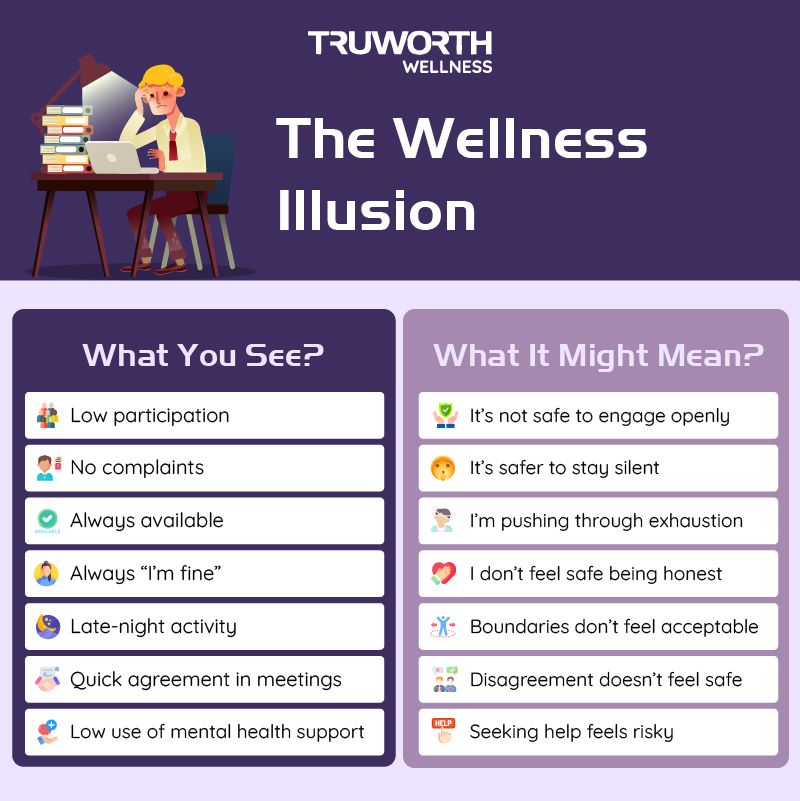
- Continue working through fatigue to avoid appearing incapable
- Stay available longer than necessary to signal commitment
- Avoid using wellness benefits unless absolutely required
- Filter their communication to stay on the safer side
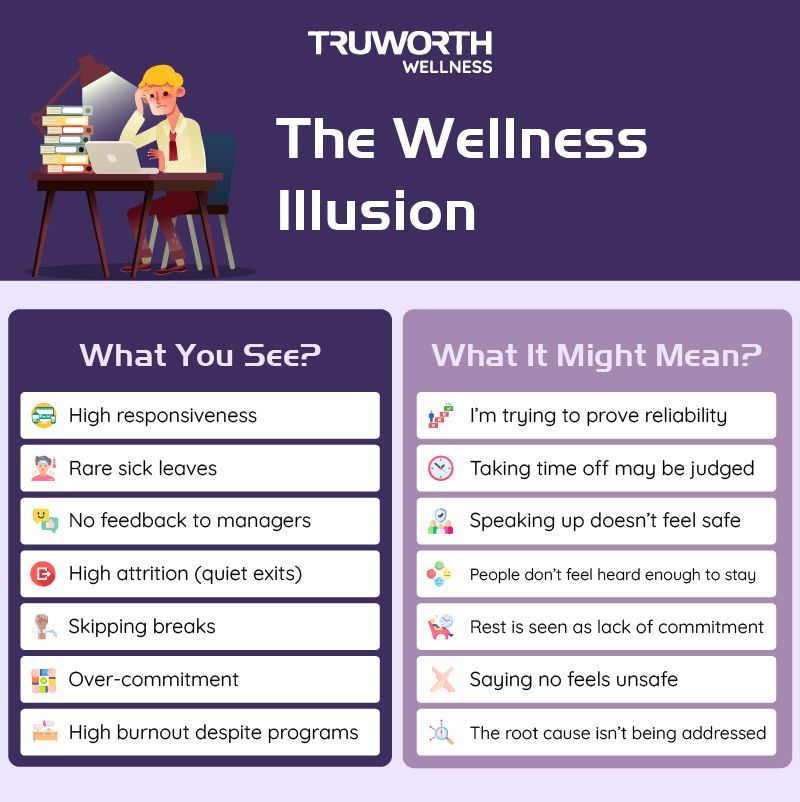
From a managerial lens, this can look like reliability.
From a human lens, it is sustained pressure.
Over time, this creates a dangerous illusion.
Because performance may remain stable, while wellbeing steadily declines underneath.
Why Traditional Wellness Metrics Miss This Completely?
Most wellness metrics are designed to track visible behavior.
They answer:
- How many people participated?
- How frequently they engaged?
- What measurable outcomes changed?
But they do not capture:
- Whether participation was voluntary or pressured?
- Whether engagement was authentic or performative?
- Whether outcomes are sustainable or temporary?
For example:
- A high participation rate can be driven by expectation, not interest
- Low usage of mental health support can be driven by fear, not lack of need
- Stable health scores can coexist with rising emotional fatigue
Without context, numbers create confidence.
With context, they often raise better questions.
What Changes When Psychological Safety Is Strong?
In environments where psychological safety exists, the shift is not loud.
It is noticeable in behavior.
Employees:
- Speak before issues escalate
- Use support systems early, not as a last resort
- Set boundaries without over-explaining
- Admit mistakes without fearing long-term judgment
Wellness stops being an initiative they need to “fit into.”
It becomes something that fits into their daily work experience.
And that is when outcomes start becoming sustainable.
The Gap Between Access and Trust
Many organizations have already invested in wellness.
- The resources are there.
- The platforms are available.
- The communication is consistent.
But access alone does not drive impact.
There is a gap that often goes unnoticed.
The gap between access and trust.
Employees ask themselves:
- Will using this affect how I am perceived?
- Is my data truly confidential?
- Will asking for help change how I am evaluated?
If the answer is uncertain, they hold back.
Not because they do not need support.
Because they are not sure it is safe to need it.
 Truworth Wellness
Reading the Signals That Actually Matter
You won’t find psychological safety on a dashboard, but you can observe it.
It shows up in patterns like:
- How often employees say “I’m fine” in situations that suggest otherwise?
- Whether managers allow space or move quickly to solutions
- If people take leave confidently or with excessive justification
- How comfortable teams are with disagreement?
These signals are easy to dismiss because they are qualitative.
But they are often more accurate than quantitative metrics.
Why Adding More Programs Does Not Solve This?
When outcomes plateau, the natural response is to add more.
- More workshops.
- More tools.
- More nudges.
But if the underlying environment does not change, more offerings simply increase noise.
Employees do not need more options.
They need fewer barriers.
And psychological safety is often the biggest barrier of all, precisely because it is not addressed directly.
Where the Real Shift Begins?
Improving psychological safety does not require large-scale transformations.
It starts in everyday interactions.
- A manager choosing to listen before responding
- A leader acknowledging their own limits
- A team normalizing breaks instead of glorifying overwork
- Conversations that allow honesty without immediate evaluation
These are small signals.
But repeated over time, they reshape how safe people feel.
And that, in turn, reshapes how they engage with wellness.
How Truworth Wellness Supports What Cannot Be Seen?
Wellness outcomes do not improve just by expanding offerings.
They improve when the hidden friction points are understood.
Truworth Wellness approaches this by looking beyond participation and into patterns, behavioral gaps, emotional health indicators, and usage inconsistencies that signal deeper issues.
This allows organizations to not just ask what is happening, but understand why it is happening.
Because when the “why” becomes clear, solutions become more precise, and far more effective.
The One Question That Changes the Conversation
Instead of asking:
“Are employees using our wellness programs?”
Ask:
“Do employees feel safe enough to use them honestly?”
This question does not produce a clean number.
But it produces clarity.
And that clarity reflects in:
- How openly people communicate?
- How early they seek support?
- How sustainably they perform?
- How long they choose to stay?
The most important wellness metric is invisible.
Not because it is unimportant.
But because it lives in human experience, not systems.
And once you begin to notice it,
you start understanding why everything else works, or doesn’t.