You May Be A Good Manager. But You Might Be Expecting Too Much Without Knowing It

Most managers don’t wake up intending to be unreasonable.
They care about their teams. They want results. They believe they are being fair, even supportive.
And yet, somewhere between intent and impact, something shifts.
Deadlines feel tighter than they should. “Quick tasks” pile up into invisible workloads. People stop speaking up. Energy drops, but output expectations don’t.
The problem is not always bad management.
Sometimes, it is invisible over-expectation.
The Modern Manager’s Blind Spot
Today’s workplace rewards efficiency, responsiveness, and ownership. Over time, these expectations quietly become the baseline.
You start appreciating employees who “just get things done.”
You begin trusting those who don’t push back.
You rely more on your strongest performers.
And slowly, without realising it, you begin expecting everyone to function at their peak, all the time.
That is where the gap begins.
Because what feels like “normal” from a manager’s lens can feel like constant pressure from an employee’s reality.
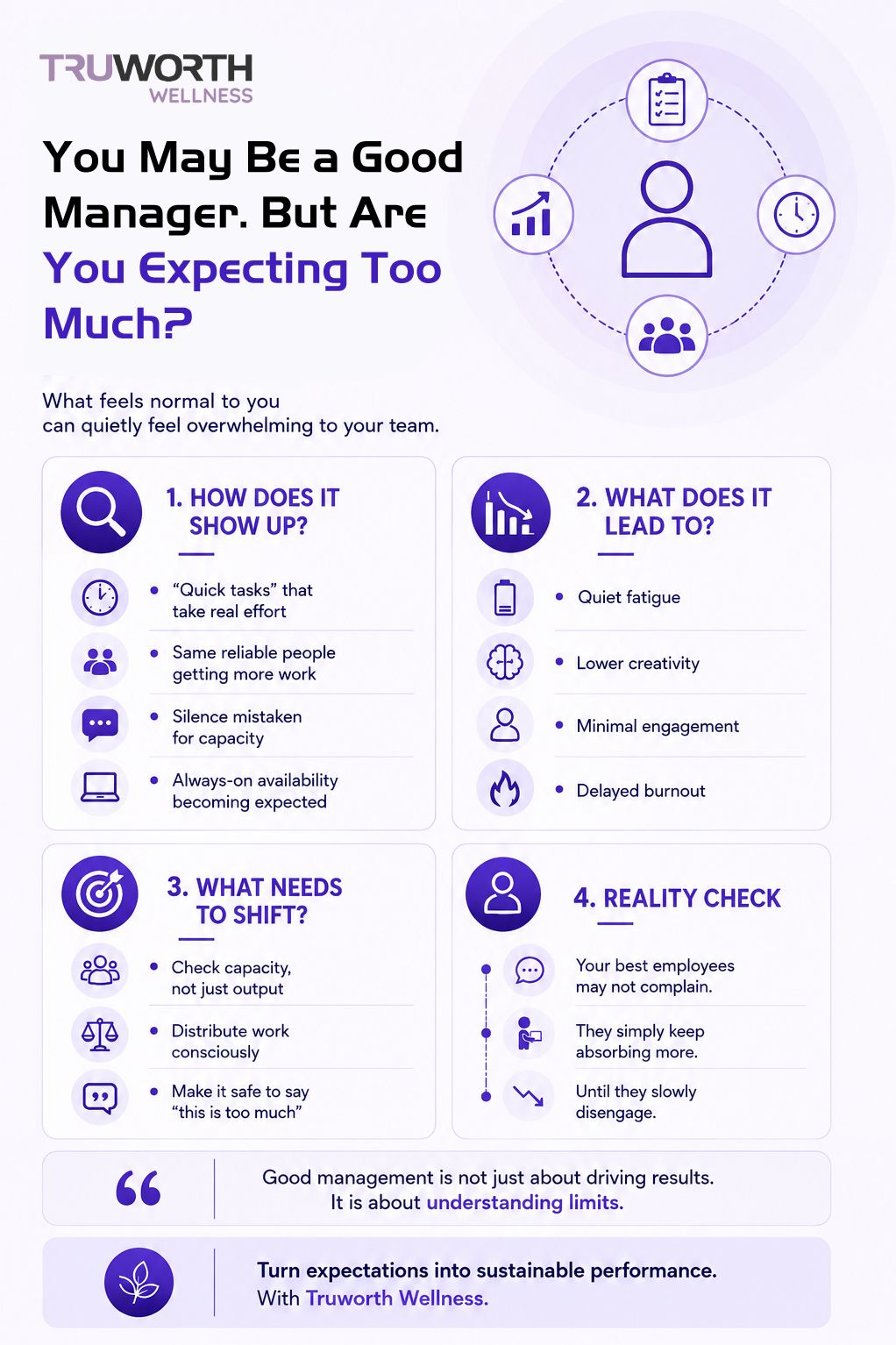
What Over-Expectation Actually Looks Like?
It rarely shows up as harsh behaviour.
Instead, it hides in everyday work culture:
- Assuming availability beyond work hours because “everyone is online anyway”
- Calling tasks “small” or “quick” without understanding actual effort
- Expecting consistent high performance without accounting for mental fatigue
- Delegating more to reliable employees because they “can handle it”
- Interpreting silence as agreement rather than overwhelm
Individually, these don’t seem harmful.
Collectively, they create a workplace where employees are always slightly stretched.
Why Good Managers Miss This?
Because performance does not drop immediately.
In fact, high-performing teams often absorb pressure silently.
They adapt. They deliver. They stretch.
But that stretch has a cost:
- Reduced creativity
- Emotional fatigue
- Quiet disengagement
- Delayed burnout
By the time it becomes visible, it is already deep-rooted.
The Emotional Math Employees Do?
Employees rarely evaluate work only by tasks.
They evaluate it by effort versus acknowledgment, expectation versus control.
When expectations rise but control, clarity, or recovery time does not, stress builds.
An employee may not say, “This is too much.”
Instead, it shows up as:
- Slower responses
- Reduced initiative
- Minimal communication
- Doing what is asked, but nothing beyond
This is not laziness. It is energy protection.
The “Reliable Employee Trap”
Every team has them.
The dependable ones. The ones who deliver without noise. The ones you trust instinctively.
And because they are reliable, they get more work.
Not intentionally. Logically.
But here is the issue.
Reliability gets rewarded with responsibility, not relief.
Over time, these employees carry disproportionate load, often without recognition or redistribution.
They don’t complain.
They just slowly disengage.
Or worse, they leave.
What Perceived Productivity Looks Like?
From the outside, everything looks fine.
Deadlines are met. Work is delivered. Targets are achieved.
But underneath:
- People are working longer, not smarter
- Recovery time is shrinking
- Work-life boundaries are dissolving
This is not sustainable productivity.
It is borrowed performance.
And borrowed performance always comes with interest.
Shifting From Output to Awareness
The solution is not lowering standards.
It is increasing awareness.
Good management today is not just about driving outcomes.
It is about understanding capacity.
That means asking:
- Is this deadline realistic, or just urgent?
- Am I distributing work fairly, or predictably?
- Are my top performers carrying hidden load?
- Have I created space for pushback?
Because when employees cannot say “this is too much,” the system is already broken.
Small Shifts That Change Everything
You don’t need a complete management overhaul.
Just a few intentional changes:
1. Redefine “quick tasks”
If it takes more than 20 minutes, it is not quick. Respect cognitive load.
2. Make workload visible
Encourage teams to share what is already on their plate before assigning more.
3. Reward boundaries, not just output
Employees who manage their time well should be seen as efficient, not less committed.
4. Check in beyond tasks
Instead of “Is this done?”, ask “How heavy is your workload this week?”
5. Rotate responsibility consciously
Do not default to the same high performers every time.
Where Workplace Wellness Comes In?
Over-expectation is not just a management issue.
It is a wellness issue.
Chronic pressure without recovery affects:
- Mental health
- Sleep quality
- Decision-making ability
- Long-term engagement
This is where structured support systems matter.
When organisations invest in employee wellbeing through counselling, stress management, and behavioural insights, they begin to see patterns managers may miss.
Not because managers don’t care.
But because they don’t always see the full picture.
The Manager’s Reality Check
You can be a good manager and still be part of the problem.
Not intentionally.
But systemically.
The real question is not:
“Am I supportive?”
It is:
“Are my expectations aligned with human capacity?”
Because teams do not burn out only under bad leadership.
They also burn out under well-meaning, unaware leadership.
The Bottom Line
High performance is not built by constantly pushing limits.
It is built by understanding them.
When managers become aware of invisible expectations, they unlock something powerful:
Sustainable performance.
Healthier teams.
And a workplace where people do not just deliver, but stay.
How Truworth Wellness Can Help?
At Truworth Wellness, we help organisations move beyond surface-level engagement and understand the deeper drivers of employee wellbeing.
Through Employee Assistance Programs, behavioural health support, and data-backed wellness insights, we enable companies to identify hidden stress patterns, workload imbalances, and early signs of burnout.
Because sometimes, the issue is not effort.
It is expectation.
And the earlier you see it, the easier it is to fix.