Mental Health Benefits In Indian Corporates: Closing The Gap Between Policy & Access

An employee is struggling to sleep. Their concentration has dropped, they have become unusually quiet in meetings, and routine tasks are taking more effort than before. They know their organization offers mental health support. They may even remember seeing the counselling helpline in an email or on the company portal.
Still, they hesitate. Not because they believe mental health support is unnecessary, or because the benefit is poorly designed, or even because they are unaware of it. They hesitate because accessing mental health support at work is rarely a simple decision.
Before booking a session, employees often evaluate risks that never appear in policy documents:
- Will my manager or HR find out?
- Is the service genuinely confidential?
- Could this affect my appraisal, promotion, or future opportunities?
- Will the counsellor understand my context?
- What happens if one session is not enough?
These questions reveal the real challenge facing mental health benefits in Indian corporates. The gap is not always between organizations that offer support and those that do not. It is between support that exists and support employees feel safe enough to use.
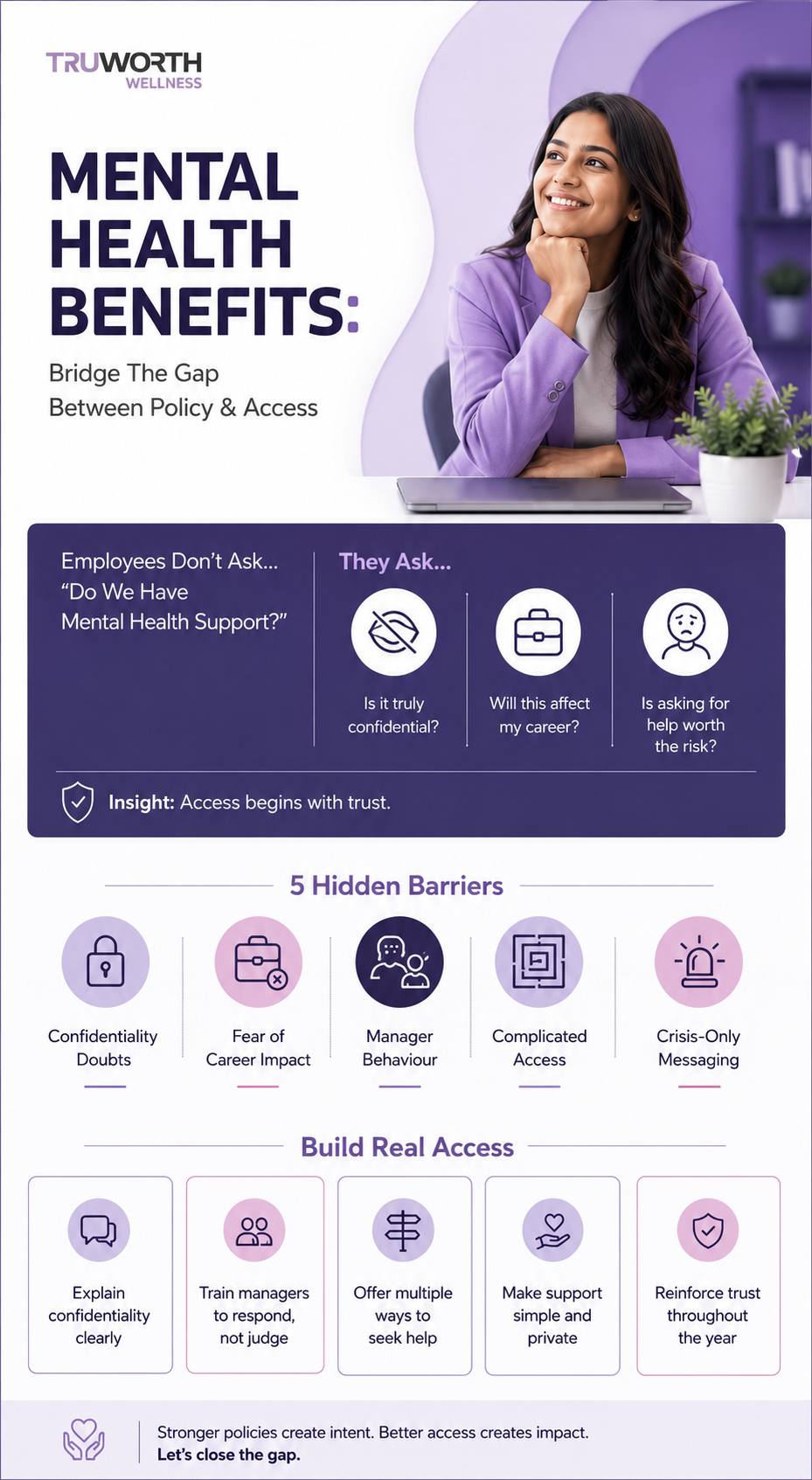
A Policy Can Create Availability Without Creating Access
Over the past few years, many organizations have introduced Employee Assistance Programmes, counselling helplines, mental wellbeing webinars, digital therapy platforms, manager sensitisation sessions, and crisis support. On paper, this is significant progress. In practice, availability does not automatically become access.
A counselling helpline may be technically open to everyone, but employees may not know when to use it. A policy may promise confidentiality, yet its communication may leave room for suspicion. A webinar may encourage help-seeking, while the daily culture continues to reward silence, overwork, and emotional self-control.
This is where organizations often confuse provision with adoption. Providing a benefit is an administrative decision; using it is a behavioural decision shaped by trust, relevance, timing, privacy, and the employee’s perception of risk.
Employees Are Evaluating the Consequences, Not Just the Service
Most mental health programmes are assessed through service-related questions: Is counselling available? How many sessions are included? Is online support offered? Are qualified professionals involved?
These questions matter, but they do not fully reflect how employees decide whether to use support. Many are also asking what seeking help might signal about their capability, reliability, or leadership potential.
Even when organizational policy says the right things, employees may still worry that counselling usage could be traced, judged, or misunderstood. They may trust the counsellor but distrust the system around the service.
The employee is therefore not simply asking, “Will this help me?” They are also asking, “What could this cost me?” Until organizations address that second question, access will remain limited.
Confidentiality Must Be Operational, Not Promotional
Confidentiality is often mentioned in mental health communication, but rarely explained with the precision employees need. A simple assurance that “counselling is confidential” is not enough.
Employees need plain-language answers to the questions that influence trust:
- What information is collected, stored, and protected?
- Who can access individual counselling information?
- What is shared with the employer, and in what form?
- Do individual identities ever appear in reports?
- Are managers ever informed that an employee has used the service?
- Under what limited circumstances may confidentiality be overridden?
When these details are missing, employees fill the gaps with assumptions—and assumptions usually favour caution. Organizations that want better adoption need to communicate confidentiality as an operating principle, not a promotional claim.
Employees should understand the difference between individual counselling information and anonymised utilisation trends. They should also know that HR can receive broad insights without receiving personal session details, and that limited exceptions usually apply only when there is an immediate risk of harm.
Clarity reduces uncertainty. Uncertainty reduces utilisation.
The Manager Is Often the Real Access Point
An organization may have a strong mental health policy, but employees often decide whether it is safe to use based on the behaviour of their immediate manager.
A manager who dismisses stress as weakness, praises people for working through exhaustion, or contacts employees outside working hours while promoting wellbeing sends a contradictory message. Employees notice the contradiction.
Manager sensitisation therefore needs to go beyond recognising signs of distress. Managers do not need to diagnose employees or act as counsellors. They need to respond without judgement, maintain boundaries, recognise when professional support may be needed, and avoid promises they cannot keep.
Simple responses can change the employee experience:
- “Thank you for telling me.”
- “You do not need to share more than you are comfortable sharing.”
- “Let us look at what support is available.”
- “We can discuss what adjustments may help right now.”
These statements create a very different experience from advice such as “try not to overthink it” or “everyone is under pressure.”
Access Must Work at the Moment of Need
Mental health support is often designed as a scheduled benefit, while employees may need help during unscheduled moments: a panic episode before an important presentation, a family crisis during a late shift, a difficult conversation with a manager, or a prolonged period of burnout that finally becomes unmanageable.
At such moments, access cannot depend on remembering a portal password, finding an old email, seeking approval, or waiting several days for a response. The quality of a mental health benefit is partly determined by how easily an employee can reach it when emotional capacity is already low.
Organizations should examine the access journey in practical detail:
- Can employees book support privately and quickly?
- Are services available beyond standard office hours?
- Can employees choose phone, video, or in-person support?
- Is multilingual support available where required?
- Are escalation pathways clear for urgent cases?
- Does support continue beyond one initial conversation?
A benefit that is technically accessible but emotionally difficult to navigate will remain underused.
Awareness Campaigns Cannot Replace Trust
Organizations often respond to low utilisation by increasing communication: more emails, posters, webinars, and awareness days. Visibility is useful, but it cannot solve a trust problem on its own.
Repeated promotional communication can even create the illusion that mental health has been addressed, while the employee experience remains unchanged. Trust is built through consistency between what the organization says and what employees experience.
Employees need to see that:
- Leaders discuss mental health without turning it into a performance
- Managers respond sensitively when employees disclose difficulties
- Workload concerns are taken seriously
- Time off for recovery does not attract judgement
- Confidentiality promises are reflected in actual processes
- Employees are not punished for setting reasonable boundaries
When these experiences align, communication becomes credible. When they do not, even the most polished campaign begins to feel symbolic.
Mental Health Benefits Should Not Begin at Crisis Point
Many corporate mental health programmes become most visible when employees are already struggling: counselling after burnout, crisis support after a serious incident, or manager intervention after performance has declined. This creates a reactive model of care.
A stronger model gives employees multiple ways to engage before a situation becomes severe. This may include stress management, financial counselling, sleep guidance, relationship counselling, parenting support, grief assistance, manager consultations, peer support, or preventive wellbeing check-ins.
Employees do not always describe what they are experiencing as a mental health problem. They may say they cannot sleep, feel constantly irritated, are worried about money, are struggling after a separation, cannot switch off from work, or feel overwhelmed by caregiving responsibilities.
When services are presented only through clinical or crisis language, many employees conclude that their problem is not serious enough to qualify. Broader entry points make support feel more relevant, earlier, and less intimidating.
Utilisation Is Important, But It Is Not the Only Measure
Low utilisation may indicate poor awareness, limited trust, access barriers, irrelevant services, or a workforce culture that discourages help-seeking. High utilisation may indicate stronger trust, but it may also reflect increasing stress or unresolved organizational pressures. This is why utilisation data should be interpreted carefully.
More useful questions include:
- Are employees returning after the first interaction?
- Are people seeking support earlier?
- Which concerns are becoming more common?
- Are certain employee groups consistently underrepresented?
- Do managers understand referral pathways?
- Are waiting times affecting access?
- Are recurring concerns pointing to broader workplace issues?
Mental health data should not be used to identify individual employees. It should help organizations understand where the work environment may be creating pressure, where access is failing, and where additional support is required.
The objective is not to turn emotional wellbeing into another dashboard. It is to make better decisions without compromising employee trust.
What Leading Organizations Do Differently?
Organizations that create meaningful mental health access do not rely on one benefit or one campaign. They design the entire experience around the employee’s perception of safety.
- Make confidentiality easy to understand
- Train managers to respond appropriately
- Provide more than one entry point into support
- Remove unnecessary approvals
- Enable private access to help
- Reflect workforce realities across language, location, work patterns, and culture
- Check whether workplace practices contradict wellbeing messaging
Because an organization cannot encourage employees to seek help while normalising the conditions that make help necessary.
A Final Reflection
Employees rarely reject mental health support because they do not value it. They avoid it when the path to support feels uncertain, visible, complicated, or unsafe.
That is why improving access requires more than expanding coverage. It requires organizations to reduce the perceived risk of asking for help.
The most effective mental health benefits do not simply tell employees that support is available.
They create enough trust for employees to believe they can use it.
And in the end, that is the difference between having a mental health policy and building a workplace where people can actually rely on it.