How To Downshift Your Nervous System In Just 5 Minutes?

Most employees are not struggling because they do not know about mindfulness. They are struggling because their nervous systems rarely get a chance to slow down.
Modern workplaces constantly activate stress responses. Notifications, deadlines, multitasking, long meetings, emotional labour, and digital overload keep the brain in a prolonged state of alertness.
This is why many employees say things like:
"I am tired even after sleeping."
"I cannot switch off after work."
"My brain feels constantly busy."
The issue is not always motivation. Sometimes the nervous system simply never fully exits survival mode.
The Power of 5-Minutes
Mindfulness is often presented as a productivity tool. But its deeper value lies in regulation. It helps the body shift out of chronic stress activation.
And sometimes, even five intentional minutes can make a measurable difference.
Yet many employees never take those five minutes because they believe they do not have time or because their workplace culture punishes pauses. The irony is that skipping recovery actually reduces total output.
A five minute reset can restore focus for the next two hours of meaningful work. Without it, the remaining hours are filled with distraction, errors, and fatigue. Recognising this trade off is the first step toward making micro recovery a daily habit rather than an occasional luxury.
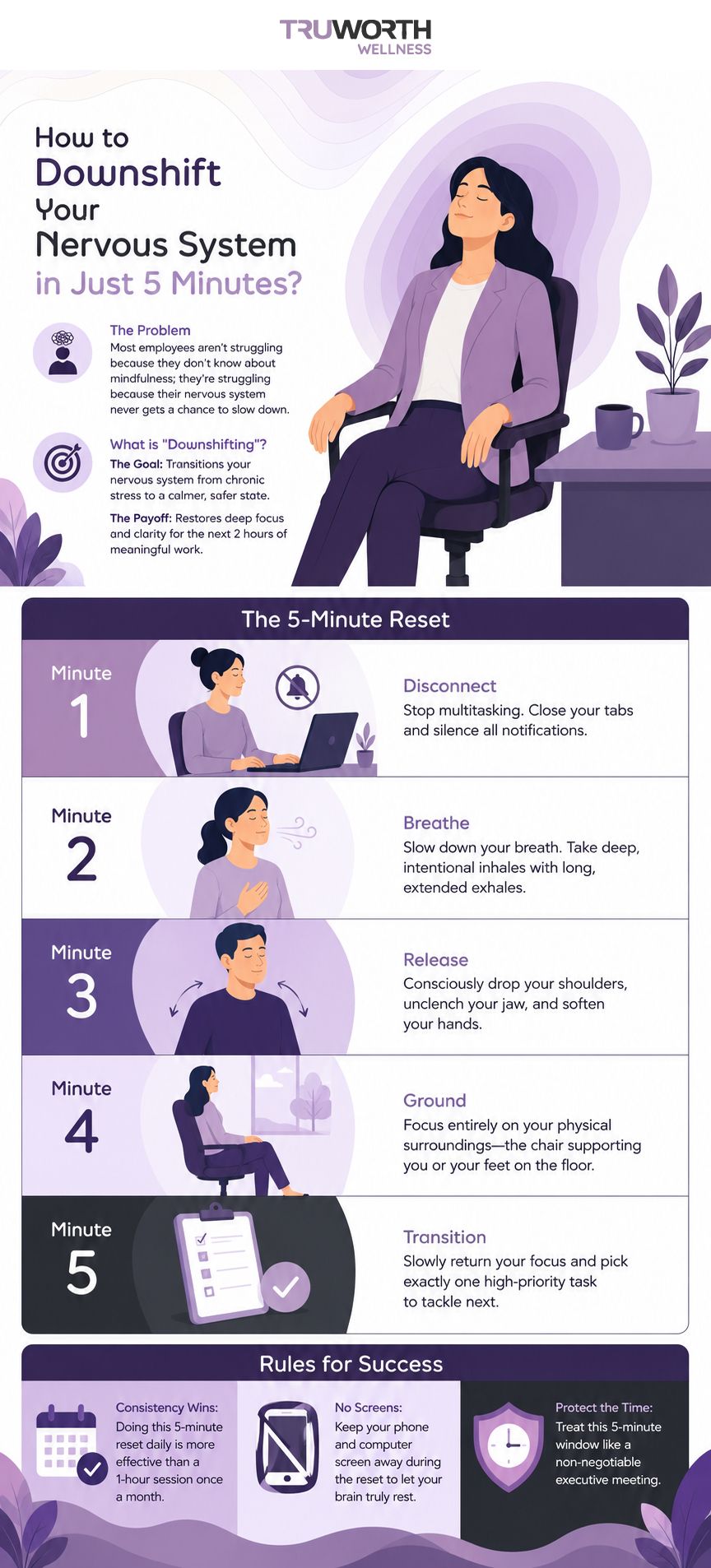
What Does "Downshifting" The Nervous System Mean?
The human nervous system constantly moves between activation and recovery.
When stress levels remain high for long periods, the body can stay stuck in:
- Hyper-alertness
- Mental restlessness
- Muscle tension
- Emotional reactivity
- Rapid thinking
- Fatigue without recovery
Downshifting refers to helping the nervous system transition toward a calmer physiological state.
This is not laziness. It is recovery. Think of it like driving a car at high speed for hours and then expecting the engine to cool down instantly. It does not work that way. The body also needs deliberate deceleration. Without downshifting, employees remain in a low grade fight or flight mode even during breaks, eating lunch while checking emails or thinking about deadlines. Their hearts race, their breathing stays shallow, and their muscles remain partially clenched. That is not rest. That is just paused productivity.
Why Employees Need Micro-Recovery?
Many people believe recovery only happens after work. But the body accumulates stress throughout the day. Without small recovery moments, stress continues to compound.
Micro-recovery practices can:
- Reduce emotional overload
- Improve concentration
- Lower physical tension
- Support emotional regulation
- Improve mental clarity
- Reduce stress accumulation
Even brief pauses can help interrupt the stress cycle. Research on high stress professions like emergency medicine and air traffic control shows that workers who take two to three short breaks per hour maintain better decision making than those who push through without stopping. The same principle applies to office work. A ninety second breathing break between meetings, a one minute stretch after finishing a report, or a thirty second pause before answering a difficult email all act as circuit breakers. They prevent the afternoon slump from turning into full evening exhaustion.
A Simple 5-Minute Nervous System Reset
Minute 1: Stop Multitasking
Close extra tabs. Silence notifications. Allow the brain to focus on one thing only. This single minute interrupts the constant task switching that keeps the nervous system on edge. Multitasking is a myth. What the brain actually does is rapidly toggle between tasks, each toggle adding a small stress spike. Stopping the toggles allows those spikes to settle.
Minute 2: Slow The Breath
Take slower, deeper breaths. Longer exhales can help activate the body's relaxation response. A practical method is to inhale for four counts, hold briefly, then exhale for six counts. The extended exhale signals safety to the vagus nerve, which runs from the brainstem to the abdomen. This is not mystical. It is physiology. Within sixty seconds, heart rate variability often improves and perceived anxiety drops noticeably.
Minute 3: Relax Physical Tension
Notice tension in:
- Jaw
- Shoulders
- Neck
- Hands
Release it consciously. Most office workers hold tension in these areas without realising it. The jaw clenches during difficult conversations. Shoulders rise toward the ears during urgent deadlines. The neck stiffens from hunching over screens. Bringing gentle awareness to each area and deliberately softening the muscles creates an immediate feedback loop. The brain receives the message that no immediate threat exists.
Minute 4: Ground Attention
Notice:
- Sounds around you
- The feeling of your chair
- Your breathing rhythm
- Physical sensations
This helps bring attention back to the present moment. Grounding works because stress often pulls the mind into the past or the future. Regret about what already happened. Worry about what might happen. Grounding interrupts that loop by anchoring awareness to the here and now. The hum of an air conditioner, the weight of feet on the floor, the subtle rise and fall of the chest. These ordinary sensations become anchors that steady the nervous system.
Minute 5: Transition Slowly
Do not immediately jump back into stress. Pause briefly before returning to work. This final minute is often skipped, which undoes much of the previous work. Rushing from a calm state straight into a high pressure task creates a rebound effect. Instead, open your eyes slowly. Take one ordinary breath. Look away from the screen. Then choose one small, manageable action to begin with rather than diving into the hardest item on your list.
Why Mindfulness At Work Often Fails?
Many employees resist mindfulness because it is sometimes presented unrealistically.
Common problems include:
- Overcomplicated routines
- Pressure to "clear the mind"
- Lack of time
- Forced participation
- Wellness programs disconnected from workplace realities
Mindfulness should not feel like another task employees are failing at. When an exhausted employee is told to sit still for twenty minutes and think of nothing, they often feel worse afterward because they could not do it correctly. That sense of failure adds shame to exhaustion. Effective workplace mindfulness avoids this trap by focusing on small, achievable actions that do not require perfection. Even sixty seconds of slow breathing counts. Even noticing three sounds in the room counts. Lowering the bar makes consistent practice possible.
Simple regulation practices are often more sustainable than perfection-driven wellness routines.
Creating Recovery-Friendly Workplaces
Employees regulate better in environments where:
- Breaks are respected
- Meetings are not excessive
- Managers model boundaries
- Psychological safety exists
- Workloads are manageable
The nervous system responds not only to meditation. It also responds to workplace culture. A team that schedules back to back meetings for six hours straight is creating a stressed nervous system regardless of how many mindfulness apps employees install. Conversely, a culture where people step away from their desks for ten minutes without guilt, where leaders say no to unrealistic requests, and where rest is treated as performance related rather than lazy creates the conditions for nervous system regulation to happen naturally. Culture either supports recovery or silently blocks it.
How Truworth Wellness Can Help?
Building emotionally sustainable workplaces requires more than occasional mindfulness sessions.
Truworth Wellness supports organisations through:
- Mental wellbeing programs
- Stress management initiatives
- Employee assistance programs
- Digital wellness solutions
- Preventive health support
- Behavioural wellbeing interventions
Because wellbeing improves when recovery becomes part of everyday work culture. Truworth Wellness does not simply offer another meditation app. It helps organisations redesign daily routines, train managers in nervous system friendly leadership, and embed micro recovery practices into the natural flow of the workday. The goal is not to add more wellness tasks. It is to make recovery feel effortless, normal, and supported from the top down. When employees can downshift their nervous systems in just five minutes without fear of judgment, both health and performance improve together.