Types Of Corporate Health Checkups Explained
Not all health checkups are the same. Here is a plain-language guide to the different types, what each one covers and which one your employees actually need.
When most people hear the words corporate health checkup, they picture a health camp. A van in the parking lot. A blood test and a blood pressure reading. A report handed over in a sealed envelope.
This is one type of corporate health checkup. It is also the most basic one. And depending on who your employees are and what you are trying to achieve, it may be far from sufficient.
Understanding the different types of corporate health checkups, what each covers and when each is appropriate, is the starting point for building a health screening strategy that is genuinely useful rather than simply completed.
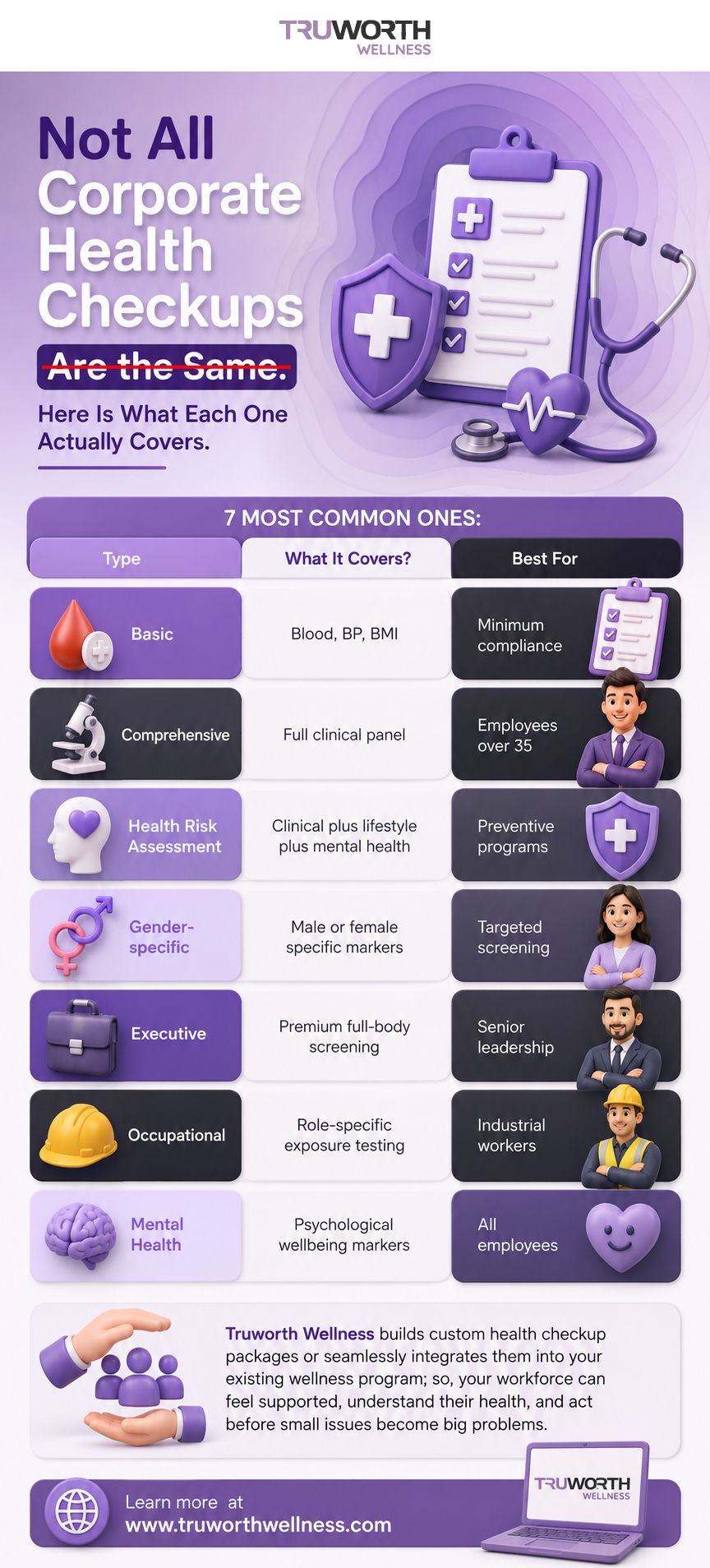
1. Basic Health Checkup
The entry-level corporate health screening. Usually delivered through a health camp or diagnostic lab network.
Typically includes:
- Complete blood count
- Blood sugar (fasting)
- Basic lipid profile (total cholesterol)
- Blood pressure
- BMI
- Basic urine test
Best for: Meeting minimum compliance requirements, providing a very basic health snapshot for younger, lower-risk employee populations.
Limitations: Misses many of the most important risk indicators for Indian corporate populations including HbA1c, full lipid panel, thyroid, Vitamin D and B12. No mental health component. No lifestyle assessment.
2. Comprehensive Health Checkup
A more complete version of the basic checkup, covering a broader range of clinical markers.
Typically adds:
- HbA1c for blood sugar trend
- Full lipid panel including HDL, LDL and triglycerides
- Liver function tests
- Kidney function tests
- Thyroid function test
- ECG
- Vitamin D and B12 levels
- Eye and dental check
Best for: Employees over 35, employees with risk factors, anyone wanting a genuinely useful clinical picture rather than a superficial one.
Limitations: Still primarily clinical. Does not capture lifestyle factors, mental health indicators or workplace-specific risk factors.
3. Health Risk Assessment
The most comprehensive form of corporate health screening. Goes beyond clinical measurements to include lifestyle, mental health, dietary patterns, sleep quality, stress levels and family history.
Covers:
- All clinical markers from the comprehensive checkup
- Lifestyle assessment including diet, activity and sleep
- Mental health indicators including stress and anxiety scores
- Work-related risk factors
- Family medical history
- Personalised health risk score
- Tailored recommendations based on individual profile
Best for: Organisations that want to move from health data collection to genuine health improvement. The HRA is the foundation of a preventive health program rather than a one-time event.
Limitations: Requires a more sophisticated delivery platform and follow-up infrastructure than a basic camp.
4. Gender-Specific Checkups
Health screenings designed around the specific health needs of male or female employees.
Female-specific additions typically include:
- Haemoglobin and iron panel for anaemia
- Thyroid function (significantly more common in women)
- Pap smear and cervical health screening
- Breast examination
- PMOS-related hormonal markers
- Bone density for women over 40
Male-specific additions typically include:
- Prostate-specific antigen for men over 45
- Testosterone screening where indicated
- Cardiovascular risk assessment given higher male cardiac risk at younger ages
Best for: Organisations with significant gender-specific health needs that are not served by standard unisex checkup packages.
5. Executive Health Checkup
A premium, comprehensive screening typically offered to senior leadership. Usually delivered in a hospital or diagnostic centre rather than through a health camp.
Typically includes:
- All markers from the comprehensive checkup
- Advanced cardiac screening including stress ECG
- Cancer screening markers
- Full body scan or imaging where indicated
- Ophthalmology consultation
- Dental assessment
- Nutritional assessment
- Results discussion with a senior physician
Best for: Senior leaders and executives where the organisation has a particular interest in health continuity. Can create equity perception issues if offered only to senior employees without broader workforce coverage.
6. Specialised Occupational Health Checkups
Health screenings designed for specific occupational health risks. Required by law in certain industries under the Factories Act, Mines Act and related legislation.
Examples include:
- Audiometry for employees exposed to high noise levels
- Lung function testing for employees exposed to dust or chemicals
- Vision testing for precision workers and drivers
- Musculoskeletal assessment for physically demanding roles
- Pre-placement medical examination for hazardous roles
Best for: Manufacturing, mining, construction, logistics and any role with specific occupational health exposure.
7. Mental Health Screening
A relatively new category in Indian corporate health but a rapidly growing one. Covers psychological wellbeing markers that clinical checkups do not capture.
Typically includes:
- Validated screening tools for anxiety and depression
- Burnout assessment
- Stress and resilience indicators
- Sleep quality assessment
- Work-life balance markers
Best for: Organisations that understand mental health is a clinical concern rather than a soft topic. Works best as part of an integrated physical and mental health screening program rather than as a standalone exercise.
How Truworth Wellness Approaches Health Checkups?
Truworth Wellness builds health screening programs around the Health Risk Assessment model because it is the only type of checkup that captures the whole person rather than just a set of clinical numbers.
The HRA combines clinical measurements, lifestyle assessment, mental health screening and occupational risk factors into a single, comprehensive health picture. Each employee receives a personalised health risk score and a tailored set of recommendations. High-risk employees are connected to follow-up support through CarePass OPD, nutrition coaching, condition management and EAP.
The result is a health checkup that does something with the data it collects. Which is the point.
Want to understand which type of health checkup is right for your workforce? Talk to Truworth Wellness about building the right screening program.