Predictive Wellness: Using AI-Driven Biometric Models To Forecast And Prevent Burnout

Is your workforce on the edge of burnout? Traditional corporate checkups only tell you what went wrong yesterday. Discover how AI-driven predictive wellness pinpoints metabolic stress before it harms your employees and your bottom line. Read the complete guide by Truworth Wellness.
Executive Summary
In the high-velocity corporate ecosystem of modern India, employee burnout is no longer an abstract HR nuisance, it is an escalating enterprise risk. Across technology parks in Bengaluru, financial complexes in Mumbai, and corporate hubs in Cyber City Gurugram, workforce exhaustion is reaching an all-time high. Traditional wellness strategies, which rely on reactive annual health checkups and annual employee satisfaction surveys, fail to capture early physiological signals of burnout.
By the time an employee reports acute fatigue or takes extended leave, biological stress cascades have already been active for months.
Enter Predictive Wellness: an innovative operational model that leverages advanced AI-driven biometric models to analyze objective, multi-point physiological markers, such as Heart Rate Variability (HRV), resting heart rate, sleep fragmentation, and glycemic trends (HbA1c). By synthesizing these biometrics in real time, Indian enterprise leaders can forecast physiological stress, mitigate metabolic risk, and deploy targeted micro-interventions long before full-blown operational burnout occurs.
Article Index
|
Section # |
Topic / Headline |
Key Takeaway / Focus |
|
1 |
The Rising Crisis of Workforce Burnout in Indian Corporate
Hubs |
The epidemiological shift in executive health across
Tier-1 Indian tech and financial centers. |
|
2 |
What is Predictive Wellness and How Do AI Biometric Models
Work? |
Decoding machine learning algorithms that convert
objective physical data into actionable risk scores. |
|
3 |
Early Warning Systems: Moving From Reactive Health
Checkups to Proactive Prevention |
Analyzing the financial impact of presenteeism, rising
insurance claims, and chronic stress on enterprise bottom lines. |
|
4 |
Key Biometric Indicators That Forecast Burnout Before It
Strikes |
Deep-dive into physiological markers: HbA1c, HRV, resting
pulse, and sleep degradation trends. |
|
5 |
How Truworth Wellness Integrates AI-Driven Insights for
Indian HR Leaders? |
Exploring Truworth’s proprietary AI engine, health risk
assessments, and targeted micro-coaching interventions. |
|
6 |
Data Privacy, DPDP Act Compliance, and Employee Trust in
Corporate Health |
Navigating India's DPDP Act 2023 with strict data
governance, consent frameworks, and anonymized HR dashboards. |
|
7 |
Implementing a Predictive Health Strategy in Your Indian
Enterprise |
A step-by-step implementation blueprint for CHROs and
wellness managers to achieve high ROI. |
|
8 |
Visual Asset Brief |
Design brief and visual content layout for corporate
communications teams. |
|
9 |
Frequently Asked Questions (FAQ) |
Clear answers for HR leaders and corporate decision-makers |
The Rising Crisis of Workforce Burnout in Indian Corporate Hubs
India’s rapid transition into a global economic power has created demanding corporate operational models. Hybrid working arrangements, cross-border timezone alignment in IT/ITeS, relentless deal cycles in BFSI, and lean manufacturing targets have normalized hyper-performance at the expense of metabolic health.
Recent findings from the Indian Council of Medical Research (ICMR) and ASSOCHAM present a clear picture of workforce health in metropolitan centers:
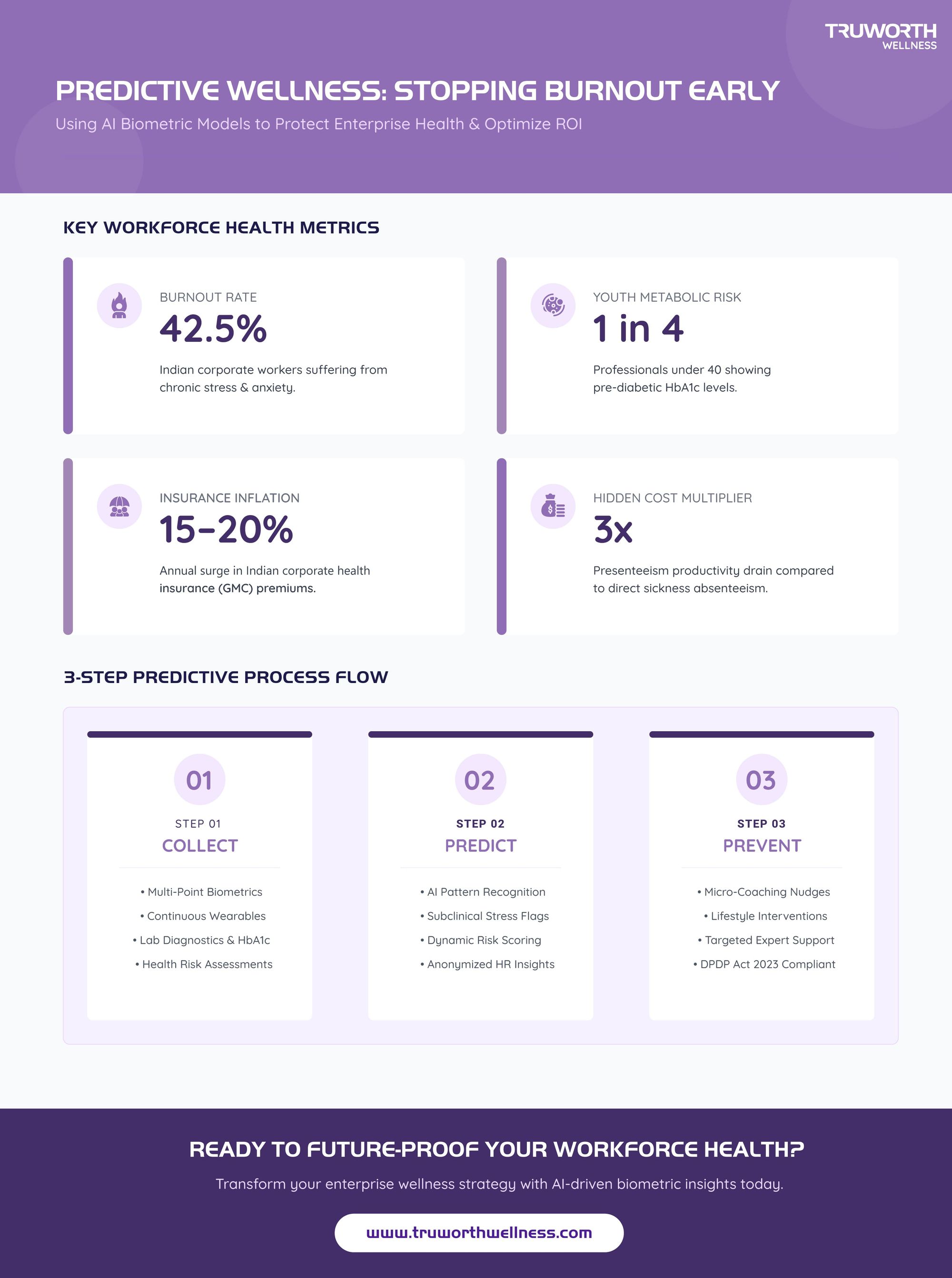
- 42.5% of Indian corporate employees suffer from clinical anxiety, chronic fatigue, or severe workplace depression.
- 1 in 4 young professionals under the age of 40 demonstrates early-onset hypertension, dyslipidemia, or pre-diabetic HbA1c levels (>5.7%).
- Group Health Insurance (GMC) premiums for Indian enterprises are compounding at 15–20% year-on-year, primarily driven by lifestyle and stress-related metabolic claims.
Traditional vs Predictive Wellness Flow
|
Model |
Workflow Steps |
Business Outcome |
|
Traditional Reactive Flow |
Asymptomatic Stress → Chronic Burnout → Clinical Disease |
High Insurance Claims & Late Intervention |
|
Predictive AI Flow |
Subclinical Biometric Alert → Automated Nudge &
Micro-Intervention |
Sustained Health & Reduced Claims |
The fundamental problem lies in legacy corporate health frameworks. Traditional wellness programs rely on annual health checkups, a single snapshot in time that misses ongoing dynamic shifts in human physiology. An annual checkup identifies disease after structural damage has occurred. It cannot detect the gradual accumulation of autonomic nervous system exhaustion, systemic inflammation, or sleep deprivation that precedes burnout.
Key Takeaway for HRs: Relying solely on annual corporate health checkups leaves your organization vulnerable to hidden attrition, reduced productivity, and surging medical claims. Modern corporate wellness in India requires real-time, predictive tracking.
What is Predictive Wellness and How Do AI Biometric Models Work?
Predictive wellness represents a structural shift from reactive symptom management to proactive health optimization. Instead of waiting for an employee to seek support through an Employee Assistance Program (EAP) or call in sick, AI-driven biometric models synthesize continuous biological data to forecast health risks before symptoms manifest clinically.
AI Risk Processing Pipeline
- Data Collection: Multi-point data gathering via wearables, HRAs, and lab diagnostics.
- Pattern Recognition: Machine learning models evaluate physiological trends against risk baselines.
- Score Calculation: Dynamic Health Risk Score (HRS) generated for the individual.
- Targeted Action: Automated micro-coaching nudges and aggregated HR risk alerts.
Key Biometric Markers: HbA1c, Resting Heart Rate, Sleep Quality, and HRV
Machine learning algorithms evaluate correlations across multiple physiological parameters:
- Subjective Survey Limitations: Standard HR surveys (e.g., quarterly pulse checks) suffer from response bias and fear of evaluation. Employees frequently underreport stress levels due to perceived professional risks.
- Objective Biometric Precision: Physiological systems cannot hide chronic stress. When the sympathetic nervous system ("fight-or-flight") is continuously activated due to long working hours, specific biomarkers change predictably weeks before psychological exhaustion sets in.
|
Biometric Marker |
Biological Mechanism |
Burnout Indicator Signal |
|
Heart Rate Variability (HRV) |
Reflects autonomic nervous system balance via variation in
time intervals between heartbeats. |
Sustained drops in HRV indicate persistent sympathetic
tone and inadequate parasympathetic recovery. |
|
Resting Heart Rate (RHR) |
Basal cardiovascular output during rest. |
Unexplained elevation (>5–10 BPM above baseline)
correlates with physical systemic exhaustion. |
|
Sleep Quality & Fragmentation |
Delta (deep) and REM sleep architecture analysis. |
Frequent micro-awakenings and reduced deep sleep duration
directly predict cognitive impairment and burnout. |
|
Glycemic Trends (HbA1c & FBG) |
Cortisol elevation induces hepatic gluconeogenesis and
insulin resistance. |
Elevated blood glucose spikes despite stable diets signal
systemic hyper-cortisolemia. |
By analyzing these variables, AI algorithms calculate a dynamic Health Risk Score (HRS) that alerts both the individual employee and corporate health algorithms to escalating strain.
Early Warning Systems: Moving From Reactive Health Checkups to Proactive Prevention
The financial toll of unmanaged workplace stress in Indian corporates goes far beyond obvious medical bills. It manifests primarily through two hidden financial drains: presenteeism (employees working at suboptimal capacity due to exhaustion) and voluntary attrition.
Breakdown of Corporate Burnout Costs
|
Category |
Visible Costs |
Hidden Costs |
|
Cost Elements |
Group Mediclaim (GMC) Claims |
Presenteeism (Suboptimal output) |
|
Direct Sick Leave Expenses |
Voluntary Attrition & Hiring Costs |
|
|
Emergency Room Visits |
Operational Error Rates & Missed SLAs |
When an enterprise transitions to early warning biometric systems, the business value is immediate and measurable:
- Mitigating Absenteeism & Presenteeism: Studies demonstrate that presenteeism costs Indian organizations up to 3x more than direct sickness absenteeism. Early micro-interventions preserve daily operational capacity.
- Lowering Corporate Insurance Loss Ratios: By identifying metabolic risk early, such as pre-diabetes or stage-1 hypertension, companies can slow the progression to severe cardiovascular conditions, stabilizing group insurance premiums.
- Improving Executive & Tech Retention: Key engineering, management, and financial talent are especially prone to burnout. Proactive care demonstrates authentic corporate empathy, directly boosting employee net promoter scores (eNPS).
Key Takeaway for HRs: Predictive wellness transforms healthcare spending from an unpredictable operational loss into an engineered corporate investment with quantifiable ROI.
Key Biometric Indicators That Forecast Burnout Before It Strikes
To effectively use AI biometric models for burnout, corporate health programs must evaluate three interconnected biological pathways:
- Metabolic Health: Stress-Glucose Axis
- Cardiovascular System: Restless Circulation & HRV
- Sleep & Activity Architecture: Wearable & Behavioral Metrics
1. Metabolic Health: The Stress-Glucose Axis
When the human brain experiences sustained workplace stress, the adrenal glands release cortisol and adrenaline. Cortisol inhibits insulin sensitivity, keeping glucose available in the bloodstream. In sedentary desk workers across Indian MNCs, this results in:
- Stepwise increases in HbA1c (>5.7%), signaling pre-diabetes.
- Mid-afternoon energy crashes and glycemic variability.
- Accumulation of visceral adiposity around abdominal organs, increasing overall metabolic risk.
2. Cardiovascular Indicators: Restless Circulation
The cardiovascular system offers clear, continuous metrics of operational fatigue:
- Elevated Resting Heart Rate: A rising trend over 14 consecutive days indicates systemic physical strain.
- Blood Pressure Trends: Stage-1 hypertension (>130/80 mmHg) often emerges in young corporate professionals long before structural symptoms appear.
3. Wearable Integration & Behavioral Markers
By integrating consumer and medical-grade wearables into the Truworth Wellness platform, algorithms track:
- Sleep Architecture: Loss of deep sleep hours, where cellular repair occurs.
- Physical Inactivity Patterns: Pronounced sedentary behavior (>8 consecutive hours) common during intense project deployment cycles.
How Truworth Wellness Integrates AI-Driven Insights for Indian HR Leaders?
As India's leading enterprise health provider, Truworth Wellness bridges the gap between raw biometric data and real-world behavior change.
Truworth AI Integration Architecture
- Input Layer: Pan-India Onsite & Digital Screenings
- Processing Core: Truworth AI Engine (The Enterprise Portal)
- Output Deliverables:
- Employee Mobile App: Hyper-personalized nudges, micro-coaching interventions, and dynamic action plans.
- HR Leadership Dashboard: Aggregated health insights, zero-knowledge data governance, and trend forecasts.
Pan-India Onsite & Digital Screenings
Truworth Wellness executes high-precision health risk assessments (HRA) and diagnostic drives across Tier-1, Tier-2, and remote employee hubs in India. From point-of-care HbA1c testing to continuous wearable data synchronization, information flows into a unified corporate health portal.
Hyper-Personalized Micro-Coaching
Data without action yields zero enterprise value. The Truworth Wellness AI app translates risk flags into personalized daily actions:
- Biometric Risk Trigger: An employee's HRV drops significantly alongside elevated blood glucose indicators.
- Automated AI Response: The platform avoids generic advice, delivering tailored micro-habits, such as guided breathwork sessions, low-glycemic dietary adjustments suited to Indian palates, and automated hydration prompts.
- Human-in-the-Loop Coaching: High-risk profiles are seamlessly connected to certified corporate nutritionists, fitness coaches, and medical professionals.
Data Privacy, DPDP Act Compliance, and Employee Trust in Corporate Health
The deployment of biometric tracking in corporate settings requires absolute transparency and strict compliance with Indian regulatory frameworks.
Key Takeaway for HRs: Employees must feel confident that their individual health data will never be weaponized for performance appraisals, insurance discrimination, or HR termination decisions.
To ensure total trust, Truworth Wellness operates under a strict security architecture:
- Compliance with the DPDP Act 2023: Full adherence to India’s Digital Personal Data Protection (DPDP) Act 2023, ensuring explicit user consent, purpose specification, and robust data isolation protocols.
- Aggregated & Anonymized HR Dashboards: HR leaders and benefits managers receive high-level organizational insights (e.g., "34% of the Tech Team demonstrates elevated metabolic risk"), while individual health records remain completely private to the employee.
- Enterprise-Grade Security: End-to-end encryption (AES-256) at rest and in transit, adhering to international ISO/IEC 27001 standards.
Implementing a Predictive Health Strategy in Your Indian Enterprise
Transitioning your enterprise from conventional checkups to an AI-powered predictive wellness framework is a structured, three-step process:
3-Phase Implementation Blueprint
Phase 1: Baseline Assessment
- Execute pan-India health diagnostics across offices and hybrid teams.
- Measure baseline metrics including HRV, HbA1c, and lipid profiles alongside online HRAs.
Phase 2: Platform Integration
- Onboard employees onto the Truworth Wellness Mobile Application.
- Sync wearable devices (Apple Health, Fitbit, Google Fit) and activate the AI micro-coaching engine.
Phase 3: Optimization & ROI Tracking
- Monitor anonymized population health trends via the HR Enterprise Dashboard.
- Correlate health improvements with reduced insurance claims and lower absenteeism over 6- to 12-month cycles.
Transform Your Workforce Health Strategy with Truworth Wellness
Moving beyond traditional, reactive wellness models is no longer optional, it is a competitive necessity for forward-thinking Indian enterprises. By leveraging predictive wellness powered by artificial intelligence and precise biometric modeling, HR leaders can build a healthier, more resilient workforce while optimizing healthcare spending.
Truworth Wellness provides full-spectrum enterprise health solutions tailored to Indian organizations. From pan-India diagnostic drives and continuous biometric analytics to DPDP-compliant data management, we help transform corporate health programs across the nation.
Ready to future-proof your workforce health?
Visit www.truworthwellness.com today to schedule a demo of our AI-driven corporate wellness platform.
Frequently Asked Questions (FAQ)
Q1: What makes predictive wellness different from standard corporate health checkups?
Standard health checkups provide a periodic, isolated look at an employee’s health, often catching diseases only after structural symptoms appear. Predictive wellness continuously analyzes real-time biometric indicators (such as HRV, resting heart rate, sleep metrics, and metabolic trends) using AI algorithms. This enables organizations to intervene with personalized care before chronic burnout or lifestyle illnesses fully develop.
Q2: How do AI biometric models forecast employee burnout without being intrusive?
AI biometric models track subtle physiological shifts, such as reduced Heart Rate Variability (HRV), elevated resting pulse, and poor sleep quality, that occur naturally when the body experiences chronic stress. These metrics are gathered passively through consumer wearables or periodic diagnostic drives, removing the need for invasive monitoring or subjective HR surveys.
Q3: Is employee health data secure and compliant with India’s DPDP Act 2023?
Yes. Truworth Wellness adheres strictly to India’s Digital Personal Data Protection (DPDP) Act 2023 and international ISO/IEC standards. Personal biometric data remains completely confidential and accessible only by the individual employee. HR leaders receive aggregated, anonymized group data to analyze overall organizational trends without exposing individual identity.
Q4: Can predictive wellness help reduce our company’s GMC insurance premiums?
Yes. Group Health Insurance (GMC) premiums are driven by claim frequencies and severe health events. By identifying pre-diabetes, early hypertension, and chronic stress early, predictive wellness programs prevent severe medical crises. This helps lower overall insurance claims and stabilizes annual premium increases.
Q5: What is required to roll out the Truworth Wellness predictive portal across remote or hybrid teams?
Deployment is straightforward. Employees download the Truworth Mobile App, complete an online Health Risk Assessment (HRA), and can sync their preferred wearable devices. Truworth also organizes onsite diagnostic drives across pan-India offices and Tier-1/Tier-2 hubs to capture baseline metabolic markers like HbA1c and lipid profiles.
Predictive Wellness in 30 Seconds
|
Problem |
Burnout hides before symptoms show. |
|
Signals |
HRV ↓ | RHR ↑ | Sleep ↓ | HbA1c ↑ |
|
AI Action |
Predict risk → trigger micro-coaching → alert HR trends. |
|
Business Win |
Lower claims, stronger retention, healthier teams. |