What A Good Employee Assistance Program Actually Delivers (And What Most Don't?)

Ask ten HR leaders whether their organization offers an Employee Assistance Program (EAP), and most will answer "yes."
Ask how many employees understand what the program offers, trust its confidentiality, and would actually use it, and the conversation becomes far more interesting.
This is where many EAP discussions begin to break down.
On paper, Employee Assistance Programs have become a standard part of workplace wellbeing. Most established organizations offer some form of counselling support, mental health assistance, or employee helpline. Yet despite widespread adoption, many HR teams continue to face the same challenge during annual reviews:
The program exists, but its impact is unclear.
Utilization remains low. Employees aren't fully aware of the services available. Managers struggle to guide employees toward support. Renewal conversations focus on vendor presentations rather than outcomes.
The issue is not that EAPs lack value.
The issue is that many organizations evaluate them too narrowly.
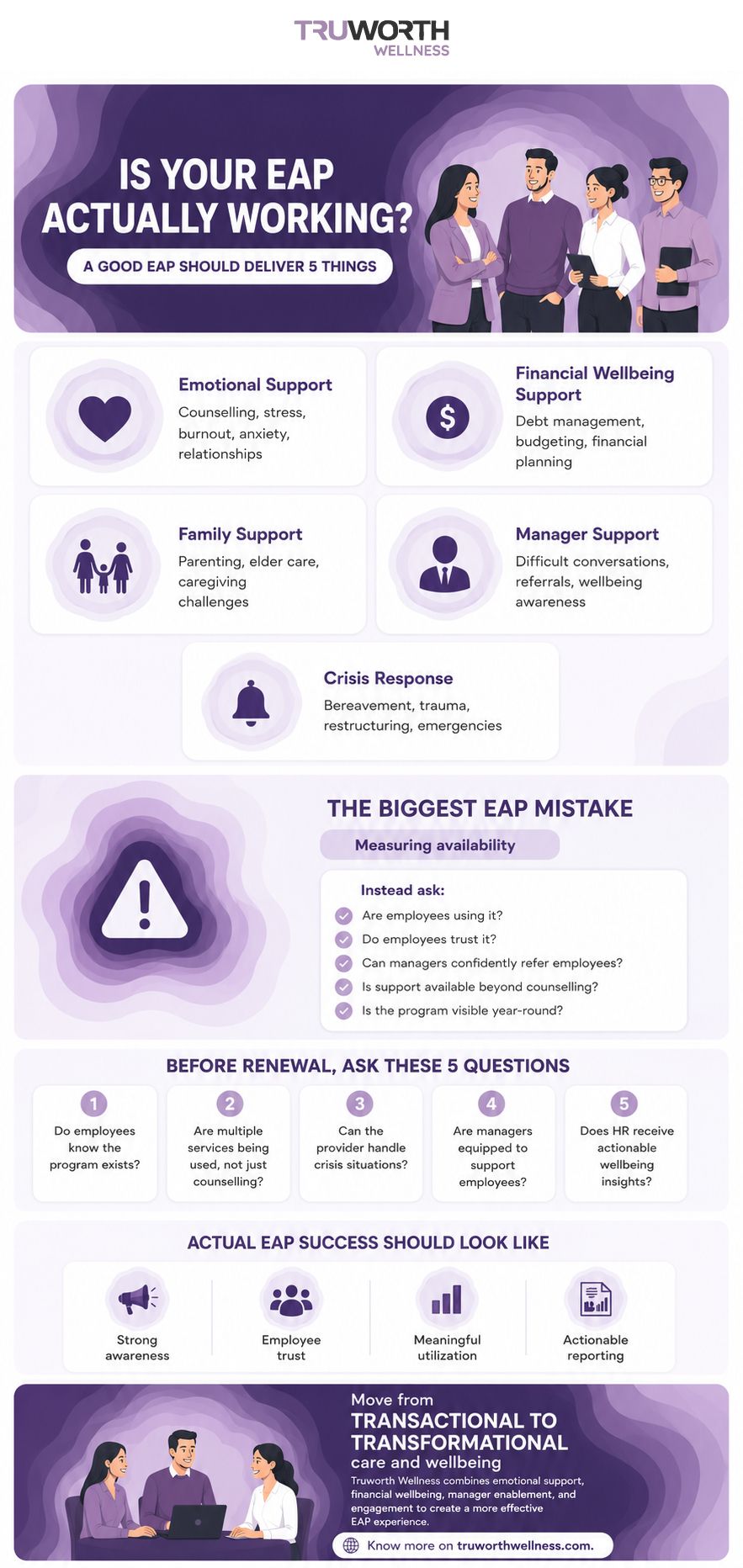
A good Employee Assistance Program is not simply a counselling service. It is a support ecosystem designed to help employees navigate personal, professional, emotional, financial, and family challenges before those challenges begin affecting wellbeing, productivity, or workplace engagement.
Understanding that distinction is the first step toward choosing an EAP that actually delivers value.
Why Many EAPs Underperform?
One of the biggest misconceptions about Employee Assistance Programs is that availability automatically creates impact.
It doesn't.
An organization may invest in an excellent EAP provider, communicate the launch, and make services available to every employee. Yet months later, utilization remains low and employee awareness remains limited.
The reason is simple.
Employees rarely think about EAPs until they need them.
And when that moment arrives, many are unsure:
- What support is available?
- Whether the service is confidential?
- How to access assistance?
- Whether their situation qualifies?
- If using the service could affect their professional reputation?
These questions create hesitation.
The result is a program that exists but remains underutilized.
This is why the most successful EAPs are not necessarily those with the largest counselling networks. They are the ones that consistently build trust, visibility, and accessibility throughout the year.
What A Modern EAP Should Actually Include?
Many organizations still view EAPs primarily through the lens of mental health counselling.
Counselling remains a critical component, but modern employee wellbeing challenges are rarely confined to a single category.
For example,
- An employee experiencing anxiety may simultaneously be facing financial pressure.
- A caregiver supporting an elderly parent may also be struggling with work-life balance.
Relationship issues may affect concentration, engagement, and emotional wellbeing at work.
The most effective EAPs acknowledge that life does not separate challenges into neat boxes.
1. Emotional & Psychological Support
This remains the foundation of every credible Employee Assistance Program.
Employees should have access to:
- Individual counselling
- Stress management support
- Anxiety and depression support
- Burnout interventions
- Relationship counselling
- Family counselling
- Grief and bereavement support
However, organizations should look beyond the existence of counselling services and evaluate the quality of delivery.
Questions worth asking include:
- Are counsellors appropriately qualified?
- Are multiple languages supported?
- Are sessions available virtually and in-person?
- What are the response times?
- Is support available during crises?
The answers often determine whether employees actually receive meaningful help.
2. Financial Wellbeing Support
Financial stress remains one of the most common causes of employee anxiety, yet many EAP evaluations overlook this area entirely.
Employees may seek guidance on:
- Debt management
- Budgeting
- Financial planning
- Retirement preparation
- Education funding
- Major life expenses
Financial concerns frequently influence mental wellbeing, workplace focus, and overall quality of life.
An EAP that ignores financial wellbeing is addressing only part of the employee experience.
3. Family & Life Support
Today's workforce includes employees managing responsibilities that extend far beyond their jobs.
Common concerns include:
- Parenting challenges
- Elder care responsibilities
- Family conflicts
- Major life transitions
- Caregiver stress
Organizations often underestimate how significantly these issues affect workplace performance and wellbeing.
A strong EAP helps employees navigate these realities rather than treating them as separate from work.
4. Crisis Response Capability
This is where many EAP providers reveal their true maturity.
Routine counselling support is important.
Crisis response is essential.
Organizations should evaluate whether an EAP can respond effectively to:
- Employee bereavement
- Workplace trauma
- Critical health diagnoses
- Layoffs and restructuring
- Workplace violence incidents
- Natural disasters
- Sudden organizational crises
An EAP should not be figuring out its crisis response process during a crisis.
It should already have one.
The Difference Between Access And Utilization
One of the most misleading ways to evaluate an EAP is to focus solely on service availability.
A program may offer counselling, financial guidance, legal support, and crisis management.
If employees never use those services, the organizational impact remains limited.
This is why utilization matters.
But utilization itself requires context.
Low utilization does not automatically indicate poor program quality.
Sometimes it reflects:
- Low awareness
- Lack of trust
- Poor communication
- Limited manager advocacy
- Confusing access processes
The strongest EAP providers invest heavily in engagement infrastructure.
They recognize that employee support begins long before an employee books a counselling session.
What Strong Engagement Infrastructure Looks Like?
Employees are significantly more likely to use an EAP when the program feels familiar rather than unfamiliar.
This requires ongoing engagement throughout the year.
Examples include:
- Employee awareness campaigns
- Wellbeing webinars
- Mental health awareness initiatives
- Digital wellbeing resources
- Self-help assessments
- Thematic wellbeing sessions
- Periodic educational content
The objective is not promotion.
The objective is normalization.
Employees should already understand how the program works before they need it.
Why Manager Enablement Matters?
One of the most overlooked components of an effective EAP is manager support.
Managers are often the first people to notice changes in employee behaviour.
They may observe:
- Increased absenteeism
- Reduced engagement
- Burnout indicators
- Emotional distress
- Workplace conflicts
- Significant behavioural changes
Yet most managers are not trained to navigate these situations confidently.
Nor should they be expected to act as counsellors.
A mature EAP should provide:
- Manager consultation services
- Referral guidance
- Mental health awareness training
- Support for difficult conversations
- Escalation pathways for serious concerns
When managers understand how to connect employees with appropriate support, EAP utilization and effectiveness often improve significantly.
What HR Should Expect From Reporting?
Reporting is another area where EAP evaluations frequently fall short.
Many organizations receive utilization numbers and little else.
Those metrics tell only part of the story.
More meaningful reporting may include:
- Service category utilization trends
- Common employee concerns
- Engagement campaign performance
- Workforce wellbeing indicators
- Satisfaction levels
- Manager support requests
- Emerging wellbeing themes
Importantly, all reporting should remain confidential and aggregated.
The purpose is not employee surveillance.
The purpose is helping HR understand workforce wellbeing trends and make better decisions.
A strong EAP should provide insights without compromising trust.
Warning Signs To Watch For
Not every EAP provider is equipped to deliver long-term value.
During evaluations, HR teams should be cautious if a provider:
- Focuses exclusively on counselling volume
- Cannot explain engagement strategies
- Offers limited manager support
- Provides weak reporting capabilities
- Has unclear confidentiality protocols
- Lacks crisis response frameworks
- Relies heavily on annual awareness campaigns
These gaps often become visible only after implementation.
Identifying them early can prevent disappointing outcomes later.
What A Renewal-Worthy EAP Should Demonstrate In Year One?
By the end of the first year, organizations should be able to evaluate their EAP against a broader set of outcomes.
A successful program should demonstrate:
- Employee Trust: Employees understand the program and feel comfortable accessing support.
- Meaningful Utilization: Services are being used across multiple support categories rather than remaining dormant.
- Strong Awareness: Employees know what is available and how to access it.
- Effective Crisis Response: The program has proven capable of supporting employees during difficult situations.
- Manager Confidence: Managers understand how and when to guide employees toward available resources.
- Actionable Insights: HR receives meaningful workforce-level wellbeing insights while preserving confidentiality.
- Sustainable Engagement: The program remains visible throughout the year rather than only during launch periods.
These indicators provide a much more accurate picture of program effectiveness than utilization numbers alone.
If your current EAP isn't delivering these outcomes, it may be time to rethink the approach.
The Bigger Question HR Leaders Should Be Asking
Many organizations have already decided that employee wellbeing matters.
The more important question today is whether the support being offered genuinely helps employees navigate the realities of modern life.
A good Employee Assistance Program does more than provide counselling sessions.
- It helps employees manage stress before burnout occurs.
- It provides guidance during financial uncertainty.
- It offers support during family challenges.
- It helps managers respond appropriately when team members need assistance.
And when crises arise, it ensures employees are not navigating them alone.
That is the standard organizations should be using when evaluating EAP providers.
Because ultimately, the success of an Employee Assistance Program is not measured by the number of services listed in a brochure.
It is measured by whether employees trust the program enough to use it when they need help the most.