Why Feeling Valued Matters More Than Free Coffee At Work?

Workplaces today are full of visible signs of employee experience investment: good coffee, wellness challenges, reward points, Friday lunches, merchandise, recreation zones, and flexible workspaces.
These efforts can make work feel easier and more enjoyable. But they are not the same as making employees feel valued.
Perks can improve comfort, but they do not automatically create belonging. They may brighten a morning, but they do not convince someone that their effort is seen, their growth matters, or their wellbeing is taken seriously.
What employees remember most are the moments that answer a more fundamental question: Do I matter here?
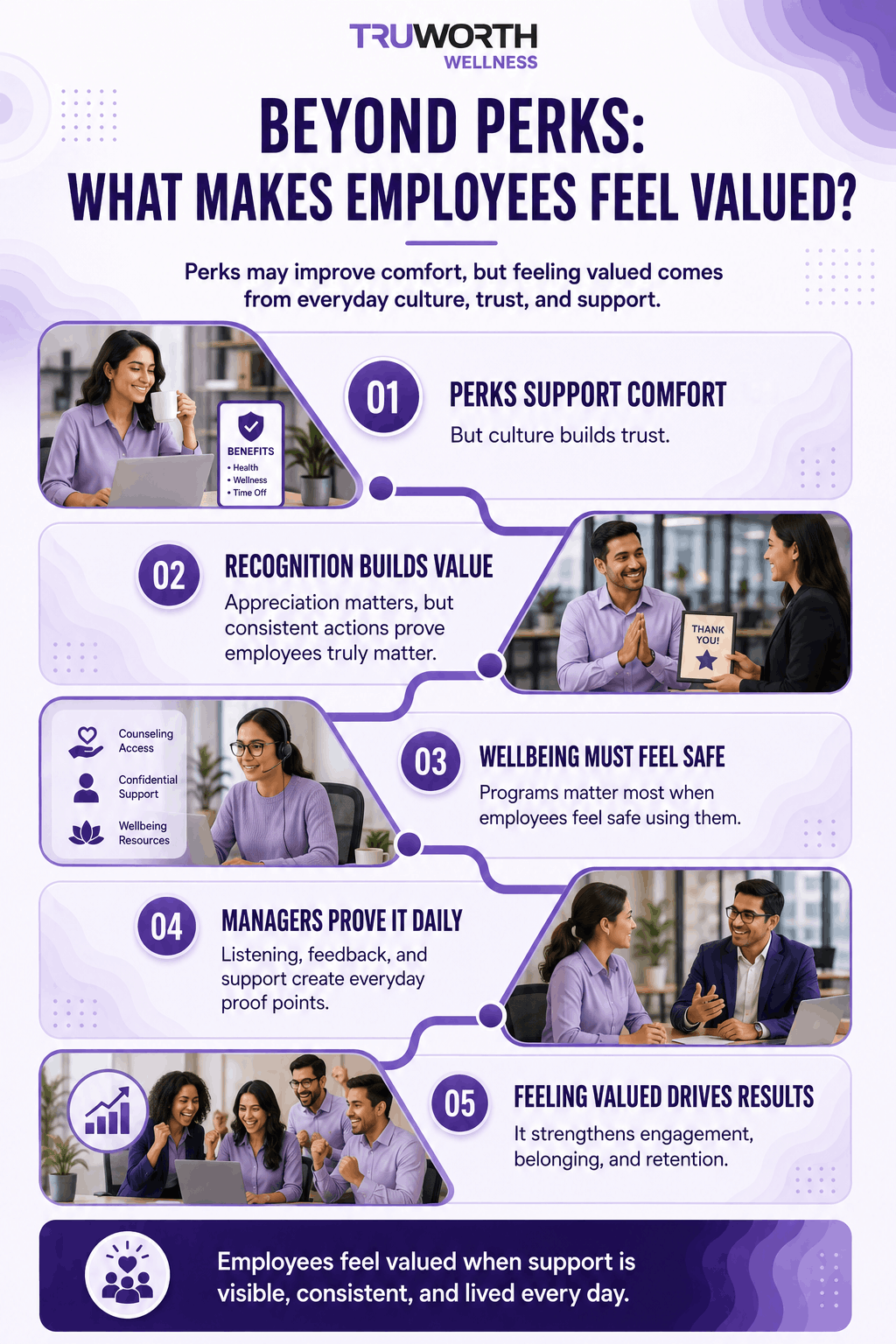
Employees Don’t Just Leave Jobs. They Leave Experiences.
One of the biggest misconceptions about retention is that employees leave only because of salary, role changes, or better opportunities elsewhere. These factors certainly influence decisions, but they are rarely the complete story.
More often, disengagement builds slowly. Employees stop feeling connected to their work, their manager, or the organization itself. They begin to wonder whether anyone notices their effort, whether their growth matters, and whether support will be available when they need it.
By the time a resignation reaches HR, the emotional decision has often been made much earlier. The exit is visible; the erosion of trust usually is not.
That is why feeling valued should not be treated as a soft workplace issue. It sits close to the heart of motivation, engagement, mental wellbeing, and trust. When people feel overlooked, work becomes transactional. They do what is expected, but they stop feeling connected to the organization’s purpose or future.
 Truworth Wellness
Feeling Valued Isn’t About Praise. It’s About Evidence.
Recognition programs matter, but feeling valued goes beyond an award, a monthly appreciation post, or a quick “good job” after a demanding week.
Employees feel valued when they repeatedly experience practical, consistent evidence that they matter.
It often shows up in moments such as:
- Manager moments: Listening before decisions, acknowledging effort, and giving feedback that helps people grow
- Growth moments: Learning opportunities, fair workloads, and visible support during personal or professional challenges
- Early experience moments: First interactions, small wins, and first-week nudges that help new employees feel welcomed, clear, and confident
These moments rarely make headlines, yet together they shape how employees interpret the workplace. They tell people whether the company’s promises are real and whether support is accessible.
Why This Matters for Employee Wellbeing?
When organizations talk about wellbeing, the conversation often revolves around programs: mental health support, Employee Assistance Programs, health checkups, fitness initiatives, nutrition consultations, and digital wellness tools.
These are valuable investments. However, wellbeing is also shaped by everyday experience: how managers respond under pressure, whether employees feel safe asking for help, how fairly work is distributed, and whether the organization creates room for recovery.
An employee who feels ignored or overwhelmed is unlikely to feel psychologically supported simply because resources exist. In contrast, someone who feels respected and heard is more likely to trust the system, speak up early, and use available wellbeing programs before challenges escalate.
Why Your Employees May Be Opting Out Of Wellness?
In many ways, feeling valued becomes the foundation on which other wellbeing initiatives succeed. Without trust, even the best-designed benefits struggle to create lasting impact.
The Difference Between Perks and Culture
Visible benefits are easy to showcase during hiring and employer branding. Culture works differently. It is judged through everyday interactions.
Consider the moments that reveal culture most clearly:
- Flexibility: When an employee requests support for a caregiving need, is the conversation handled with empathy and clarity?
- Stress: When someone says they are struggling, does the manager respond with support or only ask when the work will be done?
- Voice: When a new employee shares an idea, is it explored or dismissed because they are still new?
- Growth: When a high performer asks about development, is there a meaningful conversation or a vague promise to revisit it later?
These moments reveal far more about workplace culture than free lunches or office décor ever will. Culture is not what organizations announce. It is what employees consistently experience.
This Isn’t Just an Office Problem
It is easy to associate employee experience with corporate offices, hybrid teams, and knowledge workers. But the need to feel valued exists across every industry and every role.
- A technician wants their contribution to be recognised.
- A nurse working long shifts wants to know their wellbeing matters.
- A customer service executive wants constructive feedback, not only performance targets.
- A warehouse supervisor wants opportunities to grow.
- A salesperson wants to feel trusted, not constantly monitored.
Whether an organization employs fifty people or fifty thousand, the emotional needs remain remarkably similar. People want to know that their work has meaning and that someone notices the effort behind it.
What Leaders Often Overlook?
Many leaders care about their teams. The challenge is that appreciation often stays inside their heads instead of reaching employees in specific, timely, and believable ways.
Managers may assume people know they are valued because they continue receiving responsibilities. Employees may interpret more responsibility without acknowledgement as simply more work.
Closing that gap does not require grand gestures. It requires consistent behaviours that make value visible.
- Make growth visible: Schedule career conversations instead of limiting growth discussions to annual reviews
- Recognise the right things: Appreciate effort, learning, collaboration, and improvement alongside business outcomes
- Ask before assuming: Check what support employees need instead of deciding for them
- Strengthen early experience: Use first-week check-ins and small wins to create clarity, confidence, and belonging
None of these require significant financial investment. They require attention, manager capability, and a willingness to treat employee experience as daily practice rather than an occasional campaign.
Perhaps It's Time For A Different Conversation
Organizations spend a great deal of time discussing what employees need next. A new benefit, a new engagement initiative, another learning platform, or another wellness programme.
Before introducing something new, it may be worth pausing to examine the everyday employee experience more closely.
Leadership teams could begin by reflecting on questions like these:
- Do employees feel comfortable sharing concerns without worrying about being judged?
- Do managers regularly acknowledge effort, or only notice mistakes?
- Are career conversations happening consistently, or only during performance reviews?
- Do employees understand the support available to them, and do they trust it enough to use it?
- Are recognition programmes authentic, or have they become routine processes?
- Do employees feel their opinions are genuinely considered when decisions affect their work?
- Is wellbeing something employees experience every day, or something they hear about during campaigns?
- When someone is struggling, do managers know how to respond?
- Are we measuring how employees feel, or simply how many benefits we've launched?
- If we asked employees today whether they feel valued, would we be confident in the answer?
The answers to these questions often reveal more than another employee survey ever could. They highlight the everyday experiences that shape trust, engagement, and belonging; long before they appear in an exit interview.
For HR and benefits leaders, this distinction matters. A benefit may be available, but employees will only use it if they trust the environment around it. An onboarding process may be documented, but it will only build belonging if the first few interactions feel intentional.
This is where small design choices can create disproportionate impact:
- Before day one: A welcome message from the manager
- During week one: A plan that balances learning, connection, and contribution
- Through a buddy: Help understanding unwritten team norms
- Through quick wins: A small task that allows the employee to contribute early
- After week one: A check-in that asks what could be easier
When organizations focus on these experiences, engagement becomes stronger, trust grows, wellbeing initiatives gain participation, and retention improves because employees feel connected to something more meaningful than a list of benefits.
How Truworth Wellness Can Help?
Creating a workplace where employees feel valued requires more than standalone perks. It requires a connected wellbeing ecosystem that helps organizations listen better, support employees earlier, and make care easier to access.
Truworth Wellness helps employers move from transactional benefits to meaningful employee care through integrated wellbeing, Employee Assistance Program support, health benefits administration, preventive health initiatives, personalised wellbeing journeys, digital engagement, and data-led interventions.
For HR and business leaders, this means being able to translate good intent into everyday proof points: timely support when employees are stressed, personalised guidance for healthier habits, confidential counselling when someone needs help, preventive care that reaches people before issues escalate, and engagement tools that make wellbeing feel relevant rather than routine.
If your organization wants to build a culture where employees feel seen, supported, and genuinely cared for, Truworth Wellness can help you design a wellbeing approach that is integrated, inclusive, measurable, and aligned with real workforce needs.
Frequently Asked Questions
1. Why is feeling valued at work important?
Feeling valued strengthens trust, motivation, engagement, and belonging. When employees believe their effort is noticed and their wellbeing matters, they are more likely to contribute actively, seek support when needed, and stay connected to the organization’s purpose.
2. Are workplace perks enough to improve employee experience?
Perks can improve comfort and convenience, but they cannot replace respect, recognition, psychological safety, fair workloads, manager support, and growth opportunities. A stronger employee experience is built through consistent everyday actions, not only through visible benefits.
3. How can managers make employees feel valued?
Managers can make value visible by listening actively, acknowledging effort specifically, offering timely feedback, supporting career conversations, checking in during stressful periods, and responding with empathy when employees ask for help.
4. What role does wellbeing play in employee retention?
Wellbeing influences whether employees feel supported during both routine and difficult moments. When wellbeing programs are trusted, accessible, and connected to daily workplace experience, they can help reduce disengagement, encourage early help-seeking, and strengthen long-term commitment.
5. How can organizations measure whether employees feel valued?
Organizations can look beyond participation numbers and examine indicators such as manager check-in quality, employee feedback trends, wellbeing program trust, use of support services, onboarding experience, career conversation frequency, engagement scores, and reasons shared during stay or exit conversations.
6. How does Truworth Wellness support this kind of workplace culture?
Truworth Wellness supports organizations with integrated care and wellbeing solutions that combine preventive health, Employee Assistance Program services, personalised wellness engagement, digital access, and data-led insights. This helps employers create support systems that are easier for employees to trust, understand, and use.
A Final Thought
Work occupies a significant part of people’s lives. Most employees do not expect perfection. They understand that pressure, deadlines, and difficult days are part of every career.
What they hope for is something much more human: to be respected, to be heard, to be supported, and to know that their contribution matters.
Free coffee may brighten someone’s morning. Feeling valued can shape how they remember an organization for years.
The workplaces that understand this difference are rarely the ones with the longest list of employee perks. They are the ones where people leave at the end of the day believing they made a meaningful contribution, and that someone noticed.
For employers, that is the real opportunity: to move beyond benefits as a catalogue and build employee experience as a set of daily proof points. When people feel valued, they do not just stay longer. They contribute with more trust, more energy, and a stronger belief in the organization they are helping to build.