Where Do You Fall In The Window Of Tolerance?

Most workplace conversations around stress focus on workload, deadlines, and productivity. But what often goes unnoticed is capacity.
Understanding Emotional Capacity at Work, Not Just Stress
Why do some employees stay composed under pressure while others feel overwhelmed or shut down? Why do high performers suddenly disengage, even when nothing “major” has changed?
The answer often lies in something called the window of tolerance, a concept introduced by psychiatrist Dan Siegel.
Understanding this is not just useful for individuals. It is critical for organizations that want sustainable performance, not short bursts of output followed by burnout.
What Is the Window of Tolerance?
Your window of tolerance is the emotional and physiological zone where you can function at your best.
Within this window:
- You can think clearly
- You regulate emotions effectively
- You respond thoughtfully instead of reacting impulsively
- You stay engaged and productive
Outside this window, your nervous system shifts into survival mode. This is where performance, communication, and decision-making begin to suffer.
Importantly, this is not a personality trait. It is a state, and it changes based on your environment, stress levels, and recovery.
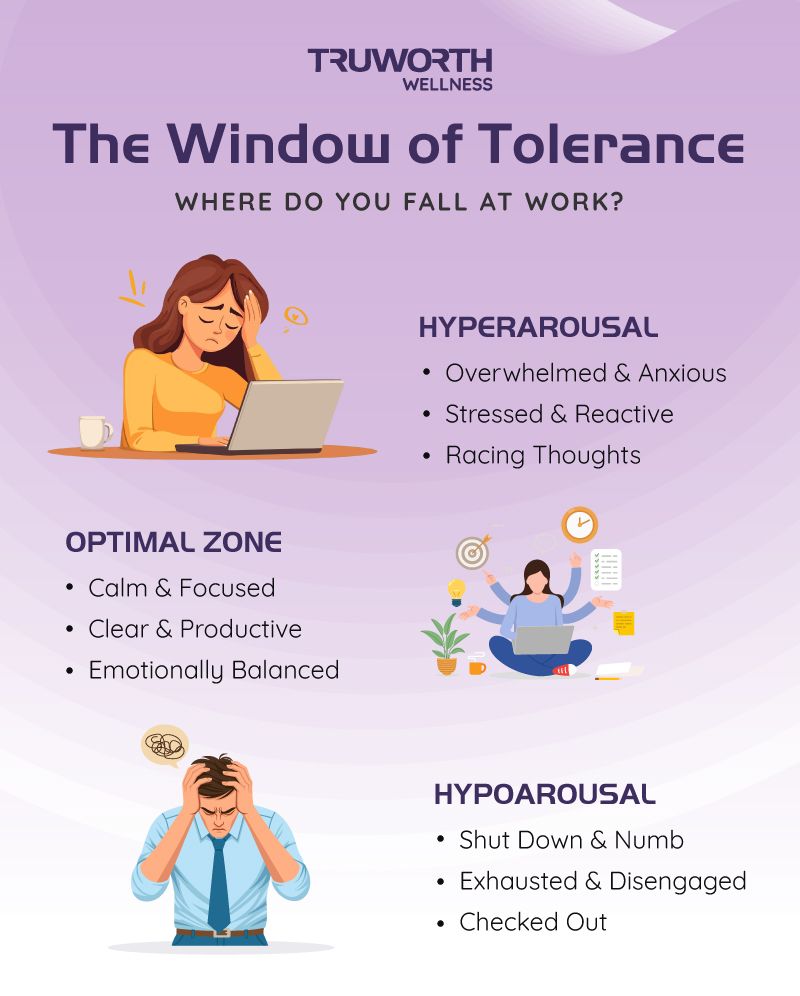
The Three Zones You Move Through
| If You Often Feel | You May Be In | What It Looks Like at Work? |
|---|---|---|
| Calm, clear, focused | Regulated | Consistent performance, strong collaboration |
| Restless, reactive, tense | Hyperarousal | Overwhelm, errors, increased conflict |
| Tired, disengaged, numb | Hypoarousal | Withdrawal, low productivity |
1) The Regulated Zone: Where Performance Feels Sustainable
This is your optimal state.
You are:
- Calm but alert
- Focused and present
- Emotionally balanced
At work, this looks like:
- Managing deadlines without panic
- Listening actively in meetings
- Giving feedback without defensiveness
- Solving problems instead of escalating them
This is not a stress-free state. It is a state where stress is manageable.
Hyperarousal: When Everything Feels “Too Much”
This is the overwhelmed zone, driven by a fight-or-flight response.
You may experience:
- Anxiety, restlessness, or irritability
- Racing thoughts
- Difficulty focusing
- Emotional reactivity
In the workplace, it often shows up as:
- Overreacting to emails or feedback
- Feeling constantly “on edge”
- Jumping between tasks without finishing them
- Struggling to switch off after work
Example: An employee receives a last-minute request and immediately feels panic, frustration, and urgency. Instead of prioritizing calmly, they multitask aggressively and end the day exhausted, with little meaningful output.
Hypoarousal: When You Start to Shut Down
This is the under-stimulated or shutdown zone, driven by a freeze response.
You may feel:
- Disconnected or numb
- Low energy or fatigue
- Unmotivated or withdrawn
- Mentally foggy
At work, this can look like:
- Procrastination despite deadlines
- Avoiding conversations or decisions
- Minimal engagement in meetings
- Doing just enough to get by
Example: An employee facing prolonged stress stops contributing ideas, delays tasks, and feels detached from outcomes. This is often mistaken for lack of interest, when it is actually a protective response.
 Truworth Wellness
A Practical Self-Check: Where Are You Most Often?
You don’t stay in one zone. You move between them throughout the day.
But patterns matter.
A simple daily question helps:
“Am I regulated, overwhelmed, or shut down right now?”
Awareness is the first step to change.
What Shrinks Your Window at Work?
Your window of tolerance narrows when stress is constant and recovery is missing.
Common workplace triggers include:
- Back-to-back meetings with no breaks
- Unclear expectations or shifting priorities
- Lack of psychological safety
- Excessive multitasking and digital overload
- Poor sleep and physical fatigue
- Personal stress spilling into work
Over time, this creates a cycle where employees operate outside their window more frequently, impacting both wellbeing and business outcomes.
What Expands Your Window (And Why It Matters?)
A wider window means:
- Better emotional regulation
- Improved decision-making
- Higher resilience under pressure
- More consistent performance
Here is how individuals and organizations can build it:
Micro-Regulation During the Workday
- Taking short pauses between meetings
- Practicing deep breathing for even 60 seconds
- Stepping away from screens periodically
Small resets prevent escalation.
Clarity and Structure
- Clear goals and realistic timelines
- Defined roles and expectations
- Reduced ambiguity in communication
Clarity reduces unnecessary stress load.
Emotional Awareness and Language
Encouraging employees to identify their state:
“I am feeling overwhelmed right now”
“I am mentally checked out”
This creates a pause between trigger and reaction.
Access to Safe Support Systems
Having spaces where employees can talk without judgment significantly improves regulation.
This includes:
- Confidential counselling
- Manager training on empathetic conversations
- Structured wellbeing programs
Why Organizations Need to Pay Attention?
When employees operate outside their window for prolonged periods, the impact is visible:
- Increased burnout and absenteeism
- Reduced productivity and focus
- Higher attrition
- Poor team dynamics
On the other hand, organizations that actively support emotional regulation see:
- Better engagement
- Stronger collaboration
- Sustainable performance
The difference is not effort. It is capacity.
 Truworth Wellness
Bringing It All Together
The window of tolerance shifts the conversation from “Why can’t employees handle stress?” to “Do employees have the capacity to handle what is being asked of them?”
The goal is not to stay perfectly regulated all the time. That is unrealistic.
The goal is to:
- Recognize when you are outside your window
- Return to regulation faster
- Gradually expand your capacity
This is where real, sustainable performance comes from.
Move from Awareness to Action
Understanding your window of tolerance is a powerful first step. But lasting change requires structured, consistent support.
With Truworth Wellness, organizations can enable employees to:
- Access confidential counselling through Employee Assistance Programs (EAP)
- Build emotional resilience with expert-led interventions
- Identify stress patterns through guided assessments
- Create psychologically safe workplaces that sustain performance
Because when employees are supported to stay regulated, they do not just feel better. They perform better.