A Day In The Life Of An Employee Whose Company Actually Cares About Wellness?

You have seen the posters. "Our people are our biggest asset." There is a fruit bowl on the third floor. The CEO posted a World Mental Health Day message on LinkedIn. Clearly, this is a wellness-forward company.
Right?
Most corporate wellness programs today exist in that exact space: somewhere between good intentions and genuine impact. The gap between the two is not always dramatic. Sometimes it shows up in the smallest moments of an ordinary workday. So let us walk through one.
Meet Riya. She works in two different universes. In one, her company has a "wellness initiative." In the other, her company has built an actual wellness culture. Watch how differently her Tuesday unfolds.
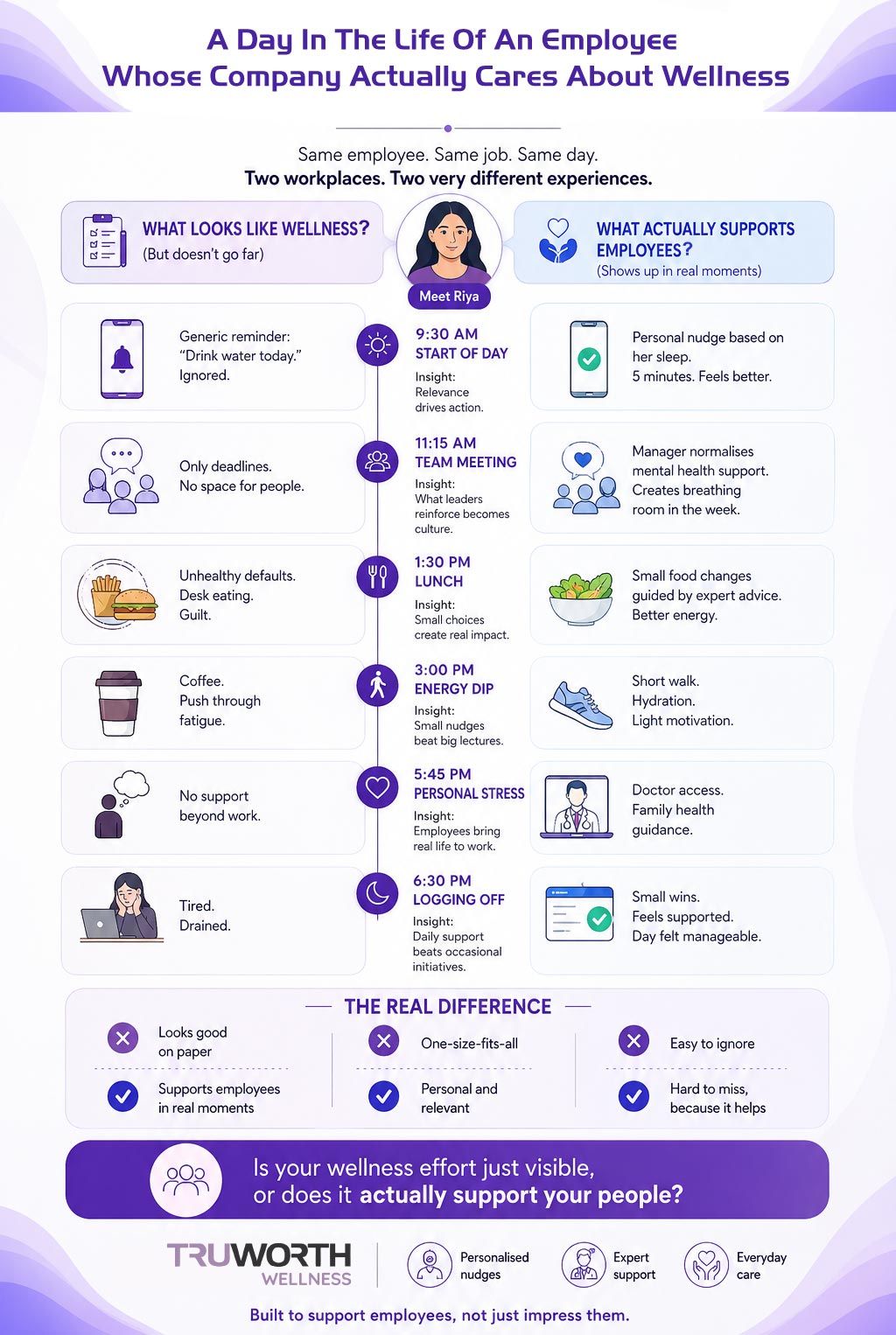
9:30 AM: The Morning Check-In
At XYZ Corp: Riya opens her laptop and sees a notification from the company wellness app she downloaded three months ago and has never opened. It says "Day 1: Drink water today!" She closes it and opens Slack.
At a Truworth-backed company: Riya gets a personalised nudge from her wellness platform. Based on her health assessment from last month, it reminds her that her sleep has been irregular and suggests a five-minute breathing exercise. She does it. It actually takes five minutes.
The difference here is not the app. Both companies have an app. The difference is whether it knows who Riya is, or whether it thinks she is everyone. That distinction is exactly what separates a real wellness platform from a checkbox exercise.
11:15 AM: The Morning Meeting
At XYZ Corp: Riya's manager opens the standup with "we need to push harder this sprint, the client is breathing down our necks." Nobody asks how anyone is doing. This is fine, it is a work meeting. But it is also the only meeting Riya will have today where a human speaks to her in real time.
At a Truworth-backed company: Riya's manager opens the standup with updates, then quietly flags that two team members have used their mental health day this week. He does not name them. He just says, "if anyone is feeling stretched, the EAP line is open and I have blocked an hour Thursday afternoon for non-meeting time."
Nobody made a big deal of it. Nobody had to. The message landed: your health here is not a personal problem to hide. It is a team consideration. This is what a functional Employee Assistance Program actually looks like in practice. Not a hotline number buried in an onboarding document. A culture where it is normal to use it.
1:30 PM: Lunch
At XYZ Corp: The office canteen offers dal fry, white rice, two deep-fried snacks, and something that might once have been a salad. Riya eats at her desk while reading emails because lunch break guilt is a very real corporate condition.
At a Truworth-backed company: Riya had a thirty-minute consultation with a nutrition coach last month through her corporate wellness program. The coach did not put her on a diet. She just helped Riya understand why she crashes at 3 PM every day. (It was the white rice. It is always the white rice.) Today Riya makes one small swap and feels slightly smug about it.
Wellness is rarely about dramatic overhauls. It is mostly about one person having enough information to make one better choice. That is it. That is the whole thing.
3:00 PM: The Slump
At XYZ Corp: Riya feels drowsy. She gets up, gets coffee number three, and wonders if this is just what being an adult feels like. Everyone seems tired. She pushes through.
At a Truworth-backed company: Riya feels drowsy. She gets up and does a five-minute walk because her company has a step challenge running this month and her team is currently in second place, which is personally unacceptable to her. She comes back, drinks water, and somehow the next two hours are fine.
Was it the steps? The water? The mild competitive energy of not letting her team down? Probably all three. This is what new-gen workplace wellness actually looks like. Not a seminar on stress. Tiny, designed moments that nudge people toward better choices without making it feel like a health lecture.
5:45 PM: Something Personal
At XYZ Corp: Riya has been worried about her mother, who has a follow-up appointment this week for a diabetes-related concern. She has nobody at work she can really talk to about this. She briefly considers Googling "how to manage a parent's diabetes" and then gets distracted by another Slack notification.
At a Truworth-backed company: Riya books a fifteen-minute call with a general physician for that evening through her company's wellness platform. She also comes across a resource on caregiver stress, which she did not even know was a category. It helps, even a little. For anyone dealing with something similar, managing chronic conditions is a topic the platform covers in depth for both employees and their families.
This is the part most companies miss entirely. Employee wellness does not begin and end at the office entrance. People carry their full lives into work. A worried daughter is not fully present at her desk, and helping her takes maybe fifteen minutes of access and an ounce of foresight.
6:30 PM: Logging Off
At Acme Corp: Riya closes her laptop. She is tired. She is not sure why. She did not do anything that felt particularly hard today. She just feels worn down in that quiet, accumulating way that does not show up on any health report anywhere.
At a Truworth-backed company: Riya closes her laptop and checks her wellness dashboard. Sleep goal: on track. Step goal: hit. She read one article on managing anxiety during difficult family times and actually saved it. She logs off feeling, if not great, then at least like someone looked out for her today.
So What Is the Actual Difference?
It is not the fruit bowl. It is not the LinkedIn post. It is not even the app.
The difference is whether wellness at your company is a program or a system. Programs have launch dates and quarterly reviews and look great in slide decks. Systems quietly show up at 9:30 AM with a personalised nudge. They sit with a worried daughter at 5:45 PM. They make second place in a step challenge feel like a reason to get off a chair.
If you want to understand what this looks like beyond the typical five-pillar model, this piece on going beyond the typical 5 types of wellness programs is worth a read.
The companies that get this right do not make a big deal of it. They just build the infrastructure so that on an ordinary Tuesday, an ordinary employee feels like she is not entirely on her own.
Is your company's wellness program a poster on the wall, or does it actually show up for your people?
If you are an HR leader thinking about the Riyas on your team, Truworth Wellness builds exactly the kind of everyday wellness infrastructure described above: personalised health nudges, nutrition and mental health access, EAP support, and platforms that treat your employees as individuals, not headcounts.