How CHROs Are Measuring The ROI Of Employee Wellness Programs In 2026?

For years, employee wellness conversations followed a familiar rhythm: launch the initiative, drive participation, celebrate the campaign, and report the numbers.
Organizations organized health camps, introduced Employee Assistance Programs, encouraged webinar attendance, and rolled out digital wellbeing platforms. At the end of the year, HR teams could point to registrations, attendance, assessments completed, and platform sign-ups as evidence of progress.
Those traditional numbers still matter, but they no longer align with the precise insight leadership teams now demand. The priority has shifted from justifying a program's existence to pinpointing the exact organizational changes that occurred as a direct result of investing in employee wellbeing.
Boards, CFOs, procurement teams, and business leaders already recognize the strategic link between wellbeing and performance. Their current focus is more commercial, practical, and urgent: establishing exactly how that investment translates into measurable value.
Why ROI Conversations Are Becoming More Sophisticated?
Employee wellbeing has matured considerably over the past decade. What began as occasional wellness activities has evolved into broader ecosystems that may include preventive healthcare, mental health support, nutrition coaching, health risk assessments, chronic disease management, fitness initiatives, annual health checks, financial wellbeing resources, and counselling access.
As these investments have grown in scale, expectations have changed. Leadership teams no longer want to know only whether a program was launched successfully. They want to understand whether it is influencing employee behavior, improving workforce health, and supporting broader business objectives.
That is not an unreasonable shift. Every significant business investment eventually faces the same discipline.
Wellbeing programs are now being evaluated with similar rigor—not because organizations have become less people-focused, but because they have become more outcome-focused.
Participation Is an Indicator. It Is Not ROI.
A common misconception in employee wellbeing is that high participation automatically signals success. It certainly signals visibility and interest. It does not always signal impact.
Consider two organizations that launch the same wellbeing platform and achieve the same headline registration rate. On paper, both programs appear successful. Twelve months later, however, the difference becomes clear.
In one organization, employees registered during launch week and rarely returned. Preventive healthcare participation remained flat, counselling access stayed low, and the program gradually became another benefit employees knew existed but did not use meaningfully.
In the other, initial registration may have been modest, but employees kept coming back to health coaching, screenings, counselling, lifestyle support, and targeted nudges throughout the year. The difference lies not in the launch moment, but in the continuity of action that follows.
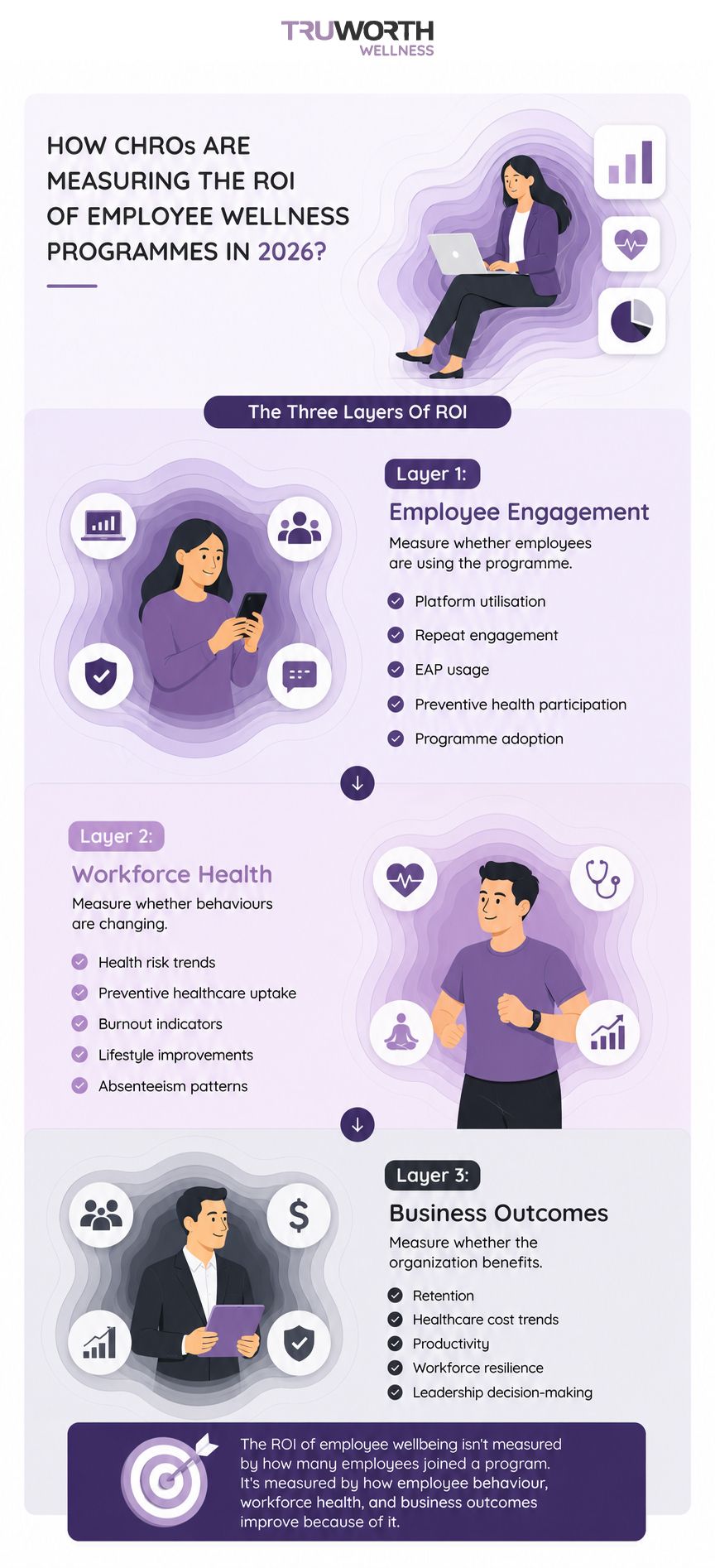
The First Layer of ROI: Are Employees Actually Engaging?
Every wellbeing program begins with engagement, but the first interaction is especially important. If employees experience the program as generic, difficult to access, or disconnected from their needs, meaningful adoption becomes harder to build.
This is where solution-led design matters. The first week after launch should not simply announce a benefit; it should help employees take one small, relevant action. A health risk assessment, a simple screening reminder, a manager-led conversation, or a confidential support prompt can create the first small win that turns awareness into trust.
Utilization, therefore, should be viewed as the beginning of the measurement journey rather than the destination. The more useful questions are:
- Are employees returning to use services beyond their first interaction?
- Which wellbeing resources generate sustained engagement?
- Are counselling services being accessed when employees need them?
- How many employees complete preventive health journeys instead of isolated activities?
- Which employee groups remain underserved?
These questions help HR and benefits leaders understand whether the program is becoming part of employees’ everyday experience rather than remaining a campaign-led initiative. They also reveal where the experience needs to be redesigned; through better communication, more relevant nudges, easier access, or stronger manager enablement—before long-term ROI is judged.
The Second Layer of ROI: Is Workforce Health Improving?
Engagement becomes meaningful when it begins influencing health outcomes. This is where organizations move beyond activity metrics and start examining workforce health trends over time.
Annual health check data, claims trends, counselling patterns, and preventive care participation can reveal whether interventions are producing measurable movement. At this stage, the focus shifts from attendance to improvement.
Leadership teams may begin asking:
- Are lifestyle-related health risks reducing over time?
- Is participation in preventive healthcare increasing?
· Are employees accessing help before concerns escalate?
- Are stress-related concerns being identified sooner?
- Are managers reporting healthier, more resilient teams?
These indicators rarely change overnight. They evolve gradually, which is why year-on-year trend analysis is far more useful than isolated annual reporting.
When organizations connect engagement data with workforce health indicators, they can see whether healthier behaviours are taking root across the employee base. At that point, wellbeing begins to move beyond an HR initiative and becomes part of a broader resilience strategy.
The Third Layer of ROI: Is the Business Seeing a Difference?
The business case becomes stronger when health-related progress starts showing up in organizational performance. Employees are not assets on a spreadsheet, but their ability to stay healthy, supported, and productive has a direct bearing on how the business functions.
The challenge is that these outcomes are rarely immediate. No wellbeing program reduces healthcare costs within a month. Retention does not improve after a single webinar. Productivity is not transformed because employees download an app.
Over time, they begin asking questions such as:
- Has absenteeism changed compared to previous years?
- Are employees using preventive services before issues become acute?
- Are lifestyle-related health risks becoming more manageable?
- Is healthcare utilisation becoming more proactive than reactive?
- Are teams reporting lower levels of burnout?
- Has voluntary attrition improved in employee groups actively engaging with wellbeing programmes?
No single metric tells the complete story. Together, however, these signals help leaders judge whether the investment is improving both employee experience and enterprise performance.
Why Procurement Is Looking Beyond Price?
Employee wellbeing has also become a procurement conversation. Traditionally, vendors were compared on commercials, service scope, implementation capability, and pricing. Those factors still matter, but they are no longer sufficient.
As a result, procurement teams are widening the lens beyond operational delivery:
- Does the vendor provide meaningful utilisation insights?
- Can workforce trends be analysed over multiple years?
- Are recommendations supported by evidence rather than assumptions?
- Does reporting help HR make better decisions?
- Is the programme evolving as workforce needs change?
- Will this partnership still create value three years from now?
The conversation is shifting from selecting a vendor to choosing a strategic partner—one that can help HR and benefits leaders move from benefits administration to measurable workforce value.
The CHRO’s Role Has Changed Too
Perhaps no role has evolved more in this conversation than that of the CHRO. Employee wellbeing was once primarily about delivering programs. Today, it is increasingly about demonstrating organizational value without reducing people to numbers.
The task is to translate employee outcomes into language that resonates across leadership teams. Instead of reporting that 2,000 employees attended wellbeing sessions, a CHRO may show that preventive healthcare participation increased year after year, stress-related concerns surfaced earlier, and managers became more confident initiating wellbeing conversations.
That is a richer, more commercially mature story. It shows that the program is shaping employee action rather than simply generating activity, which makes future investment and renewal conversations significantly stronger.
When Renewal Becomes the Real Test of ROI
The most honest measure of any employee wellbeing program often arrives long after launch: renewal. At that point, organizations must revisit a simple but demanding question: Did this program create enough value to continue investing in it?
That conversation should never be driven by participation numbers alone. A fair renewal review should examine the program through operational, workforce, and business lenses.
Operational Indicators
- Has employee utilisation increased consistently?
- Are employees returning to use services?
- Which programmes generate the highest engagement?
Workforce Indicators
- Are preventive health behaviours improving?
- Are workforce health risks changing over time?
- Has awareness translated into meaningful action?
Business Indicators
- Is the programme supporting broader workforce objectives?
- Is leadership receiving actionable insights?
- Has the investment strengthened employee experience and organizational resilience?
Looking at these indicators together creates a much more balanced assessment than relying on one utilisation percentage or attendance report. It also helps leaders identify where targeted experience improvements like smarter launch nudges, more personalized journeys, simpler access, or stronger manager prompts—can unlock greater value in the next cycle.
A Better Way to Think About ROI
The biggest shift taking place in employee wellbeing is a move from measuring activity to measuring progress.
Activity answers questions such as:
- How many employees attended?
- How many webinars were conducted?
- How many reports were generated?
Progress asks better questions:
- Are employees becoming healthier?
- Are they seeking support earlier?
- Are managers having better wellbeing conversations?
- Are workforce risks becoming more visible?
- Are business decisions becoming better informed?
These questions are harder to answer, but they are also far more useful. They help organizations understand whether wellbeing is becoming a lever for employee experience, organizational resilience, and sharper decision-making.
A Final Thought
Employee wellbeing has never been difficult to justify. Demonstrating its long-term value has always been the greater challenge.
The organizations leading this space in 2026 are not necessarily investing more than everyone else. They are measuring with greater discipline. They understand that participation creates awareness, engagement drives action, healthier habits strengthen the workforce, and stronger workforce outcomes eventually create business value.
That journey cannot be captured through a single dashboard or one annual report. It requires organizations to connect employee experience, workforce health, and business performance into one continuous story.
Because the ROI of employee wellbeing is rarely found in one metric. It becomes visible when employee health, leadership insight, and business performance begin reinforcing one another.
Wellness ROI is strongest when adoption, health movement, and commercial outcomes are measured as one connected value story.