Employee Wellness Programs For Banks That Work During Peak Pressure

Practical wellbeing support for busy banking professionals
Banking employees rarely experience pressure in a steady, predictable way. Audit cycles, financial closures, tax deadlines, regulatory submissions, sales targets and customer escalations create sharp peaks in workload. Yet many employee wellness programs for banks continue to follow a fixed annual calendar, offering support when employees have time rather than when they need it most.
Effective wellness solutions for banking professionals should move with the BFSI calendar. By combining timely stress check-ins, confidential counselling, preventive screenings and short wellbeing activities, banks can make support usable during high-pressure periods without adding another demand to an already crowded day.
Short Answer
What makes a wellness programme work for busy bankers?
It must fit the pressure cycle of banking work. Effective employee wellness programs for banks provide short, accessible and confidential support during audits, closures, target periods and regulatory deadlines. The best wellness solutions for banking professionals combine practical stress support with preventive care, manager action and easy access—not more activities competing for employees’ time.
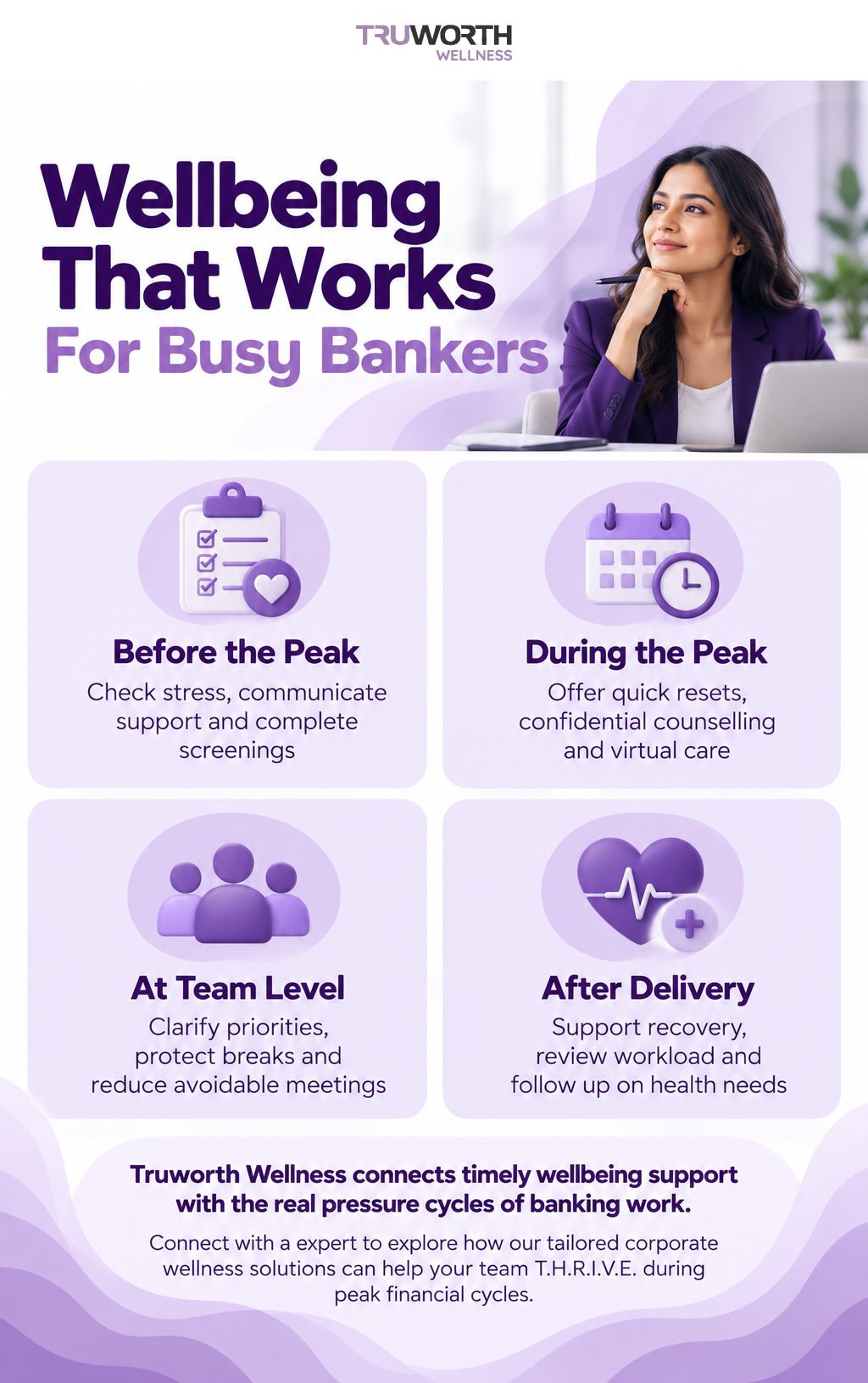
Why Generic Wellness Programmes Fail Busy Bankers?
Traditional wellness calendars often assume employees have consistent time and attention throughout the year. Banking does not work that way. A session that attracts interest during a normal week may be ignored during quarter-end closing or an audit because employees cannot step away from customer queues, reconciliations, reports or approvals.
This does not mean employees are uninterested in wellbeing. It means wellness programs for busy professionals must respect workload reality. If participation requires a 60-minute webinar, several app downloads or a daytime appointment, the people under the most pressure may be the least able to use it.
Peak Periods Create More Than a Time Problem
High workload can affect sleep, concentration, patience, eating patterns and emotional recovery. Employees in customer-facing and target-driven roles may also absorb complaints while managing accuracy and compliance expectations.
The World Health Organization identifies excessive workload, high work pace, long or inflexible hours and low control over workload as psychosocial risks. WHO also estimates that depression and anxiety contribute to 12 billion lost working days and around US$1 trillion in lost productivity globally each year. These are global figures, not banking-specific estimates, but they explain why corporate wellness for BFSI employees should address working conditions alongside individual coping skills.
Growth and Digital Convenience Can Increase Operational Intensity
Digital banking reduces friction for customers, but it can create continuous service, monitoring and fraud-prevention demands for banking teams. According to India’s Ministry of Finance, retail digital-payment volume reached 22,167.90 crore transactions in FY 2024–25, rising 35.04% year on year. This figure does not directly measure employee workload, but it illustrates the scale and pace of the ecosystem in which bank employees operate.
Workplace wellness for bank staff should therefore recognise the combined pressure of customer responsiveness, transaction accuracy, technology change, cyber-risk awareness and regulatory discipline.
How the Banking Calendar Shapes Employee Wellbeing?
Banking stress is often cyclical. A useful strategy maps support to known pressure points rather than treating every month the same.
1) Audit and Compliance Periods
Documentation reviews, reconciliations and evidence requests can increase both workload and fear of error. During these periods, mental wellness programs for bankers should prioritise brief stress check-ins, manager guidance, protected breaks and rapid counselling access.
2) Month End Quarter End and Financial Closure
Closures can extend working hours and compress decision-making. Employee wellbeing programs for financial services can support employees with short recovery prompts, nutrition guidance and access to consultations that do not require long periods away from work.
3) Tax and Regulatory Deadlines
Deadline-driven work often creates a final-week surge. Relevant wellness programs for busy professionals should be communicated before the surge begins, with clear reminders about available support during the peak itself.
4) Sales Campaigns and Target Pressure
Target-driven employees may feel unable to admit that workload is affecting them. Wellness initiatives for target-driven bank employees should include psychologically safe manager conversations and clear boundaries against humiliating or coercive performance practices.
5) Customer Escalations and Fraud Events
Employees handling distressed customers, disputed transactions or suspected fraud can experience emotional strain even when processes work correctly. EAP and wellness support for banking teams should make confidential counselling and post-incident support easy to reach.
What Employee Wellness Programs for Banks Should Include?
The strongest programmes combine organisational action, preventive healthcare and confidential emotional support. They remove friction instead of asking employees to become more efficient at managing impossible demand.
1) Timely Stress Check Ins
Short voluntary check-ins can help employees recognise persistent stress, sleep disruption or emotional exhaustion. Aggregate trends can help HR identify pressure hotspots without exposing individual responses.
For employee wellness programs for banks, timing matters more than survey length. A two-minute check-in before quarter-end may create more value than a detailed annual assessment disconnected from peak workload.
2) Confidential Counselling and EAP Access
Employees need confidence that seeking support will remain private and will not affect performance reviews or career opportunities. Mental wellness programs for bankers should explain confidentiality clearly, repeat the message regularly and offer simple routes to qualified counsellors.
A Deloitte study of 3,995 employees in corporate India examined workplace mental wellbeing and barriers to care, including stigma. Although the research was not limited to BFSI, it reinforces why EAP and wellness support for banking teams must be trustworthy as well as available.
3) Preventive Health Screenings
Long sedentary hours, disrupted meals and postponed appointments can make preventive care easy to defer. Onsite or conveniently scheduled screenings can support blood-pressure, glucose-risk and other appropriate health checks, followed by private explanations and referrals.
Practical wellness solutions for banking professionals connect screening results with next steps. A health camp has limited value if an employee receives a number but no guidance on what it means or where to seek care.
4) Short Accessible Wellbeing Activities
During peak periods, the format should become lighter—not disappear. Five-minute breathing practices, desk mobility, guided resets, sleep support and short nutrition sessions are easier to use than lengthy events.
This is what wellness programs that work for busy schedules look like: useful support that fits between real responsibilities. Well-designed workplace wellness for bank staff should reduce friction, not become another attendance target.
5) Manager Led Workload Practices
Managers influence priority, meeting volume, break access, after-hours messages and psychological safety. Training should help them recognise overload, redistribute urgent work where possible and respond appropriately when an employee asks for help.
WHO recommends organisational interventions that address workplace risks, along with manager training and mental-health literacy. This makes corporate wellness for BFSI employees a shared operating responsibility rather than an HR campaign delivered beside unchanged working conditions.
Wellness Solutions for Banking Professionals Aligned to the BFSI Calendar
A calendar-aligned approach can adapt the format and intensity of support to predictable business demands.
These wellness solutions for banking professionals should be planned around operational pressure rather than added to the calendar as isolated events.
Banking period | Common employee pressure | Useful wellness response |
Pre-audit preparation | Documentation load and fear of error | Stress check-ins, prioritisation guidance and counselling reminders |
Month or quarter end | Extended hours and compressed decisions | Short recovery breaks, virtual consultations and meal support |
Tax or regulatory deadlines | Time pressure and repeated follow-ups | Micro-activities, manager check-ins and rapid EAP access |
Sales campaigns | Target pressure and customer rejection | Resilience support, ethical manager practices and confidential counselling |
Post-peak recovery | Fatigue after delivery | Recovery time, health screening and workload review |
These are not rigid prescriptions. Practical wellness programs for bankers should be adapted to branch operations, central teams, contact centres, technology functions and different workforce groups.
The same principle applies to employee wellbeing programs for financial services beyond banking. Insurance, lending, payments and investment teams have different calendars, but all benefit when support appears before, during and after predictable pressure.
How Managers Can Support Employees During Peak Periods?
Managers do not need to become counsellors. They need the skills and authority to make work safer and help employees reach qualified support.
Their everyday decisions determine whether workplace wellness for bank staff feels practical or disconnected from the realities of the job.
1) Clarify Priorities
When everything is urgent, employees spend additional energy deciding what can wait. Clear daily priorities make wellness programs for high-pressure jobs like banking more credible because wellbeing is supported by practical workload decisions.
2) Protect Short Recovery Time
Encourage real breaks during long closure or audit days. Rotate coverage where possible and avoid treating uninterrupted availability as proof of commitment. These practices help wellness programs for busy professionals translate into behaviour employees can actually sustain.
3) Watch for Changes Without Diagnosing
Managers can notice persistent withdrawal, irritability, unusual errors or visible exhaustion without labelling an employee’s health. They should begin a private, supportive conversation and share appropriate support routes.
4) Avoid Making Wellness Another Target
Participation should be encouraged, not forced or linked to performance ratings. Mental wellness programs for bankers depend on trust, especially when they include counselling or self-assessments.
How Truworth Wellness Supports Banking Workforces?
Truworth Wellness helps organisations align preventive care, mental wellbeing and engagement with the actual rhythm of banking work. Its wellness solutions for banking professionals can combine stress check-ins, confidential counselling, screenings, virtual consultations and short wellbeing activities within a coordinated employee experience.
This approach makes corporate wellness for BFSI employees more responsive across branches, operations centres, contact teams and corporate functions.
For employee wellness programs for banks, journeys can be tailored around audit cycles, closures, regulatory deadlines and target periods. Communications can be timed before peak pressure, while digital access keeps support available when employees cannot attend a scheduled onsite activity.
Truworth Wellness can also help segment workplace wellness for bank staff by role and work setting. Branch employees, relationship managers, operations teams, contact-centre staff and corporate functions may need different formats even when they share the same benefit ecosystem.
With privacy-conscious reporting, organisations can review aggregated participation and broad wellbeing trends without accessing private counselling details. This supports more responsive employee wellbeing programs for financial services while preserving employee trust.
Measuring Whether the Programme Is Working
Event attendance alone cannot show whether a programme is useful. Employers should track whether support is reaching employees during peak periods and whether access is becoming easier.
Relevant measures may include:
- Awareness of available benefits and confidentiality
- Participation during normal and peak workload periods
- Time to access counselling or a virtual consultation
- Screening completion and referral follow-through
- Employee-reported stress, recovery and manager support
- Absence, attrition and overtime trends
- Repeat engagement with relevant services
Together, these measures show whether wellness solutions for banking professionals remain accessible when workload is highest, not only during quieter months.
Strong corporate wellness for BFSI employees connects these measures with operational context. A drop in participation during a closure may indicate poor timing, not low employee interest.
Useful employee wellbeing programs for financial services should also compare access across roles and peak periods so quieter teams do not hide areas where support remains difficult to use.
The aim of employee wellness programs for banks is not to eliminate all pressure from responsible financial work. It is to prevent predictable pressure from becoming unmanaged strain and to make help accessible before employees reach exhaustion.
Making Wellbeing Work When Banking Gets Busy
Banking employees need support most when time is scarce. Generic programmes often lose relevance because they continue unchanged through audits, closures and target cycles.
Calendar-aligned wellness solutions for banking professionals respond differently. They combine manager action, brief interventions, preventive care and confidential support at the moments employees are most likely to need them. This makes employee wellness programs for banks easier to use and more meaningful during the realities of banking work.
The same principle makes wellness programs for busy professionals and mental wellness programs for bankers feel supportive rather than performative.
Help banking teams stay supported through every peak period with Truworth Wellness.
Frequently Asked Questions
Why do wellness programmes have low participation in banks?
Participation often falls when activities clash with customer responsibilities, audits, closures or targets. Programmes become easier to use when communication, duration and access are aligned with the banking calendar.
What are practical wellness programs for bankers?
They may include short stress check-ins, confidential counselling, onsite screenings, virtual consultations, brief recovery activities and manager-led workload adjustments. The right mix depends on employee roles and peak periods.
How can banks support mental health during financial closure?
Banks can clarify priorities, protect short breaks, reduce unnecessary meetings, repeat confidential support information and offer virtual or rapid counselling access throughout the closure period.
What should EAP and wellness support for banking teams include?
It should provide confidential counselling, clear privacy communication, simple access, crisis escalation and relevant preventive or wellbeing services. Managers should refer employees to support without trying to diagnose them.
How can banks measure wellness programme effectiveness?
Measure awareness, access time, participation during peak periods, repeat use, screening follow-through, employee-reported stress and broader absence or attrition patterns. Interpret these measures alongside changes in workload and staffing.