Employee Wellness V/S Employee Engagement: Key Differences

They are often used as if they mean the same thing. They do not. And confusing them leads to programs that measure the wrong outcomes and miss the people who need support most.
Employee wellness and employee engagement are two of the most used terms in Indian HR conversations. They appear in the same breath, in the same strategy documents and sometimes in the same sentence, as if they describe the same organisational priority.
They do not.
The confusion between them is not just a semantic issue. It produces wellness programs designed to drive engagement rather than health, engagement programs mistaken for wellness interventions and measurement frameworks that report high engagement scores while employee health quietly deteriorates.
Understanding the actual difference between wellness and engagement, and how they relate to each other, is the starting point for building programs that genuinely serve both.
What Employee Wellness Actually Means?
Employee wellness refers to the overall health and wellbeing of employees across physical, mental, financial and social dimensions.
It covers:
- Physical health including chronic disease risk, metabolic health, cardiovascular health and physical fitness
- Mental health including stress levels, anxiety, depression risk, burnout and psychological safety
- Financial wellbeing including financial stress, debt burden and financial literacy
- Social wellbeing including connection, belonging and the quality of workplace relationships
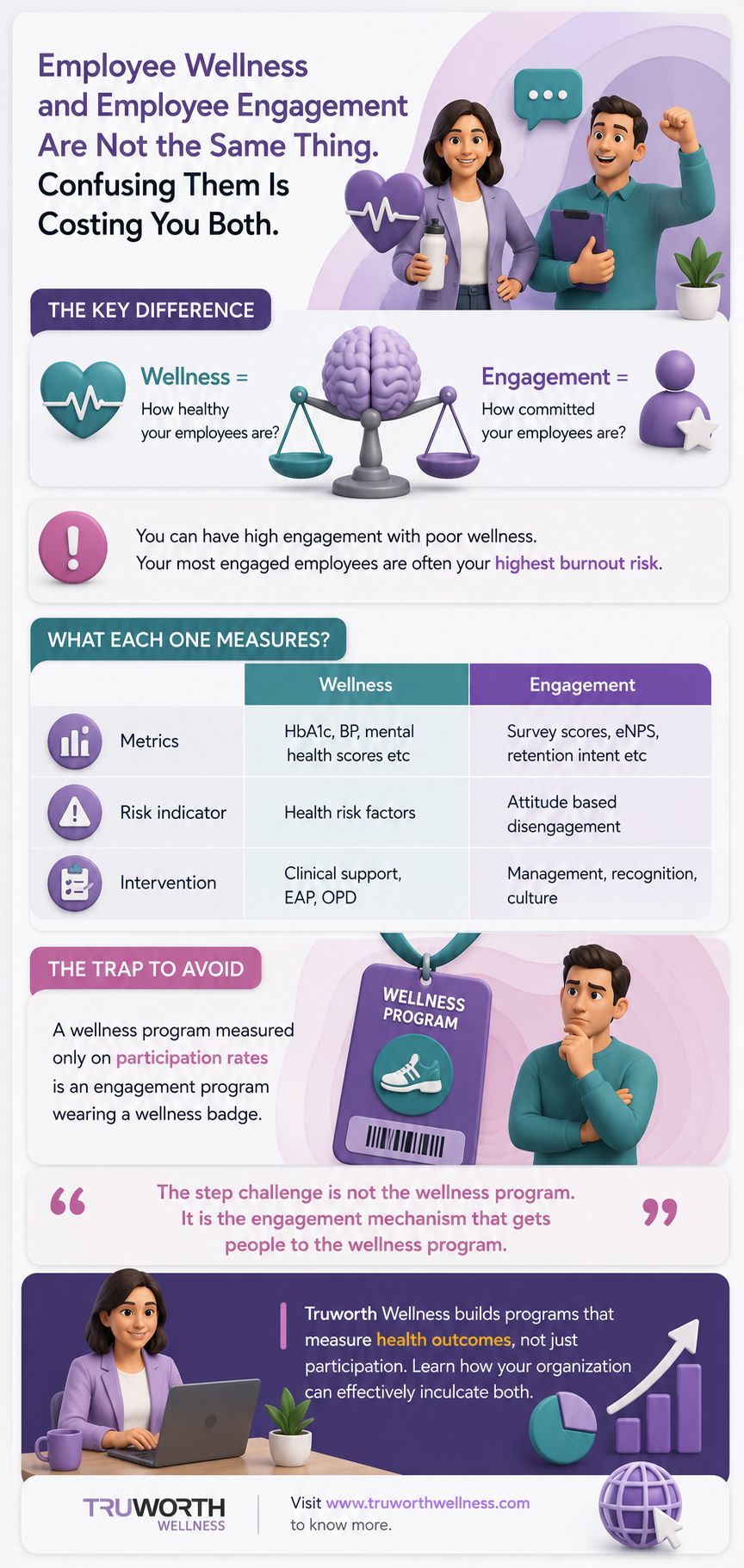
Wellness is about how an employee is, in a clinical and human sense. It is measurable through health data, health risk scores, utilisation of health support services and over time through health outcomes.
Critically, wellness can be poor even when engagement is high. The high performer who loves their work, is deeply engaged with the organisation's mission and consistently exceeds their targets is not necessarily well. They may be running on chronic stress, poor sleep and unmanaged anxiety in a way that their engagement metrics completely mask.
Which Engagement Elements Should You Prioritize In Wellness Programs Based On Organizational Goals?
What Employee Engagement Actually Means?
Employee engagement refers to the degree to which employees are emotionally invested in their work and their organisation. It is about how committed employees are, how motivated they are to contribute and how connected they feel to the organisation's purpose.
Engaged employees:
- Go beyond the minimum requirements of their role
- Feel a sense of pride in their organisation
- Are unlikely to leave unless significantly better opportunities arise
- Actively contribute to a positive culture
- Advocate for the organisation externally
Engagement is measurable through surveys, eNPS scores, participation in discretionary activities, advocacy behaviour and retention data.
Critically, engagement can be high even when wellness is poor. In fact, some of the most engaged employees in an organisation are carrying the highest health load, precisely because their commitment drives them to push through warning signs that less engaged employees would respond to by pulling back.
Where the Confusion Comes From?
The two concepts are related. Wellness affects engagement and engagement affects wellness. But they are not the same thing and the relationship between them is not simple.
1) High engagement does not guarantee good wellness
A highly engaged employee is one who cares deeply about their work and their organisation. That caring is often expressed through working longer hours, taking on additional responsibility, suppressing personal health needs in favour of professional commitments and pushing through physical and mental health warning signs because the work feels too important to step back from.
The most engaged employees in many organisations are among the highest burnout risks. Their engagement is the mechanism through which their wellness is being depleted.
Programs designed to increase engagement without simultaneously protecting wellness may be accelerating the very depletion they are meant to address.
2) Wellness programs are sometimes designed as engagement tools
Step challenges, wellness challenges and team-based health competitions are effective engagement tools. They create social connection, shared experience, friendly competition and visible organisational investment in employee health. These are valuable outcomes.
But they do not address iron deficiency anaemia. They do not catch prediabetes. They do not provide support for an employee managing anxiety or a personal crisis. They engage without necessarily improving health.
When wellness programs are evaluated primarily on engagement metrics, participation rates, challenge completion and app download numbers, the programs that perform best on those metrics are not necessarily the ones producing the best health outcomes.
The Four Key Differences
1. What they measure?
Wellness measures health outcomes: HbA1c trends, blood pressure, mental health scores, EAP utilisation, sick day rates, chronic disease incidence.
Engagement measures attitudinal and behavioural outcomes: survey scores, eNPS, discretionary effort, advocacy, retention intent.
2. What causes poor outcomes?
Poor wellness is caused by health risk factors: genetic predisposition, lifestyle factors, working conditions that drive physical or mental health deterioration, inadequate access to healthcare.
Poor engagement is caused by attitudinal factors: poor management, misalignment with organisational values, lack of recognition, inadequate growth opportunity, poor culture.
3. Who is most at risk?
In wellness terms, the highest-risk employees are often those with specific health risk profiles: metabolic dysfunction, high stress, poor sleep, chronic conditions, iron deficiency, cardiovascular risk factors. These employees may be invisible to wellness programs designed around participation.
In engagement terms, the most disengaged employees are often visible: they are the ones flagged in performance reviews, the ones who seem checked out, the ones HR is already aware of.
The overlap between the two groups is real but incomplete. The high-performing, highly engaged employee with unmanaged health risk is in the wellness risk category but entirely invisible to engagement-focused programs.
4. What interventions work?
Wellness improves through health screening, clinical support, access to healthcare, condition management, nutrition coaching, sleep support, EAP access and the structural changes that reduce health-damaging working conditions.
Engagement improves through management quality, recognition programs, career development, cultural investment, purpose alignment and the relational aspects of the employment experience.
Some interventions serve both. A manager who is trained to notice struggling employees and make EAP referrals is doing something that supports both wellness and engagement. A flexible working policy that reduces stress and supports work-life balance improves both wellness and engagement. These are the high-leverage interventions worth prioritising.
Why Both Matter and How They Interact?
Wellness and engagement are not in competition. The healthiest, most high-performing organisations invest intentionally in both. But they do so with clarity about which outcomes each investment is designed to produce and how the two relate.
The relationship looks like this:
- Good wellness enables engagement: An employee who is physically healthy, mentally well, financially stable and socially connected has the resources to bring genuine commitment and energy to their work. Wellness is the foundation that makes sustainable engagement possible.
- Good engagement supports wellness: An employee who feels connected to their purpose, valued by their organisation and supported by their manager is more resilient to the stressors that drive poor health outcomes. Engagement provides the psychological resources that buffer against wellness deterioration.
- They reinforce each other when both are invested in: They undermine each other when one is neglected. The high-engagement, low-wellness organisation is burning through its most committed people. The high-wellness, low-engagement organisation is healthy but directionless.
The goal is both.
How Truworth Wellness Approaches the Distinction?
Truworth Wellness designs wellness programs that measure health outcomes, not just engagement metrics. The Health Risk Assessment generates health data that tracks genuine physical and mental health trends over time. EAP utilisation, condition management participation and clinical health marker improvements are the primary measures of program success.
This does not mean engagement is ignored. The platform includes gamification, team challenges and social wellness features that drive engagement with the wellness program. But the engagement is designed to serve health outcomes rather than substitute for them.
The step challenge is not the wellness program. The step challenge is the engagement mechanism that gets employees to notice and think about their health, with the clinical infrastructure of the HRA, the EAP and the OPD benefit there to support the health outcomes that actually matter.