Flexible Work Isn’t Just For Parents Of Toddlers Anymore!

For years, workplace flexibility has been framed as a benefit for new parents. The conversation usually revolves around daycare pickups, sick days, and sleep deprivation. Once children grow older, the assumption quietly changes. Parents are expected to “settle back in,” work longer hours, travel more, and operate as if home life has stabilised.
But parenting does not get easier as children grow. It gets more complex.
Parents of teenagers are navigating some of the most emotionally demanding years of family life, often while they are in peak career roles. The need for flexibility does not disappear when a child learns to tie their shoelaces. It simply changes form.
Also Read: Flexibility & Total Well-Being For Corporate Wellness
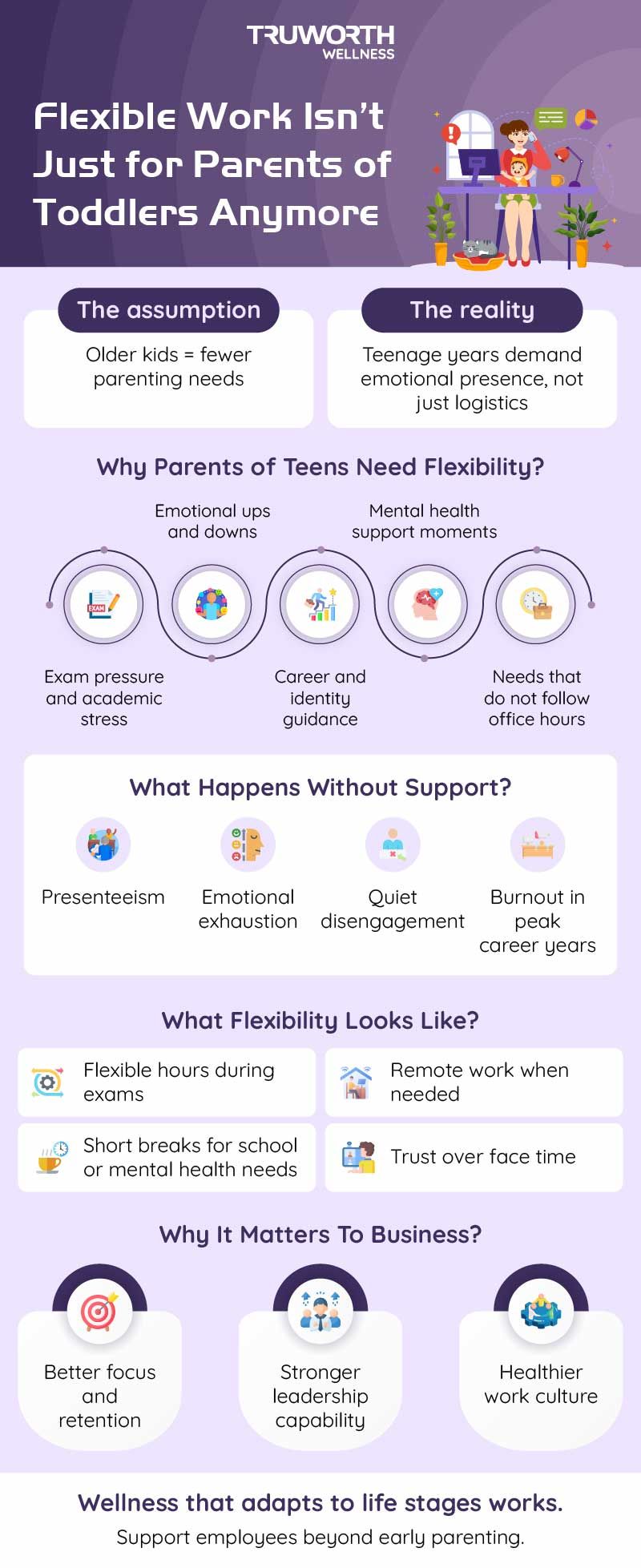
The Overlooked Reality Of Parenting Teenagers
Teenage years are marked by transition. Academic pressure intensifies, emotional regulation is still developing, and identity questions become louder. For working parents, this often means:
- Supporting exam preparation and performance anxiety
- Managing emotional outbursts, withdrawal, or mood swings
- Addressing mental health concerns such as stress, anxiety, or low self-esteem
- Guiding career and education decisions that feel high stakes
Being emotionally available during moments of crisis, not just physically present
These challenges do not follow a 9 to 5 schedule. A difficult school day can spill into the evening. A panic attack may happen before an important meeting. A conversation about career direction may need time, patience, and presence.
None of this fits neatly into traditional workplace expectations.
Why The “Older Kids Need Less Support” Assumption Is Wrong?
One of the biggest misconceptions in corporate culture is that older children are more independent and therefore less demanding. In reality, teenagers often need less logistical support and more emotional support.
Unlike toddlers, teens can articulate distress, but they cannot always manage it. Unlike younger children, their problems are not easily solved with a quick fix. They need adults who can listen, stay calm, and guide without controlling.
This kind of parenting requires emotional bandwidth. When workplaces remove flexibility too early, parents are forced to choose between being present at home and being fully engaged at work.
That tension does not disappear. It turns into chronic stress.
Also Read: How To Deal With Stress At Work : Things You Should Know
The Cost Of Ignoring This Stage Of Parenthood
When organisations fail to acknowledge the needs of parents of teenagers, the impact shows up in subtle but measurable ways:
- Increased presenteeism, where employees are physically present but mentally preoccupied
- Higher emotional exhaustion and irritability
- Reduced focus during high pressure projects
- Quiet disengagement from growth opportunities
- Guilt driven overworking that accelerates burnout
Many of these employees are experienced professionals, people leaders, and subject matter experts. Losing their energy or long term commitment is not just a wellbeing issue. It is a business risk.
Flexibility For Teens Looks Different
Supporting parents of teenagers does not mean unlimited time off or reduced accountability. It means recognising that flexibility at this stage is about control and predictability, not absence.
Examples include:
- Flexible start or end times during exam periods
- Remote work options during emotionally intense phases at home
- The ability to step away briefly for school related or mental health appointments
- Understanding that performance may fluctuate temporarily during family transitions
- Managerial trust instead of rigid face time expectations
These adjustments are often small, but their impact is significant. They allow employees to show up with less guilt and more focus.
Also Read: Help Employees Overcome Financial Stress & Mental Health Challenges!
Why This Is A Leadership Issue, Not A Personal One?
Employees rarely talk openly about parenting teenagers at work. There is a fear of being seen as distracted or less ambitious. As a result, managers may misinterpret signs of stress as disengagement.
This is where leadership maturity matters.
Supporting employees through different life stages requires moving beyond one size fits all policies. It requires managers who can offer flexibility without prying, empathy without overstepping, and clarity without pressure.
When leaders normalise conversations around evolving caregiving needs, they create psychological safety. That safety directly influences performance, loyalty, and trust.
The Link Between Teenage Parenting And Emotional Fitness At Work?
Parenting a teenager demands patience, emotional regulation, and perspective. These are the same skills required for effective leadership, conflict management, and decision making at work.
However, when parents are depleted, these strengths cannot surface.
Organisations that invest in emotional fitness, stress management, and mental resilience are not just supporting parents. They are strengthening leadership pipelines and team culture.
This is where corporate wellness must evolve from surface level benefits to deeper, life stage aware support.
Also Read: Office Politics: Resolving Conflicts/Issues At Work
Rethinking Parental Support In The Workplace
If workplace policies stop supporting parents once children enter school, they are missing a critical window. The teenage years are when guidance, presence, and stability matter the most.
Forward thinking organisations are beginning to ask better questions:
- Do our flexibility policies account for different stages of parenting?
- Are managers trained to respond to life stage stress without judgement?
- Do our wellbeing initiatives address emotional load, not just physical health?
- Are we retaining our most experienced employees through their most demanding personal years?
The answers to these questions shape the future of work more than perks ever will.
Where Corporate Wellness Can Step In?
At Truworth Wellness, we work with organisations to design wellbeing strategies that reflect real life, not ideal scenarios. This includes recognising that parenting challenges do not end after early childhood.
Through emotional fitness programs, stress resilience workshops, and manager sensitisation initiatives, organisations can support employees navigating complex life stages, including parenting teenagers.
When employees feel supported beyond the obvious milestones, they stay engaged, loyal, and mentally present.
The Bottom Line
Flexible work was never meant to be a short term benefit. It is a long term tool for sustaining performance across changing life demands.
Parents of teenagers are not asking for less responsibility. They are asking for realistic support.
And when workplaces get this right, everyone benefits.