Everything Is Good At The Workplace, Yet You Feel Lost?

On paper, everything looks right. You have a stable job, decent pay, supportive colleagues, manageable work hours, and even appreciation from your manager. There are no major complaints, no obvious red flags, no dramatic burnout episodes. And yet, somewhere between logging in and logging out, you feel oddly disconnected.
You wake up on workdays without dread, but also without excitement. Tasks get done, meetings are attended, deadlines are met, but something feels missing. A quiet sense of confusion lingers. You ask yourself, “Why do I feel lost when nothing is actually wrong?”
If this resonates, you are not alone. This is one of the most under-discussed emotional states in modern workplaces, especially among high-functioning professionals. It is subtle, uncomfortable, and often dismissed because it does not fit the typical narrative of stress or burnout.
Let us unpack what is really happening.
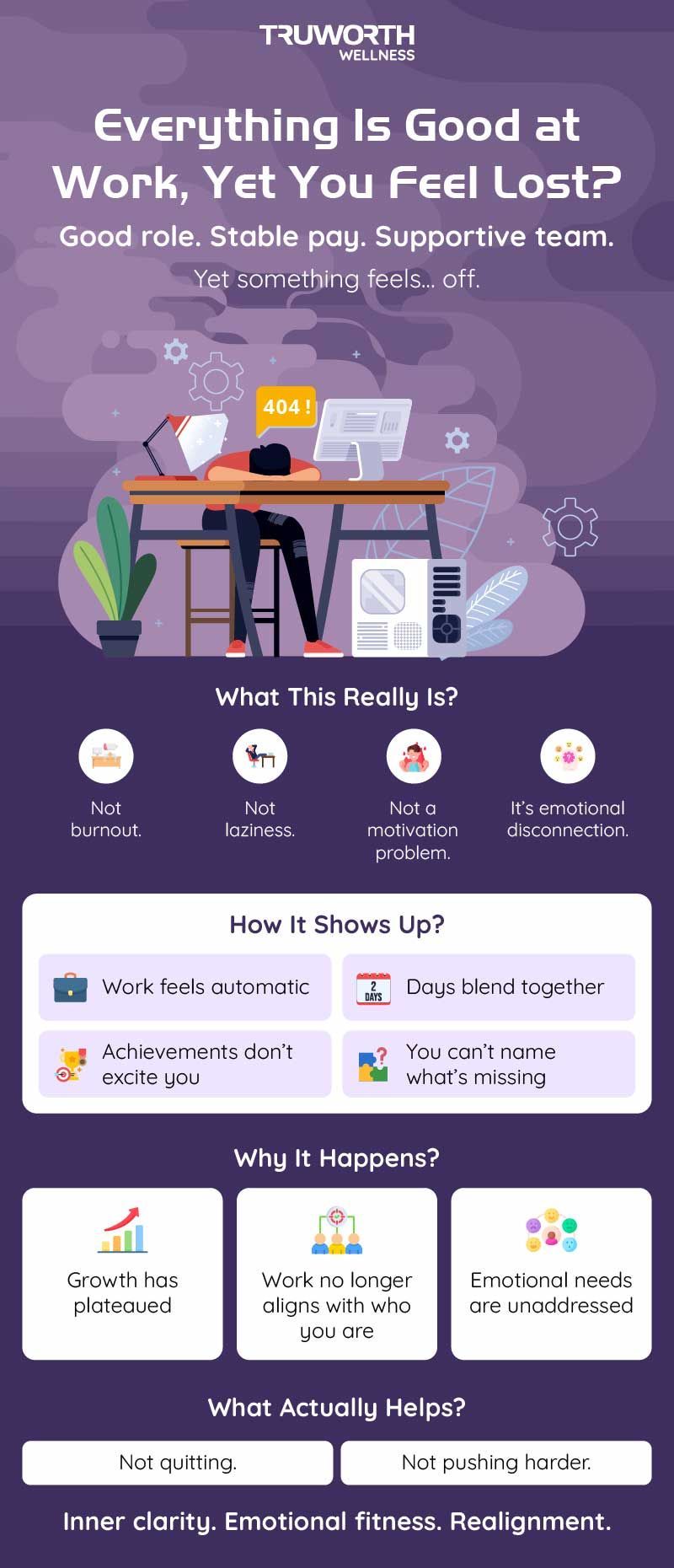
When ‘Fine’ Becomes the Problem
Workplace conversations often revolve around extremes. Either you are overwhelmed, burned out, or deeply dissatisfied, or you are expected to be grateful and motivated. There is very little space to talk about the in-between state, where everything is technically fine, yet emotionally unfulfilling.
This feeling of being lost is not laziness, entitlement, or lack of ambition. In many cases, it is a sign of emotional stagnation rather than emotional exhaustion.
You are functioning well, but not growing in ways that feel meaningful to you anymore.
Common Signs You Might Be Experiencing Workplace Drift
This state often shows up quietly. Some common indicators include:
- You complete tasks efficiently but feel emotionally detached from outcomes
- Workdays blur into each other with little sense of progress
- You feel restless even after achieving goals
- You struggle to explain what exactly feels wrong
- You fantasize about change but feel unclear about what kind
- You feel guilty for feeling dissatisfied when others seem to be struggling
Because these signs are not disruptive, they often go unnoticed by managers and even by the individuals experiencing them.
Also Read: 5 Practices To Boost Emotional Well-Being
Why This Happens Even in “Good” Workplaces?
1) Success Without Alignment
Many professionals build careers based on early decisions driven by security, societal expectations, or external validation. Over time, personal values evolve, but job roles often do not. When work no longer aligns with who you are becoming, a sense of internal conflict emerges.
You are successful, but the success no longer feels personal.
2) Growth Plateaus
Learning and challenge are essential for psychological engagement. When roles become predictable, even comfortable ones, the brain switches to autopilot. Without stimulation or stretch, motivation fades, not because you are incapable, but because you are under-engaged.
3) Identity Overlap
In many corporate cultures, identity becomes tightly tied to performance. When work is stable but not inspiring, people struggle with a deeper question: “If this is not energizing me anymore, who am I becoming?”
This is less about the job itself and more about meaning.
4) Emotional Needs Are Ignored
Most workplaces address physical health and productivity metrics far more than emotional wellbeing. Feelings like confusion, lack of purpose, or quiet dissatisfaction rarely find space in corporate conversations, leaving employees to internalize them.
Why Ignoring This Feeling Is Risky?
Because this state is not acutely painful, many people push through it for years. However, unresolved emotional drift often leads to:
- Gradual disengagement
- Reduced creativity and initiative
- Increased cynicism
- Sudden burnout without warning
Impulsive career decisions driven by frustration
By the time action is taken, the issue feels much larger than it originally was.
This Is Not a Motivation Problem
One of the biggest misconceptions is assuming that feeling lost means you need more motivation, discipline, or gratitude. In reality, this is rarely about effort.
You are already performing.
What is missing is emotional clarity.
What You Actually Need: An Inner Reset
Feeling lost at work often signals a need to pause and recalibrate, not escape. Before changing roles, companies, or careers, it is important to reconnect with:
What currently matters to you
What drains versus nourishes your energy
What kind of growth feels meaningful now
What success means at this stage of life
This process requires emotional awareness, not just career planning.
The Role Of Emotional Fitness At Work
Emotional fitness is the ability to understand, process, and respond to internal experiences with clarity rather than avoidance. In corporate settings, this is critical because emotional states directly influence focus, decision-making, collaboration, and long-term engagement.
Employees who are emotionally fit are not always the most energetic, but they are self-aware, resilient, and aligned. They recognize when something feels off and know how to address it constructively.
Also Read: How To Gain Mental Clarity: Psychological Tricks And Activities
How Organizations Can Support Employees Who Feel Lost?
This feeling is not just an individual issue. It is a systemic one.
Forward-thinking organizations are beginning to:
- Normalize conversations beyond stress and burnout
- Offer emotional wellbeing programs, not just physical wellness
- Create spaces for reflection, not only performance reviews
- Support inner clarity, purpose, and resilience
- When employees feel seen beyond output, engagement naturally improves.
Small Steps Employees Can Take Today
If you are experiencing this sense of being lost, consider starting with these gentle steps:
- Name the feeling without judgment
- Reflect on what has changed internally, not externally
- Track moments that energize versus drain you at work
- Talk about it with a coach or wellbeing professional
- Avoid making drastic decisions from emotional fog
- Clarity comes from understanding, not rushing.
Where Structured Wellness Support Makes a Difference
This is where corporate wellness needs to evolve. Traditional programs often focus on stress reduction or fitness challenges. While useful, they do not address emotional drift, lack of meaning, or internal misalignment.
At Truworth Wellness, programs are designed to go beyond surface-level wellbeing. By focusing on emotional fitness, self-awareness, and sustainable inner resilience, employees are supported not just to perform, but to feel connected to their work and themselves again.
When people regain clarity, motivation returns naturally, without pressure or force.
Final Thoughts
Feeling lost at work when everything looks good on the outside does not mean something is wrong with you. It means something within you is asking for attention.
This is not a failure phase. It is often a transition phase.
When workplaces and individuals learn to listen to this quiet signal, it becomes an opportunity for growth, alignment, and renewed purpose rather than a silent struggle.
Because sometimes, the most important reset is not changing your job, but reconnecting with yourself.