Leaders, You Might Be Quietly Damaging Psychological Safety

It is a typical Monday meeting.
A junior team member notices a flaw in the plan. It is small now, but it could become expensive later. They open their mouth, pause, and then say nothing.
The meeting moves on. The plan gets approved. No one realises what was left unsaid.
This is not a lack of ideas. It is not disengagement. It is a quiet calculation.
“Is it safe to speak here?”
Most employees ask this question every day. And most leaders believe the answer is yes.
That gap is where psychological safety breaks.
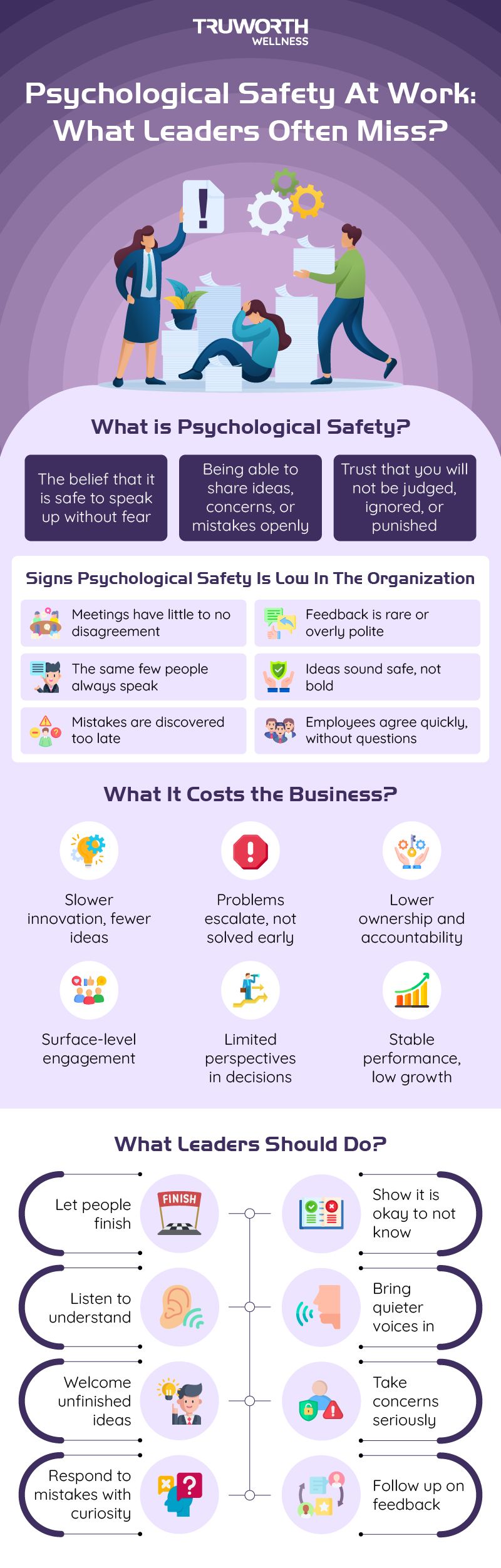
What is Psychological Safety (Simple Explanation)
Psychological safety is not about being nice all the time. It is not about avoiding tough conversations.
It is about whether people feel safe enough to speak honestly without fear of embarrassment, punishment, or being dismissed.
In simple terms, it answers one question.
“If I say what I really think, what will happen to me?”
In workplaces with high psychological safety, people ask questions, admit mistakes, and challenge ideas. Not because they are encouraged once, but because they trust what will happen next.
In workplaces without it, silence becomes a strategy. People filter themselves. They choose what is safe to say, not what is true.
The Leadership Blind Spot
Most leaders do not wake up thinking, “I will make my team feel unsafe today.”
In fact, many believe they are approachable, fair, and open to feedback.
The problem is not intention. It is perception.
Small, everyday behaviours send signals. These signals are often stronger than policies, values, or leadership messages.
A leader might think they are being efficient, decisive, or helpful. The team might experience the same behaviour as dismissive, intimidating, or unsafe.
Psychological safety rarely breaks in big moments. It erodes in small ones, repeated over time.
 Truworth Wellness
Subtle Behaviours That Damage Psychological Safety
1) Interrupting or Finishing Sentences
Sometimes, speed takes priority over understanding.
Why it seems harmless?
You are trying to move the conversation faster or show that you understand.
What it signals?
“Your full thought is not worth hearing.”
Over time, people stop trying to express complex or unfinished ideas. They simplify, or worse, they stay silent.
Top Skills For New Managers To Focus On
2) Rewarding Only “Perfect” Outcomes
High standards can quietly turn into fear of failure.
Why it seems harmless?
You want high standards. You celebrate success.
What it signals?
“Only flawless work is safe here.”
This discourages experimentation. People avoid taking risks because failure feels visible and costly. Innovation quietly slows down.
Also read: Role Managers Play In Employee Well-Being
3) Dismissing Concerns Quickly
Efficiency can sometimes come at the cost of listening.
Why it seems harmless?
You are solving problems quickly. You do not want to dwell on negativity.
What it signals?
“Your concern is not important enough to explore.”
Even a quick “that is not an issue” can shut down future input. Employees start filtering what they share.
4) Being Overly Solution-Focused
Helping too quickly can reduce space for thinking.
Why it seems harmless?
You are being helpful. You jump in with answers.
What it signals?
“I trust my thinking more than yours.”
When leaders constantly provide solutions, teams stop thinking independently. They wait for direction instead of contributing ideas.
Authority Without Intimidation: A Modern Leadership Skill
5) Reacting Strongly to Mistakes
Emotional reactions often leave a longer impact than the mistake itself.
Why it seems harmless?
You care about outcomes. Mistakes have consequences.
What it signals?
“Mistakes are dangerous here.”
Even a raised tone or visible frustration can create fear. People start hiding errors instead of addressing them early.
6) Praising Only the Loudest Voices
Visibility often gets mistaken for value.
Why it seems harmless?
You are acknowledging visible contributors.
What it signals?
“Speaking up is valued, but only in a certain way.”
Quieter employees, or those who think differently, begin to feel invisible. Diversity of thought reduces without anyone noticing.
7) Not Following Up on Feedback
Silence after feedback is a message in itself.
Why it seems harmless?
You are busy. Priorities shift.
What it signals?
“Your input does not lead to action.”
When feedback disappears into a void, people stop giving it. Silence becomes efficient.
Truworth Wellness
The Cost of Low Psychological Safety
The impact is not always dramatic. It is gradual, and that is what makes it dangerous.
Innovation drops because people stop sharing half-formed ideas. Only safe, polished thoughts make it to the table.
Errors go unreported. Small issues grow into larger problems because no one wants to be the bearer of bad news.
Engagement becomes superficial. Employees participate, but only at the surface level. They do what is required, not what is possible.
Thinking reduces. Compliance increases. Teams stop challenging decisions and start executing them without question.
From a business perspective, this is not just a culture issue. It is a performance risk.
Must Check: Why Your Wellness Partner Should Be A Culture Builder? (Not Just A Health Partner)
What Leaders Should Change?
Improving psychological safety does not require large programs. It requires small, consistent behaviour shifts.
- Pause before responding: Let people finish. Silence for a few seconds shows that you are listening, not waiting to speak.
- Acknowledge before solving: Instead of jumping to solutions, say, “That is a valid concern” or “Tell me more.” This keeps the conversation open.
- Normalise mistakes: Share your own missteps. Talk about what you learned. This makes it safer for others to do the same.
- Reward thinking, not just outcomes: Recognise effort, ideas, and attempts, even when they do not succeed.
- Ask better questions: Instead of “Any questions?”, ask “What might we be missing?” or “What would you challenge here?”
- Follow through on feedback: Even a small update builds trust. It shows that speaking up leads somewhere.
These are not dramatic changes. But over time, they reshape how safe people feel in everyday moments.
Where Wellbeing and Psychological Safety Intersect?
Psychological safety is not just a leadership concept. It is deeply connected to emotional wellbeing.
When employees constantly filter themselves, it creates stress, self-doubt, and fatigue. Over time, this affects not just performance, but overall mental health.
This is where organisations need structured support. Platforms like Truworth Wellness help bridge this gap by combining behavioural insights, emotional wellbeing support, and culture-focused interventions. When psychological safety is reinforced alongside wellbeing, the impact becomes more sustainable and measurable.
Conclusion
Most leaders do not break psychological safety in obvious ways.
They do it in small moments. A rushed response. A quick dismissal. A reaction that lasts a few seconds but leaves a longer impression.
And teams remember.
Not what you said once, but what consistently happens when they speak.
So the real question is not, “Am I a safe leader?”
It is, “What happens to people when they take the risk to be honest with me?”