The Urgency Bias: Why Your Team Cannot Stop Checking Their Screens?

Every ping feels like an emergency. Every message feels like it cannot wait. This is not a discipline problem. It is a brain chemistry problem. And the workplace built it.
It is 1 PM on a Tuesday.
An employee sits down for lunch. Opens a container. Takes one bite.
The phone lights up. A Slack message from the manager. They read it. It is not urgent. They reply anyway, because not replying feels wrong. By the time they look up, the food is cold and twelve minutes have passed.
They did not choose to skip lunch. They did not decide that the message was more important than eating. The response was automatic. Immediate. Almost involuntary.
This is not a story about someone who lacks discipline or cannot manage their time. This is a story about a brain that has been trained, very deliberately and very effectively, to treat every notification as something that cannot wait.
And the training did not happen by accident. It happened because of how modern workplace communication was designed. And it is quietly doing significant damage to the health, focus and mental wellbeing of your entire workforce.
What Urgency Bias Actually Is?
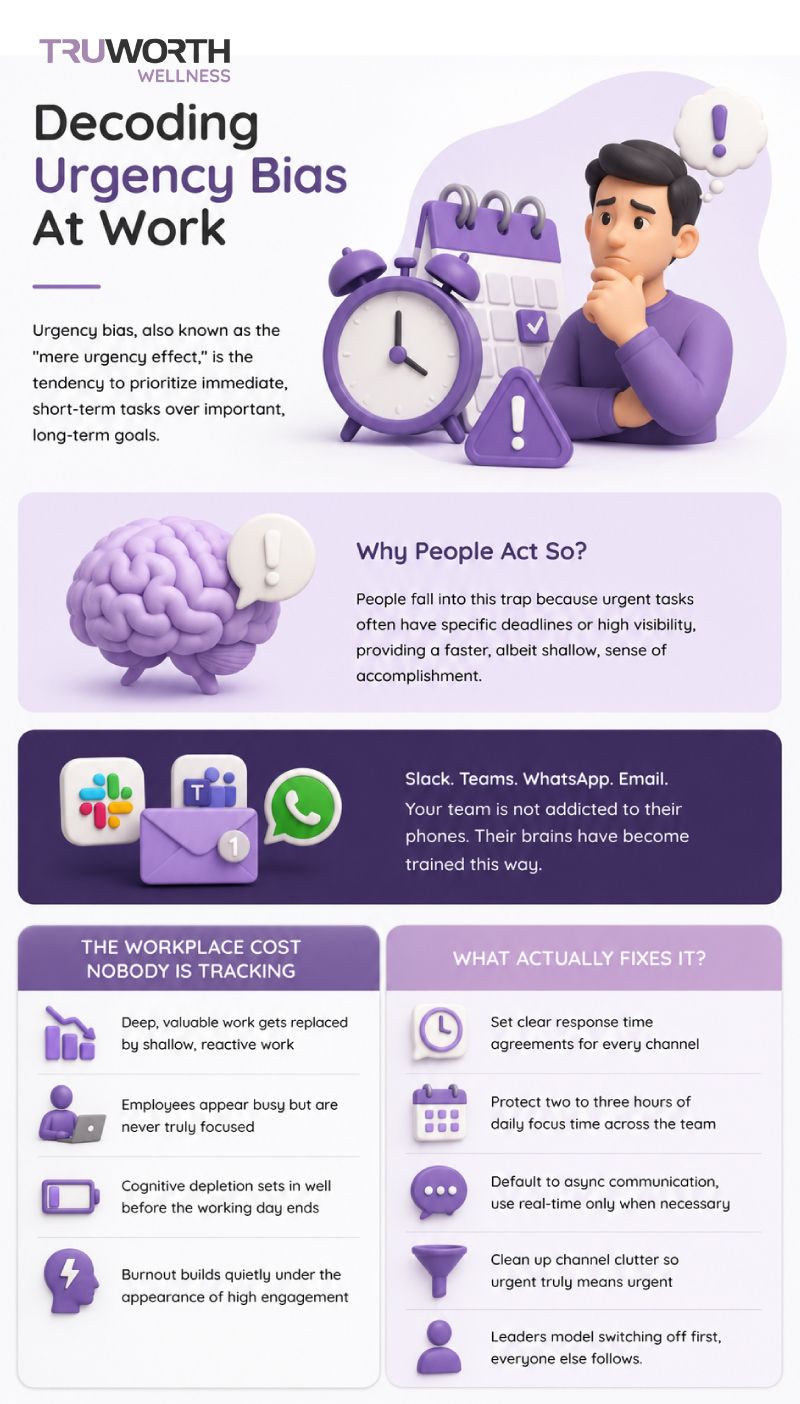
Urgency bias is the tendency to treat incoming information as requiring immediate action, regardless of whether it actually does.
In everyday terms, it is the feeling that every Slack message needs a response in five minutes. Every WhatsApp ping from the work group needs to be read right now. Every email that arrives during a focused task needs to be checked before finishing that task. Every notification, regardless of its actual importance, triggers a small spike of anxiety until it is addressed.
This is not a personality trait. It is a conditioned response.
Here is how it was built.
Communication platforms like Slack, Microsoft Teams and WhatsApp are designed around instant response. The read receipt tells you when someone has seen your message. The typing indicator shows you someone is responding. The notification badge on the app icon counts unread messages in red. The default notification setting is alert for everything, always.
Every one of these design choices is optimised for speed of response. None of them is optimised for the health of the person responding.
The brain, exposed to this design consistently across an entire working day, learns a simple pattern. Notification arrives. Anxiety slightly increases. Notification is addressed. Anxiety briefly reduces. Repeat, several hundred times a day.
This is a dopamine-cortisol loop. The brief relief of addressing the notification is just rewarding enough to reinforce the behaviour of checking immediately. Over weeks and months, the brain comes to associate unread notifications with discomfort and immediate checking with relief. The behaviour becomes automatic. The urgency feels real even when the content is not.
What This Is Doing to the Body?
The urgency bias loop is not just a productivity problem. It is a physiological one.
Every time the brain perceives an incoming message as potentially urgent, cortisol is released. Cortisol is the body's primary stress hormone. In small, appropriate doses it is useful. It sharpens focus and prepares the body to respond to a real challenge.
In the context of modern workplace communication, the cortisol response fires dozens of times an hour, all day, every day.
Here is what sustained cortisol elevation does to the body over time:
- Sleep Issues: Cortisol suppresses melatonin. An employee whose brain has been in alert mode all day, and who checks messages in the evening or keeps their phone on the bedside table, is actively preventing the hormonal shift the body needs to move into restorative sleep. The result is lighter sleep, more fragmented sleep and waking up feeling unrestored despite adequate hours.
- Attention Deficit: Deep, sustained concentration requires the brain to enter a state where it is not monitoring for incoming signals. Every notification, even one that is ignored, interrupts this state. Research shows that after a notification interruption, it takes an average of twenty-three minutes to return to the same level of focused concentration. In an environment where notifications arrive every few minutes, deep focus never actually happens. The entire working day is spent in a state of shallow, interrupted attention.
- Mood and emotional dysregulation: Sustained cortisol elevation directly affects the brain areas responsible for emotional regulation. Employees in chronic alert mode are more reactive, less patient, more prone to irritability and less able to manage interpersonal friction calmly. The short temper that shows up in afternoon meetings is not a character issue. It is a neurological consequence of a day spent in sustained low-level stress.
- Poor decision-making: Every micro-decision to check, respond or ignore a notification depletes the same cognitive resource that is used for real decision-making. By mid-afternoon, an employee who has been processing notifications since 8 AM is making meaningfully worse decisions than they were in the morning. This is called decision fatigue and it is an entirely predictable consequence of an always-on communication culture.
- Long-term health ill effects: Chronically elevated cortisol is associated with increased cardiovascular risk, metabolic dysfunction, immune suppression and higher rates of anxiety and depression. The employee who has lived in notification-driven alert mode for three years is not just tired and distracted. They are accumulating real health risk.
The Workplace Cost Nobody Is Measuring
The productivity cost of urgency bias is enormous and almost entirely invisible on standard metrics.
Employees are at their desks. They are responding to messages. They are appearing engaged. The dashboards show activity.
What the dashboards do not show:
- Context switching cost: Every time an employee switches from a focused task to a notification and back, there is a cognitive cost. The brain has to reload the context of what it was doing before the interruption. Research from the University of California found that the average employee is interrupted or self-interrupts every three minutes and five seconds during a working day, and that full recovery of focus after an interruption takes over twenty minutes. In a notification-heavy environment, full focus recovery essentially never happens.
- Shallow work replacing deep work: Knowledge work that creates genuine value, writing, analysis, strategic thinking, complex problem-solving, requires sustained concentration. In organisations where the communication culture demands constant availability, employees default to the work that can be done in fragments. Emails get answered. Messages get replied to. But the important work that requires an uninterrupted hour gets deferred, rushed or never fully done.
- Presenteeism from cognitive depletion: An employee sitting at their desk at 4 PM, having been in notification-driven alert mode since 8 AM, is not performing at their cognitive potential. They are performing at whatever their depleted, cortisol-saturated brain can manage. This is presenteeism in its most common and least measured form.
Why Telling Employees to Manage Their Own Notifications Has Failed?
The standard organisational response to this problem is to put responsibility on the individual. Turn off notifications. Set boundaries. Manage your own time.
This has not worked. It will not work. Here is why.
When the culture of an organisation implicitly or explicitly expects fast responses, the individual who turns off notifications is professionally disadvantaged. They appear less available, less responsive and less committed. In a culture where reply speed is associated with engagement, logging off feels like career risk.
No individual can sustainably opt out of a cultural norm that the organisation has not officially changed. The person who sets their Slack status to Do Not Disturb and actually means it will find themselves in a conversation with their manager about their responsiveness within a week.
The urgency bias problem was created at the organisational level. It requires an organisational solution. Individual behaviour change is not possible without structural and cultural change first.
Practical Frameworks HR Leaders Can Implement
This is the section that matters most. Not the diagnosis of the problem but the operational response to it.
Here are specific, implementable frameworks for HR leaders and leadership teams:
1. Establish explicit response time agreements
The single most effective intervention is also the simplest. Define, officially and publicly, what response times are actually expected for different communication channels.
For example:
- Email: response expected within 24 hours on working days
- Slack direct messages: response expected within 2 to 4 hours during working hours
- Slack channel messages: response expected by end of working day
- Truly urgent issues: phone call only, no other channel
When employees know that a 3-hour response to a Slack message is acceptable and expected, the anxiety of not responding immediately dissolves. The urgency bias loses its fuel. The cortisol response stops firing for messages that do not warrant it.
2. Protect focus hours across the organisation
Designate specific hours each day, typically two to three hours in the morning, as focus time. During focus hours:
- No meetings are scheduled
- Notification checking is not expected
- Responses to messages sent during focus hours are not expected until focus time ends
- Leaders model this behaviour visibly and consistently
When focus hours are a cultural norm rather than an individual preference, the professional risk of being unreachable during those hours disappears. Everyone is unreachable. That is the point.
3. Default to async, use real-time only when necessary
The cultural default in most organisations is to communicate in real time unless there is a specific reason not to. Flip this. Make async the default and reserve real-time communication for situations that genuinely require it.
In practice, this means:
- Questions that can wait get sent as messages, not raised in impromptu calls
- Updates that do not require discussion get shared as written posts, not live meetings
- Decisions that can be made through a shared document do not require a meeting
- Real-time calls and meetings are reserved for genuine collaboration, creative work and complex discussion
Every hour of async communication is an hour where multiple people can process information at a time that suits their own cognitive rhythm rather than being interrupted simultaneously.
4. Establish channel hygiene
Most organisations have created a sprawling, overlapping communication ecosystem with no clear rules about what goes where. The result is that everything feels equally urgent because everything arrives in the same place.
Clear channel hygiene looks like:
- One channel for truly urgent operational issues, monitored actively
- Separate channels for different projects or teams with clear purposes
- Email for formal, non-urgent communication
- Phone or video call for genuinely complex or sensitive conversations
- A clear agreement that group chat channels are not for broadcasting urgent requests to everyone
When employees know which channel to monitor for genuinely important information, they stop monitoring all channels all the time as a precaution.
5. Create an evening and weekend norm
Explicitly state, from leadership level, that messages sent outside working hours do not require responses outside working hours. This sounds obvious. In most organisations it is not the cultural reality.
When a senior leader sends a message at 10 PM and a junior employee feels they need to respond immediately or risk being seen as unengaged, the policy is irrelevant. The culture has overridden it.
Leaders need to explicitly model the behaviour. Send the message at 10 PM if you want. But begin it with: no response needed until morning. And mean it. And make sure the organisational culture reflects it.
6. Measure focus time, not just activity
Most productivity metrics measure output and activity. They do not measure the quality of the cognitive environment in which that output was produced.
Consider measuring:
- Average number of meeting-free focus hours per employee per week
- Self-reported ability to do deep work without interruption
- Notification-related stress in regular pulse surveys
- EAP utilisation patterns that may indicate communication-driven anxiety
What gets measured gets managed. If focus quality is never measured, it will never be prioritised.
The Wellness Dimension
This is not only a productivity conversation. It is a health one.
The sustained cortisol elevation, the disrupted sleep, the cognitive depletion, the chronic low-level anxiety that urgency bias creates are clinical risk factors. They drive burnout, anxiety disorders, cardiovascular risk and metabolic dysfunction in ways that accumulate invisibly over months and years.
Employees who are struggling with the psychological effects of always-on culture are increasingly presenting to EAP counsellors with symptoms that trace directly back to communication-driven stress. The inability to switch off. The anxiety when the phone is out of sight. The guilt of an unanswered message. The physical tension of a brain that has not been allowed to rest during a working day.
A well-designed EAP that is accessible, trusted and normalised gives employees somewhere to take these experiences before they become clinical crises. But the EAP treats the symptoms. The frameworks above treat the cause. Both are necessary. Neither is sufficient alone.
An organisation that invests in communication reform and mental health support simultaneously is addressing the problem at the root and the branch. That combination produces meaningfully better employee health outcomes than either intervention alone.
The Bottom Line
Your team is not addicted to their phones because they lack discipline.
They are addicted to their phones because the organisation trained them to be. Because the culture rewards fast responses. Because the platforms are designed to create anxiety in the absence of checking. Because switching off feels professionally dangerous in an environment that has never officially said it is safe to do so.
The fix is not a wellness tip about putting the phone face down at dinner. The fix is structural, cultural and operational. It requires leadership to make decisions about communication norms and then visibly live by them.
The brain can be retrained. The dopamine loop can be interrupted. The cortisol response can be calmed. But it requires the organisation to change the environment before it asks the individual to change their behaviour.
Start with the norms. The behaviour follows.
Truworth Wellness builds workplace wellness programs that address the root causes of employee mental health challenges, including the communication culture and digital environment factors that drive chronic stress and burnout. From EAP support and stress management coaching to organisational wellness strategy, we help companies create the conditions where their people can actually do their best work. Talk to us about building a healthier communication culture for your workforce.